


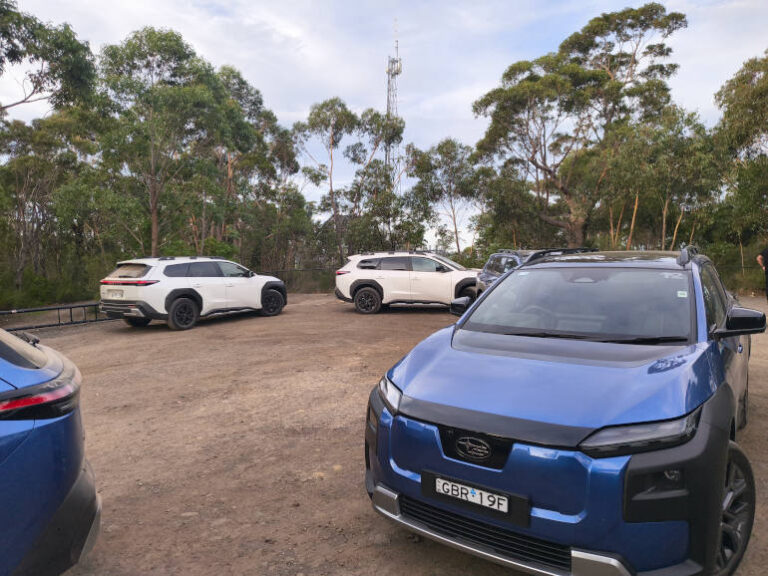
Electric SUVs have become commonplace on Australian roads, but there are still plenty of fleet applications where an EV needs to do much more than commute between an office and home.
Regional councils, utilities, infrastructure operators and organisations with staff travelling on gravel roads or poorly maintained surfaces need ground clearance, traction and usable range as well as zero tailpipe emissions.
That is where Subaru believes the Trailseeker can bring something different to the growing electric SUV market.
The specifications provide the starting point: dual-motor all-wheel drive, 211mm of ground clearance, Dual-Mode X-Mode, a 74.7kWh battery and up to 533km of WLTP range in the Trailseeker AWD.
But discussions with Subaru engineers at the vehicle’s Australian launch offered more insight into why the company believes an electric drivetrain can actually improve some of the capabilities traditionally associated with Subaru.
Electric motors change AWD
Brad Hickin, Product Engineer at Subaru Australia, explained that Trailseeker’s two-motor layout does more than generate its 280kW power figure.
“What matters is not simply that power figure alone. It’s how that power is managed,” Hickin said.
“The all-wheel drive torque split is continuously variable, and the response near instantaneous. Electric motors can adjust torque delivery within milliseconds, far quicker than any conventional hydraulic or clutch based system.”
According to Hickin, the vehicle continuously reads inputs including acceleration, steering, wheel speeds and slip rates to adjust its response.
For fleet applications, the important part isn’t the technology for its own sake. It’s the ability to control torque quickly when grip changes.
That can be useful when a vehicle moves between sealed roads, gravel, mud and other loose surfaces during the same working day.
Atsushi Nakashima, Project Manager, Product and Portfolio Innovation Division at Subaru Corporation, said the electric drivetrain allows Subaru to develop its familiar all-wheel-drive philosophy in a different way.
He explained that Trailseeker can change the front-to-rear torque distribution when understeer is detected, while the immediate torque characteristics of the electric motors can also be useful on rough surfaces where an internal-combustion engine would traditionally need to build revs before producing its torque.
Nakashima described Trailseeker during the presentation as Subaru’s “most capable EV ever”.
The battery is part of the chassis
The positioning of the battery is another part of the story. Trailseeker is based on the e-Subaru Global Platform, with its 74.7kWh battery mounted low and centrally within the floor structure.
“It drops the centre of gravity to a point where a conventional vehicle with an engine and a fuel tank simply cannot achieve,” Hickin said.
He explained that the battery enclosure also contributes to the stiffness of the platform, helping the suspension and steering work from a more rigid structure.
That’s useful engineering background for a Fleet Manager because EV weight is often discussed as a disadvantage.
Trailseeker has a tare mass of 2040kg in AWD form and 2070kg as the AWD Touring, so it certainly isn’t light. Subaru’s argument is that the location of that mass and the rigidity created by the battery installation can be used to improve vehicle behaviour.
What happens when the road disappears?
Trailseeker also carries over one of Subaru’s familiar features: X-Mode.
“Dual Mode X-Mode is not simply a button that makes the vehicle feel more confident off road,” Hickin said. “It is a comprehensive control system that changes how the all-wheel drive, the throttle, the brakes and the stability program all work together.”
The system provides Snow/Dirt and Deep Snow/Mud settings, while Grip Control can maintain a low vehicle speed on difficult surfaces. Hill Descent Control is also incorporated.
That doesn’t automatically make Trailseeker the answer for every regional fleet. There is an important qualification.
Where’s the spare?
Both Australian Trailseeker variants are supplied with a puncture repair kit rather than a spare wheel. That issue was raised specifically during the media launch given the vehicle’s positioning.
Asked why a vehicle designed to travel beyond sealed roads did not have a spare, Scott Lawrence, General Manager, Subaru Australia, said: “We’re investigating options.”
For metropolitan drivers, a repair kit might be acceptable. For a fleet vehicle travelling hundreds of kilometres through regional Australia, the risk assessment may produce a different answer.
It is exactly the kind of detail a Fleet Manager should examine before putting any vehicle into service.
Worth assessing against the application
Trailseeker also supports up to 150kW DC charging and up to 22kW three-phase AC charging, a useful combination for organisations with three-phase power at depots or workplaces. The AWD is rated at 533km WLTP, while the Touring’s larger 20-inch wheels and additional equipment contribute to a lower 488km figure.
The result is an EV that deserves consideration beyond metropolitan passenger-car applications.
Trailseeker won’t make charging infrastructure, tyre risks or remote-area operational planning disappear.
What it does demonstrate is that moving to electric power doesn’t necessarily mean abandoning all-wheel drive, useful ground clearance or the ability to leave the bitumen.
For some fleets, that could open another group of vehicles to electrification.