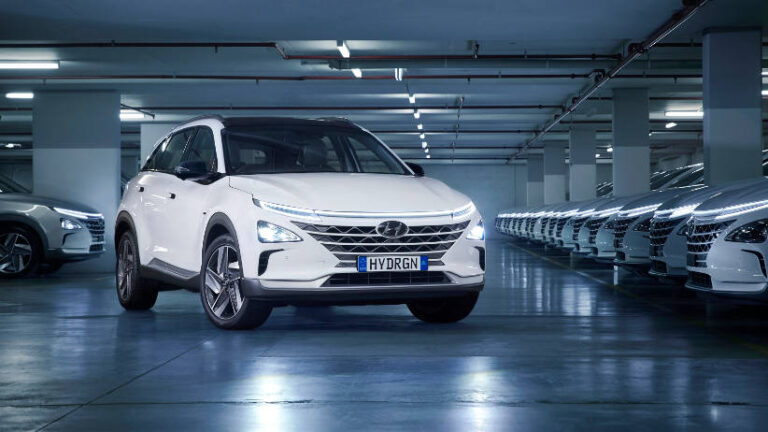
The Hyundai NEXO is unlike any other vehicle we’ve reviewed. Not because it’s difficult to drive or understand, but because you can’t actually buy one in Australia.
Despite being on sale globally since 2019, the hydrogen fuel cell electric vehicle (FCEV) has remained a demonstration of what’s technically possible rather than a mainstream fleet option. Yet after spending time behind the wheel, it’s clear the NEXO deserves attention—not because it’s about to replace battery electric vehicles, but because it demonstrates another pathway to zero-emission transport.
A Different Type of Electric Vehicle
One of the biggest misconceptions surrounding hydrogen vehicles is that they’re something completely different to an EV. They’re not.
The NEXO drives exactly like a battery electric vehicle because, in reality, it is one. Instead of charging a large battery from the electricity grid, the NEXO generates its own electricity on board.
Hydrogen stored in high-pressure tanks feeds a fuel cell, where it combines with oxygen to produce electricity. That electricity charges a small battery, which then powers the electric motor driving the wheels.
The result is everything people enjoy about EVs—instant torque, quiet operation and smooth acceleration—but without plugging into a charger.
It’s an important distinction that often gets lost in the debate between hydrogen and battery electric vehicles.
Comfortable, Quiet and Relaxed
From the driver’s seat, there’s very little to remind you this is powered by hydrogen.
Performance is smooth and refined, with silent acceleration that anyone familiar with an EV will immediately recognise. Around town it’s effortless, while highway cruising is relaxed and comfortable.
The NEXO isn’t trying to be a performance SUV. Instead, it focuses on comfort, refinement and everyday usability, and it succeeds.
Ride quality is compliant, steering is predictable and visibility is excellent. It feels every bit like a premium medium SUV rather than an engineering experiment.
A Cabin Designed Before Touchscreens Took Over
Perhaps the biggest surprise inside the NEXO is just how many physical buttons it has. In an era where many manufacturers have moved almost every function onto a touchscreen, Hyundai’s approach now feels refreshingly practical.
The centre console is packed with clearly labelled controls that resemble an aircraft cockpit. While visually busy, they’re intuitive once you become familiar with the layout and allow frequently used functions to be operated without diving through menus.
The only control that takes some getting used to is the push-button gear selector. It works well enough, but a conventional selector or rotary dial would probably be easier for many drivers.
Otherwise, the cabin still feels impressively well specified despite being several years old.
Highlights include:
- Heated front seats and heated steering wheel.
- Dual-zone climate control.
- Wired Apple CarPlay.
- DAB+ digital radio.
- Wireless phone charging.
- Multiple USB and power outlets.
- Large centre console storage.
- Floating lower storage area beneath the console.
- Panoramic sunroof.
- Premium artificial leather trim.
Small Design Details That Still Impress
Some of the NEXO’s design touches were ahead of their time. The electronically deployed door handles remain one of the best examples. As you approach the vehicle they extend automatically, creating a full-sized handle that’s comfortable to grip.
It’s a simple feature, but compared with some of today’s more complicated flush door handle designs, it’s arguably easier to use—especially at night or when carrying bags.
Sometimes practical design ages better than fashionable design.
Safety Without the Constant Interruptions
The NEXO includes the suite of Hyundai driver assistance technologies expected of a premium SUV, including adaptive cruise control and a range of active safety systems.
What stands out today is what it doesn’t do.
Unlike many newer vehicles, it avoids the constant stream of speed warnings, driver monitoring alerts and other electronic reminders that have become commonplace. Drivers still benefit from modern safety technology, but without feeling like the vehicle is continually supervising every decision behind the wheel.
Living With Hydrogen
The obvious question everyone asks is: how do you fill it up? For the Australian vehicles currently operating, refuelling takes place at Hyundai Australia’s hydrogen station at its Macquarie Park headquarters in Sydney.
Once connected, refuelling takes approximately seven minutes from arrival to departure, including the connection process.
In everyday use, it feels remarkably similar to filling a petrol or diesel vehicle. The limitation, of course, isn’t the process—it’s the infrastructure.
Planning is required because public hydrogen stations remain extremely limited. However, for organisations with dedicated refuelling access, the experience itself is straightforward and familiar.
Why Hyundai Continues to Invest
While battery electric vehicles dominate headlines, Hyundai continues to invest heavily in hydrogen technology globally.
The company’s hydrogen strategy extends well beyond passenger vehicles into stationary energy systems and heavy commercial transport.
Australia has already seen Hyundai’s XCIENT hydrogen fuel cell trucks begin local operations, while New Zealand has demonstrated successful commercial deployment over several years.
Rather than competing directly with battery electric vehicles, hydrogen may ultimately find its greatest value where rapid refuelling, high utilisation and heavier payloads become more important than outright energy efficiency.
Verdict
The Hyundai NEXO isn’t a vehicle most Australians will ever purchase. That’s almost beside the point.
Its value lies in demonstrating that hydrogen fuel cell technology is no longer theoretical—it works, it feels mature and, from behind the wheel, it delivers exactly what drivers expect from a modern electric vehicle.
For Fleet Managers, the NEXO provides a glimpse into one possible future where multiple zero-emission technologies coexist. Battery electric vehicles will undoubtedly play a major role, but hydrogen may prove equally important in applications where charging time, utilisation or vehicle weight make batteries less practical.
As a vehicle, the NEXO is comfortable, refined and easy to live with.
As a technology demonstrator, it raises an even bigger point: the future of transport is unlikely to rely on a single solution. Hydrogen deserves to remain part of that conversation.
- Tesla adds Vehicle to Load across its range
 Tesla has announced Vehicle to Load (V2L) capability across all models from October 2026 production, adding the ability to power external electrical equipment from the vehicle’s battery. The new Model 3 RWD is among the first vehicles to receive the technology, which gives owners another use for their EV beyond transport. The announcement addresses a
 - Tesla targets 200,000 Australian deliveries as growth moves beyond vehicle salesTesla is aiming to reach 200,000 cumulative vehicle deliveries in Australia during October 2026, as strong Model Y demand and a broader vehicle range support its next stage of growth. Speaking at a Sydney event for the fleet community, Thom Drew, Country Director (Motors) for Australia & New Zealand at Tesla, outlined a business focused
- MG backs powertrain choice as Australian EV market growsMG Motor Australia says the rapid growth in electric vehicle sales doesn’t mean every Australian buyer — or every fleet — is ready to make the same transition at the same time. Speaking at Everything Electric in Sydney, MG Motor Australia Marketing Director Dimitri Andreatidis outlined a multi-powertrain strategy that will see the company continue
- EV sales hit 24% of Australian market as data transparency becomes a bigger issueAustralia’s electric vehicle market continued its rapid expansion in September, with battery electric vehicles accounting for almost one in four new vehicles sold. According to the Federal Chamber of Automotive Industries (FCAI), 102,924 new vehicles were sold in September 2026, up 0.9 per cent on the same month last year. More significantly for the EV
- Range Is Only Part of the Subaru Trailseeker Fleet EquationRange tends to dominate conversations about electric vehicles, but a Fleet Manager evaluating a BEV needs to ask considerably more. How quickly can it charge at the depot? What information can the organisation get from the vehicle? How will software updates be managed? What is the battery warranty? What happens when the vehicle is used