

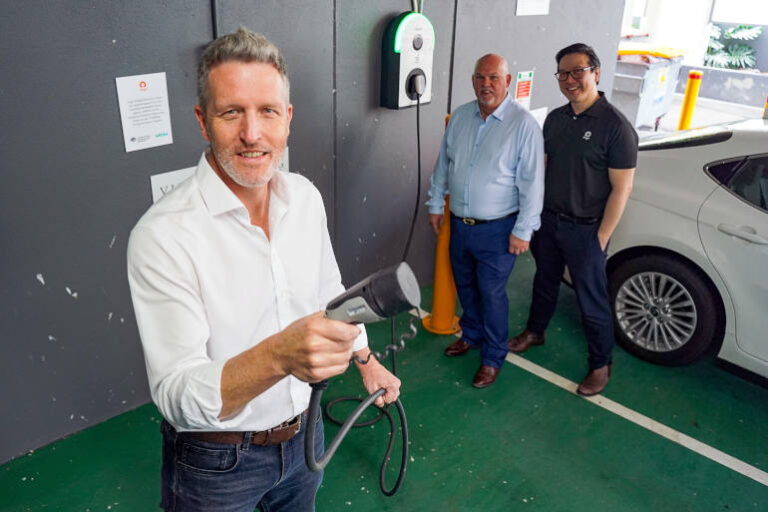
Apartment living has been one of the challenges facing electric vehicle adoption in Australia, but a Brisbane residential complex is showing how existing buildings can be prepared for EV charging without every resident needing to install their own infrastructure from scratch.
Urban Edge at Kelvin Grove has become the site of Origin’s largest residential EV charging retrofit to date, with all 380 apartments now able to support EV charging at home.
The project includes shared EV chargers, electrical cabling and smart load management technology designed to balance charging demand with the building’s other electricity requirements.
It’s a significant step towards addressing one of the barriers to EV ownership: convenient access to charging for people who don’t live in a detached house with their own driveway or garage.
Making older apartment buildings EV-ready
While new residential developments can incorporate EV charging infrastructure during construction, upgrading existing apartment buildings presents a different challenge.
Electrical capacity, shared parking areas, installation costs and the need to manage multiple vehicles charging simultaneously can make retrofits complicated.
At Urban Edge, Origin has installed the electrical backbone needed to support charging, rather than relying on individual residents to arrange separate installations.
Daryl Wong, from Origin’s Centralised Energy Services and EV team, said the infrastructure was designed to support current demand while preparing for future growth.
“At Urban Edge, we’ve installed the backbone for EV charging, including cabling, cable trays and a load management system, alongside chargers for residents and visitors.”
The smart load management system is an important part of the installation. Instead of allowing every connected vehicle to draw electricity at maximum capacity simultaneously, the system balances EV charging requirements against the building’s other electricity needs.
This approach can help apartment buildings accommodate growing EV ownership while making better use of their available electrical capacity.
Charging demand grows sevenfold
The project is already demonstrating how access to convenient charging can translate into greater use.
Since the shared chargers became operational in December 2025, usage increased sevenfold during the first three months.
Between January and October 2026, the network recorded:
- More than 880 charging sessions
- 29 unique EV drivers using the network
- 23,993 kWh of electricity delivered
- An average plug-in duration of seven hours per charging session
The average connection time highlights an important difference between residential and public charging.
Drivers charging at home generally have the flexibility to leave their vehicle connected for several hours, rather than needing to recharge quickly and move on.
This creates an opportunity for smart charging systems to spread electricity demand across longer periods, reducing the need for every vehicle to charge at maximum power.
A model for 16 apartment complexes
Urban Edge is the first of 16 apartment complexes scheduled to receive similar infrastructure through Origin’s rollout, supported by funding from the Australian Renewable Energy Agency (ARENA).
The program will help Origin evaluate different approaches to installing and managing EV charging in existing residential buildings.
“It’s one of 16 sites in our ARENA-supported rollout, helping us test different ways to deliver charging infrastructure efficiently and economically,” Wong said.
“We’ll take those learnings to other apartment buildings, with the aim of making it simpler and more affordable for residents to charge where they live.”
Assistant Minister for Climate Change and Energy Josh Wilson MP recently visited the complex to inspect the chargers and supporting infrastructure.
“This EV charging rollout is tackling a national challenge. People living in apartments want the opportunity to choose an electric vehicle and charge it safely where they live,” Wilson said.
“Projects like this help show how existing apartment buildings can accommodate EV charging and manage the additional electrical demand, giving more Australians that choice.”
Why apartment charging matters for EV adoption
According to the Electric Vehicle Council, battery electric vehicles and plug-in hybrids accounted for more than one in four new vehicles sold during the first half of 2026, more than double their share during the corresponding period in 2025.
As EV ownership increases, residential charging infrastructure will need to expand beyond detached homes.
For fleet managers and novated leasing providers, access to reliable home charging is also becoming an important consideration when assessing whether an employee can transition to an electric vehicle.
Employees living in apartments may have suitable driving patterns for an EV but face practical challenges if they cannot charge where they live.
Projects such as Urban Edge demonstrate how this barrier could be reduced through building-wide infrastructure and centrally managed charging systems.
More than just EV charging
The retrofit forms part of a broader energy upgrade at Urban Edge.
Origin already manages the building’s embedded electricity network and is upgrading its centralised hot water system, with rooftop solar also planned.
Together, these initiatives demonstrate how EV charging can be incorporated into a wider building energy management strategy rather than treated as a standalone installation.
For Australia’s growing EV market, the significance of the Urban Edge project extends beyond the 380 apartments.
It provides a practical example of how existing residential buildings can become EV-ready, potentially making electric vehicle ownership accessible to more Australians without requiring them to move house or depend entirely on public charging infrastructure.