
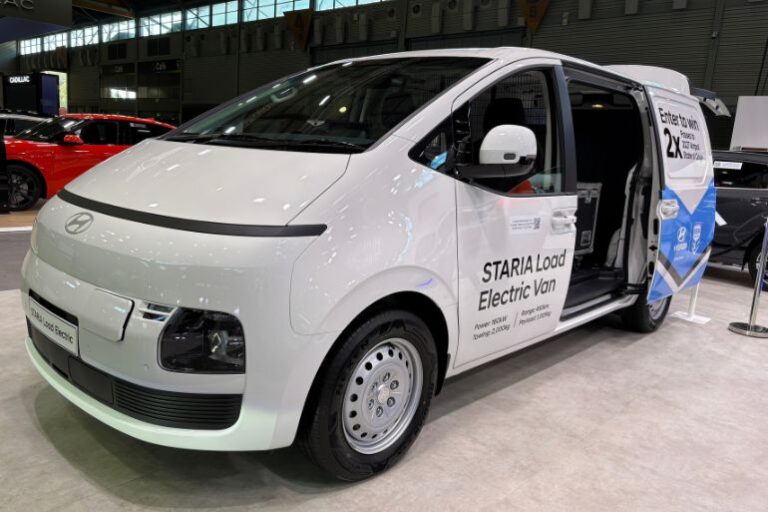
Hyundai is expecting government and corporate fleets to lead demand for its new Staria Load Electric, with the manufacturer suggesting the battery-electric version could eventually account for up to 20 per cent of Staria Load sales.
Speaking at the Australian launch of the Staria Load Electric, Hyundai executives identified government operations, corporate fleets and last-mile delivery as key opportunities for the new model.
The introduction of an electric powertrain alongside the existing diesel and hybrid variants gives Hyundai a broader offering for fleet customers looking to reduce emissions without changing their preferred light commercial vehicle.
Hyundai Motor Company Australia General Manager Product Planning Jonathan Lam said the company recognised the potential for the electric model, although fleet purchasing decisions could take time to translate into sales.
“There’s a lot of fleet opportunities in here, but obviously, fleet opportunities are a bit more of a slow burn,” Lam said. “We see it could be anything up to even 15 to 20%.”
The forecast reflects Hyundai’s expectations for the electric variant within the Staria Load range, rather than the broader electric van market.
Government and corporate fleets in Hyundai’s sights
Hyundai Motor Company Australia Chief Operating Officer Gavin Donaldson said the electric Staria Load was expected to attract strong interest from government and corporate customers.
Donaldson identified last-mile delivery and government operations as potential applications, including organisations such as Australia Post and police fleets.
These customers often have predictable operating patterns, established vehicle replacement programs and organisational emissions reduction targets that could support the introduction of electric commercial vehicles.
The Staria Load Electric also provides Hyundai with an opportunity to strengthen its position in the fleet market as organisations consider how to transition their light commercial vehicles to lower-emission alternatives.
Donaldson acknowledged that the introduction of the electric van would also contribute to Hyundai’s position under the New Vehicle Efficiency Standard (NVES), although the focus of the launch was clearly on the opportunities within the fleet sector.
Three powertrains give fleets more flexibility
One of the advantages of Hyundai’s Staria Load strategy is the availability of three different powertrains within the same vehicle range.
For fleet managers, this creates an opportunity to select diesel, hybrid or electric vehicles according to operational requirements rather than adopting a single powertrain across an entire fleet.
The electric Staria Load retains much of the familiar vehicle layout and cargo space of the diesel and hybrid versions, which could make it easier for organisations to introduce electric vehicles progressively.
This consistency is particularly relevant for government and corporate fleets that operate large numbers of vehicles across different departments and locations.
It also provides an opportunity to maintain familiar driver ergonomics and vehicle configurations while transitioning towards lower-emission operations.
Fleet pricing will be critical
With the electric Staria Load carrying a substantial purchase price premium over the diesel model, Hyundai recognises that fleet pricing will be an important factor in attracting customers.
During the launch Q&A, Donaldson said Hyundai had been working on its fleet pricing strategy to ensure the new electric model would be positioned appropriately for government and corporate buyers.
He expressed confidence that Hyundai could establish competitive pricing for these important fleet segments.
For fleet managers, the purchasing decision will ultimately extend beyond the initial price difference.
Whole-of-life costs, annual kilometres travelled, charging infrastructure, energy prices, maintenance and operational suitability will all influence whether the electric model represents the best option.
A gradual transition to electric vans
Hyundai’s expectation that the electric Staria Load could eventually represent 15 to 20 per cent of sales suggests the company sees fleet electrification as a gradual transition rather than an immediate replacement of diesel vehicles.
The availability of three powertrains gives fleet managers the flexibility to introduce electric vehicles where they make operational and financial sense, while continuing to use diesel or hybrid models for other applications.
For government and corporate fleets working towards emissions reduction targets, that flexibility could be one of the Staria Load Electric’s strongest selling points.
And with Hyundai targeting fleet customers from the outset, the success of the new electric van may depend as much on procurement policies, whole-of-life costs and operational requirements as it does on the vehicle itself.