


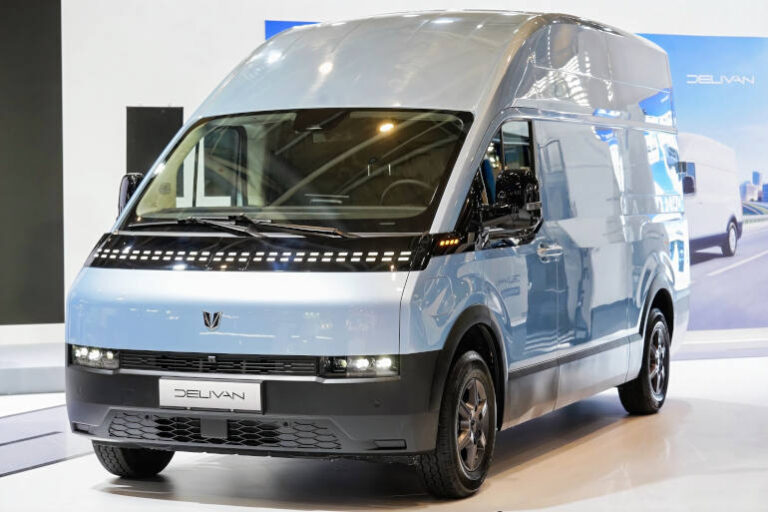
Chery Commercial Vehicle’s new DELIVAN brand has used IAA Transportation 2026 in Hannover to outline a European electric van strategy that goes well beyond the vehicle itself, combining battery-electric commercial vehicles with fleet management, predictive servicing and specialist conversions.
DELIVAN presented two core electric vans and four conversion solutions at the show as it prepares for a commercial launch in Europe and the UK during 2027.
For fleet operators, the more interesting part of the announcement may be DELIVAN’s attempt to build the vehicle, data platform, servicing and body conversion ecosystem together rather than treating them as separate elements.
Electric vans developed around fleet requirements
The DELIVAN L1H1 and L2H3 form the foundation of the European range, with the company saying development included input from customers and fleet partners in the UK, Germany, France, the Netherlands and Spain.
Battery capacities range from 50.4kWh to 97.4kWh, with DELIVAN quoting up to 426km of WLTP combined range with the vehicle limited to 100km/h.
The company also claims approximately 22-minute DC charging from 15 to 80 per cent.
Payload and carrying capacity have clearly been part of the development brief. The larger L2H3 provides up to 11.6 cubic metres of cargo space, while the L1H1 offers payload of up to 1,400kg. Both vans have a quoted 2,500kg towing capacity.
A separate L3CC chassis cab offers payload of up to 2,120kg and provides the basis for more specialised fleet applications.
Ross Davies, COO of Chery Commercial Vehicle UK, said the company deliberately used European requirements as the benchmark for the new range.
“Built not only for Europe, but with Europe.”
For fleets evaluating electric commercial vehicles, the combination of range, payload and body configuration is important because electrification needs to work within an existing operational task rather than forcing the fleet to redesign the job around the vehicle.
Conversions part of the electric van strategy
DELIVAN also displayed Crew Van, Fridge Box, Tool Storage and 3-Way Tipper configurations at IAA.
The company is working with European conversion specialists including GRUAU, SORTIMO, JUNGE and BOTT as it develops application-specific vehicles.
That approach could be particularly relevant to government, utilities, field service and delivery fleets, where buying the base van is often only the first stage of putting a vehicle into operation.
An electric van still needs shelving, refrigeration, tool storage or other equipment without pushing weight, energy consumption or payload outside the fleet’s operating requirements.
Fleet management built into the proposition
DELIVAN calls its broader offering the “1+3” model, combining the vehicle with three supporting platforms: DELIVAN I, DELIVAN PRO and DELIVAN X.
DELIVAN I is focused on connected vehicle and fleet management functions, including vehicle status, driver behaviour, route efficiency and energy consumption.
DELIVAN PRO is aimed at vehicle servicing and uptime, with remote diagnostics and maintenance alerts delivered through an Uptime Centre.
DELIVAN X covers vehicle conversion and customisation through partnerships with specialist suppliers.
For fleet managers moving to electric vehicles, integrating these systems could become increasingly valuable. Energy consumption becomes an operational metric alongside kilometres travelled, servicing, utilisation and driver behaviour, while remote diagnostics can potentially help fleets identify problems before they result in unplanned downtime.
Yueqiong Gong, Vice President of Chery Holding Group and General Manager of Chery Commercial Vehicle, said DELIVAN intends to use connected vehicle information across the fleet operation.
“Every vehicle, every kilometer of operational data is turned into measurable, tangible returns for our customers.”
DELIVAN says its system uses real-time connected vehicle data and AI to link information from individual vehicles through to fleet management, with the aim of improving safety and operating efficiency.
Another electric commercial vehicle brand emerges
DELIVAN is a subsidiary of Chery Commercial Vehicle and made its global debut at the Commercial Vehicle Show in Birmingham in April 2026.
Rather than positioning itself purely as another vehicle manufacturer, DELIVAN says its strategy combines purpose-built commercial vehicles with connected fleet management, conversion services and predictive maintenance capabilities.
The next step will be turning that technology proposition into a functioning sales, service and support network.
DELIVAN has already established operations in the UK and Germany, along with European R&D and service capabilities, and says it will continue developing dealer and distribution partnerships ahead of its 2027 European and UK launch.
No Australian launch plans have been released, but DELIVAN’s IAA debut shows how quickly competition in the electric commercial vehicle market is expanding — and how new entrants increasingly see fleet software, uptime management and conversion support as part of the vehicle proposition rather than optional extras.