


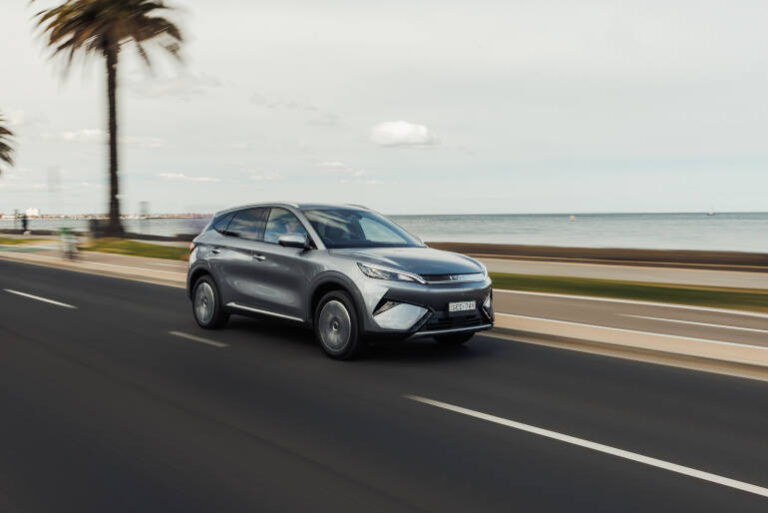
The BYD ATTO 3 EVO offers fleet buyers a choice of two electric SUVs with differences in carrying capacity, towing capability and charging performance that could influence vehicle selection.
Available in Dynamic and Premium variants, the five-seat compact SUV offers up to 510 kilometres of claimed WLTP range. However, for organisations assessing vehicles for site visits, regional travel and everyday business use, its practical capabilities deserve equal attention.
Matching the vehicle to the job means considering what employees carry, how far they travel and when they can recharge.
More room for people and equipment
The ATTO 3 EVO Premium has a payload of 530kg, compared with 410kg for the Dynamic.
That 120kg difference could be significant for vehicles regularly carrying several employees alongside luggage or work equipment. Fleet managers need to assess the combined load when determining whether a vehicle suits its intended role.
The Premium also provides more storage, with 490 litres of rear luggage space compared with 434 litres in the Dynamic. Folding the rear seats increases capacity to 1,360 litres and 1,340 litres respectively.
A separate 101-litre front storage compartment in the Premium adds space for charging cables and smaller items, helping keep the rear luggage area available for larger equipment.
Both variants feature a 60/40 split-folding rear seat and a one-touch opening and closing tailgate.
Towing adds flexibility
The Premium offers a braked towing capacity of 1,500kg, while the Dynamic is rated at 750kg. Both have a 750kg unbraked towing capacity.
For fleets with occasional trailer requirements, the higher towing capacity could influence which variant is allocated to particular employees or business functions.
Fleet managers will also need to consider passengers, equipment and trailer loads together, along with the effect towing has on energy consumption and charging requirements.
Towing capacity remains subject to state regulations and towbar design.
Power beyond the vehicle
Vehicle-to-load capability is standard across both variants, providing up to 3.3kW of power for external devices through a supplied discharge adaptor.
For employees undertaking site visits or working away from buildings, the ability to power suitable equipment from the vehicle could provide practical value.
Introducing this feature into a fleet also creates a driver education requirement. Employees should understand equipment limits and how external power use affects the battery charge available for their next journey.
Charging that fits the working day
The Dynamic combines a 60.48kWh BYD Blade battery with a claimed WLTP range of 420 kilometres. The Premium uses a larger 74.88kWh battery to deliver a claimed 510-kilometre range.
Both batteries use lithium iron phosphate chemistry.
Charging capability differs substantially. The Dynamic supports up to 7kW AC and 110kW DC charging, with BYD quoting a zero-to-80 per cent charging time of 41 minutes.
The Premium features an 800V electrical architecture and supports up to 11kW AC and 220kW DC charging. Its quoted zero-to-80 per cent charging time is 30 minutes.
For vehicles returning to a charger each evening, the priority may be replenishing daily energy use during the overnight parking window. Vehicles travelling longer distances or completing multiple shifts could benefit from the Premium’s higher charging capability, where compatible infrastructure is available.
Actual driving range will vary with load, conditions and driving style.
Comfort and assistance across the range
Both variants include heated and ventilated front seats, a power-adjustable driver’s seat, an 8.8-inch digital driver display and a 15.6-inch touchscreen.
Wired and wireless Apple CarPlay and Android Auto are standard, alongside a 50W wireless phone charger and USB connections in both seating rows.
A 360-degree camera and front and rear parking sensors support manoeuvring. Standard driver assistance features include autonomous emergency braking, adaptive cruise control, blind spot detection, driver monitoring and rear cross traffic alert and braking.
The Premium adds front cross traffic alert and braking.
For shared fleet vehicles, familiarisation should cover charging, vehicle controls and driver assistance settings so employees can confidently move between vehicles.
Matching capability to the task
The ATTO 3 EVO presents two different options for fleet passenger vehicle duties.
The Dynamic offers 420 kilometres of claimed range for organisations with predictable travel patterns and accessible charging. The Premium adds range, payload, storage and towing capability that could broaden its suitability for more demanding roles.
For fleet managers, those differences provide a useful basis for vehicle allocation. Daily distance, carrying requirements and charging access should guide the choice, with whole-of-life costs completing the business case.




