

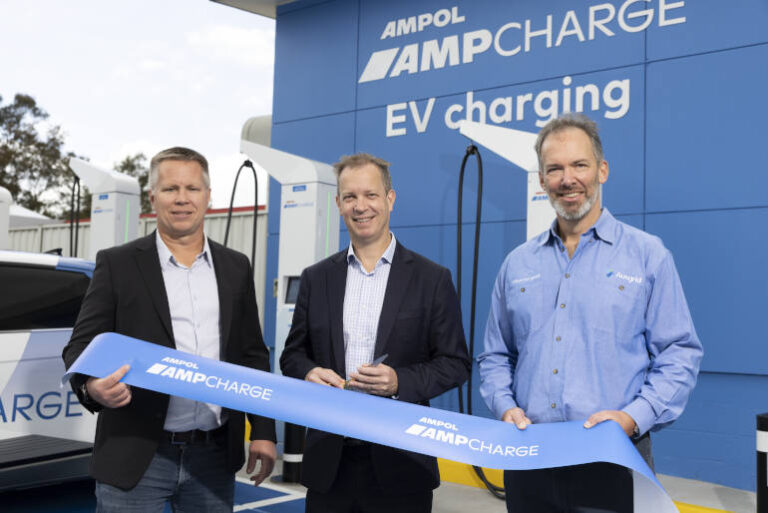
Ampol has unveiled a new approach to public EV charging at its M1 Wyong service stations, using technology that allows charging capacity to respond to electricity network demand without requiring traditional grid upgrades.
Developed in collaboration with Ausgrid and charging technology provider Kwetta, the project represents an Australian first for Ampol’s AmpCharge network and could provide a blueprint for accelerating the rollout of high-capacity EV charging infrastructure along major transport corridors.
The two Ampol Foodary service stations on the M1 Pacific Motorway at Wyong will provide a combined 16 charging bays, with eight in each direction.
Each location includes two drive-through charging bays designed to accommodate larger commercial vehicles and passenger EVs towing caravans or trailers.
The northbound charging site is now operational, with the southbound location expected to open in late November.
More charging capacity without expensive network upgrades
One of the biggest challenges facing Australia’s public EV charging rollout is securing sufficient electricity network capacity.
Installing multiple high-powered chargers can require significant network upgrades, adding cost and time to projects.
Ampol, Ausgrid and Kwetta have addressed this challenge through a dynamic connection model that allows the charging infrastructure to adjust its electricity consumption in near real time based on available network capacity.
Rather than relying on a traditional fixed connection, the system communicates directly with Ausgrid’s electricity network to determine how much capacity is available.
This allows the charging site to access additional electricity capacity when the network can support it, without waiting for conventional network augmentation works.
The arrangement also enables the two Wyong locations to share network capacity during certain outage scenarios, improving operational resilience.
Ausgrid Head of Customer Network Solutions Adam Baxter said the project demonstrated how collaboration could deliver charging infrastructure faster and at lower cost.
“This project showcases the value of strong relationships and innovative thinking. By working closely together, Ausgrid and Ampol have developed a faster and cheaper solution through this dynamic connection, to support EV charging infrastructure,” Baxter said.
“The commissioning of these sites is a significant milestone and demonstrates how customer-led innovation can help accelerate the rollout of critical EV charging infrastructure.”
A potential blueprint for highway charging
For fleet managers considering electric vehicles, the availability of reliable public charging infrastructure remains an important factor in vehicle selection and route planning.
Highway charging locations with multiple bays are particularly valuable for vehicles travelling between metropolitan areas, where charging delays can affect productivity and operating schedules.
The inclusion of drive-through bays is another important consideration for commercial fleet operators.
Many conventional EV charging sites require drivers to reverse into parking spaces, creating difficulties for vehicles towing trailers or carrying larger loads.
Providing dedicated drive-through charging bays makes the infrastructure more accessible to a broader range of vehicles.
Kwetta Co-Founder and CEO Dustin Murdock said the Wyong installation demonstrated how dynamic connections could be used at other busy highway locations.
“Seeing a dynamic connection running public charging sites on the M1 is a big moment. Kwetta’s system responds in near real time to what Ausgrid’s network can support, so the site can use more capacity whenever it’s available, without waiting on upgrades,” Murdock said.
“Ausgrid’s leadership on dynamic connections, working alongside the Ampol and Kwetta teams, is what made it possible, and it gives other busy highway sites a model to follow.”
Technology already operating in New Zealand
Although the Wyong project is the first Australian deployment of Kwetta technology within the AmpCharge network, the technology is already being used at 13 public charging locations operated by Ampol-owned Z Energy in New Zealand.
The Australian installation demonstrates how experience gained across the Tasman can support the expansion of charging infrastructure locally.
The Wyong chargers were commissioned by Plus ES and Electronet.
Ampol Executive General Manager, Commercial Fuels and Energy Brent Merrick said the project highlighted the benefits of cooperation between charging operators, electricity networks and technology providers.
“The launch of AmpCharge at our M1 Wyong sites is a practical demonstration of what can be achieved when energy networks, technology providers and charging operators work together to solve shared infrastructure challenges,” Merrick said.
“With the opening of Southbound to follow later this month, this project will deliver a stronger and more resilient charging experience in both directions of the M1.”
What this means for fleet electrification
The significance of the Wyong project extends beyond the installation of another 16 public charging bays.
As electric vehicle adoption increases, charging operators will need to deliver more capacity at existing and new locations without placing unnecessary pressure on electricity networks.
Dynamic connections offer one potential solution by making better use of available network capacity.
For fleet operators, this could eventually mean more charging locations, additional bays at busy sites and fewer infrastructure bottlenecks along major transport routes.
However, charging capacity at a dynamically connected site can vary according to network conditions, making reliable management of available power an important part of the customer experience.
The Ampol project also highlights the importance of designing charging infrastructure for commercial vehicles, rather than focusing exclusively on passenger cars.
With electric vans, utes and larger commercial vehicles entering the Australian market, accessible charging bays and dependable highway infrastructure will become increasingly important to fleet operations.
If the dynamic connection model proves successful at Wyong, it could provide a practical approach for other charging operators seeking to expand their networks without waiting for expensive electricity infrastructure upgrades.