

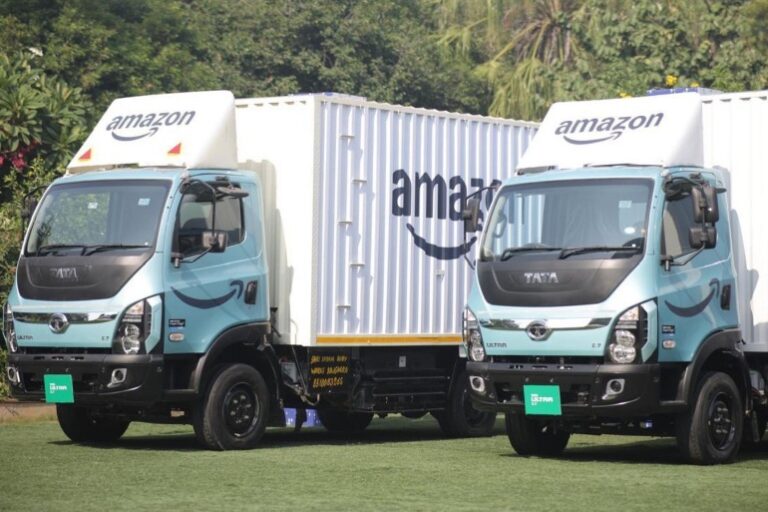
Amazon is taking a significant step towards electrifying its freight operations in India, announcing a collaboration with Tata Motors to deploy 3,000 electric trucks across its transportation network.
The agreement represents the largest electric truck deployment announced by an e-commerce company in India and signals a shift beyond electric last-mile delivery vehicles towards the electrification of middle-mile freight transport.
The trucks will transport customer shipments between distribution facilities, across major cities and eventually along national freight corridors.
Importantly, the vehicles will be supplied by Tata Motors but owned and operated by Amazon’s carrier partners, demonstrating how large organisations can influence fleet electrification across their transport supply chains without directly owning the vehicles.

Electric trucks to tackle long-distance freight
The first vehicles, including the Tata Ultra E.7, will begin operating in Delhi during India’s festive season, when freight volumes traditionally increase.
The initial deployment will focus on light- and medium-duty electric trucks operating within cities before expanding to major highways.
One of the most ambitious elements of the announcement is the plan to electrify the 2,800-kilometre Delhi–Bengaluru–Chennai freight corridor along National Highway 48.
The corridor spans seven states and connects six of India’s largest e-commerce regions.
Supporting the expansion will require dedicated charging infrastructure, with Amazon working alongside charging provider Yahhvi to establish charging hubs.
Amazon already has 10 charging yards across India developed by Yahhvi, providing an initial infrastructure network to support its electric freight ambitions.
Tata Ultra E.7 designed for commercial operations
The Tata Ultra E.7 will be among the first electric trucks deployed under the agreement.
The vehicle features an integrated e-axle, CCS2 fast charging capability and regenerative braking to improve energy efficiency during commercial operations.
It also incorporates a new-generation crash-tested cabin and high-voltage safety systems.
Tata Motors says the electric truck has been developed to deliver lower operating costs, improved uptime and reduced transport emissions compared with conventional diesel alternatives.
Rajesh Kaul, Vice President and Business Head – Trucks at Tata Motors, said the commercial case for electric trucks was becoming increasingly attractive.
“Electric trucking in India is moving beyond the pilot stage and entering a phase of wider adoption. With deep localisation driving affordability and a compelling total cost of ownership, zero-emission trucks are becoming a practical business proposition for fleet operators across segments.”
Kaul said the collaboration would extend beyond vehicle supply to include charging infrastructure, servicing and operational support.
This integrated approach is particularly important for commercial fleet operators, where vehicle availability, maintenance support and access to energy are essential to maintaining service delivery.
Amazon already operating 15,000 electric vehicles
The electric truck announcement builds on Amazon’s existing fleet electrification activities in India.
The company reports that more than 15,000 electric vehicles are already operating across more than 500 Indian cities.
However, most electric delivery deployments have focused on shorter urban routes, where predictable daily distances and depot-based charging make electrification relatively straightforward.
Moving into middle-mile freight introduces additional operational challenges, including heavier payloads, longer distances, higher daily utilisation and the need for charging infrastructure along transport routes.
Abhinav Singh, Vice President, Operations, Amazon, APAC, Middle East, Africa and Turkey, said the partnership was an important part of Amazon’s commitment to achieving net-zero carbon emissions by 2040.
“We are now setting a bold vision to scale electric trucking, addressing one of the toughest challenges in decarbonising transportation.”
The company has also supported the Laneshift programme with C40 Cities, which previously piloted electric trucks along the Bengaluru–Chennai corridor.
Government policy supporting electric truck adoption
The announcement comes as Indian governments introduce measures to encourage the adoption of electric commercial vehicles.
Delhi’s 2026 EV Policy includes an incentive for early adopters, allowing the first 1,000 eligible privately owned medium-duty electric trucks registered within three months of the policy’s launch to enter the city at any time of day for 10 years.
This provides a potential operational advantage compared with conventional freight vehicles that face restrictions during designated hours.
For transport operators, policies that improve vehicle access and operating flexibility can influence the commercial viability of electric trucks alongside traditional considerations such as purchase price, maintenance and energy costs.
What Australian Fleet Managers can learn
Although the announcement relates to India, the scale and structure of the agreement provide several lessons for Australian organisations planning to reduce transport emissions.
The first is that fleet electrification does not necessarily require organisations to own every vehicle. Amazon’s approach demonstrates how major customers can work with contracted transport providers to encourage the adoption of lower-emission vehicles.
The second is the importance of planning charging infrastructure alongside vehicle procurement. Electric trucks cannot be assessed in isolation from the routes they operate, their daily utilisation and the availability of charging facilities.
Finally, the collaboration highlights the value of engaging vehicle manufacturers, charging providers and transport operators early in the planning process.
For Australian Fleet Managers and Sustainability Managers, the announcement reinforces that successful fleet electrification requires more than selecting an electric replacement for a diesel truck.
It requires an understanding of operational requirements, whole-of-life costs, energy infrastructure, maintenance arrangements and the partnerships needed to support reliable transport operations.
Amazon and Tata Motors have announced an ambitious deployment target, and the next test will be demonstrating how electric trucks perform as the rollout expands from urban freight routes to longer-distance transport corridors.
For the broader fleet industry, the project could provide valuable evidence about the practical and commercial requirements of electrifying freight transport at scale.