

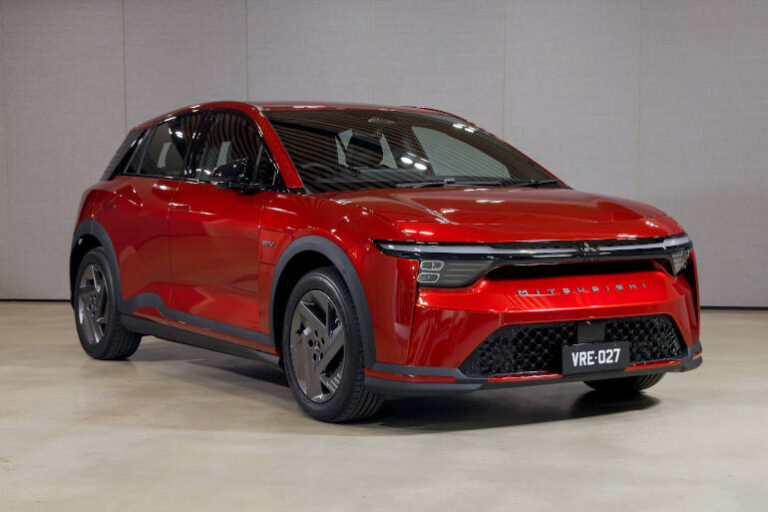
Mitsubishi is preparing to launch the all-new ASX VR-e in Australia, introducing a battery electric SUV that combines advanced EV technology, connected features and local engineering development.
Expected in showrooms in late 2026, the ASX VR-e marks an important step in Mitsubishi’s electrification strategy, expanding its offering beyond the plug-in hybrid technology that has become an established part of its Australian range.
Developed in collaboration with Foxtron Vehicle Technologies (FVT), the new model combines specialist electric vehicle technology with Mitsubishi’s knowledge of Australian driving conditions.
Mitsubishi Motors Australia CEO Shunichi Kihara said the partnership had been central to developing a vehicle suited to local expectations.
“Our collaboration with Foxtron Vehicle Technologies has brought together FVT’s advanced EV technology and Mitsubishi’s deep understanding of Australian customers and driving conditions, which makes ASX VR-e drive and feel the way a Mitsubishi should.”
Australian engineering shapes driving experience
Mitsubishi has undertaken extensive testing in Australia, Taiwan and Japan to refine the ASX VR-e’s suspension, steering and vehicle stability.
The development program resulted in revised suspension dampers, larger rear bump stops and recalibrated electric power steering to improve comfort over uneven roads and stability at highway speeds.
Drivers can also select three steering assistance settings independently of the vehicle’s driving modes.
For fleet operators, these refinements are relevant when selecting vehicles that will be used by multiple drivers across metropolitan and regional environments. Comfort, predictable handling and ease of use can influence driver acceptance during the transition to electric vehicles.
Software-defined technology opens new possibilities
One of the ASX VR-e’s most significant features is its software-defined vehicle architecture, which allows functionality to be improved through over-the-air software updates.
The centralised electronic platform brings vehicle systems together, reducing complexity and supporting future upgrades.
This technology represents an important shift in vehicle ownership, with manufacturers increasingly able to introduce improvements after a vehicle has been delivered.
The ASX VR-e also introduces a dedicated connected vehicle application, giving drivers access to battery charge levels, charging history, estimated charging completion times and vehicle health information.
Remote climate control, tyre pressure monitoring and vehicle location services are also included.
For fleet managers, access to charging information could help employees manage home and public charging, although the app is designed for individual vehicle users rather than centralised fleet reporting.
Battery technology designed for everyday use
The ASX VR-e uses a CATL lithium iron phosphate (LFP) battery, with liquid cooling to support battery durability and consistent performance.
Driving range extends to 403km under WLTP testing, depending on the variant, while DC fast charging can replenish the battery from 10 to 80 per cent in approximately 30 minutes under suitable conditions.
Three driving modes — Eco, Comfort and Sport — allow drivers to adjust the vehicle’s performance to suit their preferences.
Mitsubishi has also partnered with JET Charge to provide home charging solutions, recognising that charging infrastructure is an important part of the ownership experience.
For organisations transitioning passenger vehicles to electric, the combination of overnight charging and occasional public fast charging could suit employees with predictable daily travel requirements.
Aerodynamic design meets everyday practicality
Designed by Italian styling house Pininfarina, the ASX VR-e incorporates aerodynamic features intended to improve efficiency and refinement.
An S-Duct channels airflow through the front of the vehicle, while flush door handles, active grille shutters and underbody panels help reduce drag.
Inside, a large central touchscreen and digital driver display provide access to vehicle information and settings.
Mitsubishi has retained physical switches for frequently used functions, including climate control and demisters, while wireless Apple CarPlay and Android Auto are standard.
The ASX VR-e also includes a comprehensive package of driver assistance systems, including autonomous emergency braking, adaptive cruise control, lane keeping assistance, blind spot detection and driver monitoring technology.
Established support network adds confidence
The ASX VR-e will be offered in four variants, including three rear-wheel drive models and a flagship dual-motor all-wheel drive GSR.
The vehicle will be supported by Mitsubishi’s Diamond Advantage aftersales program, which includes conditional extended warranty coverage, capped price servicing and roadside assistance. Separate battery warranty and capacity protection arrangements also apply.
For fleet operators, Mitsubishi’s established Australian dealer network and existing service relationships may provide reassurance when assessing an unfamiliar electric vehicle platform.
The ASX VR-e arrives as competition intensifies across Australia’s electric SUV market, giving fleet buyers another option from a manufacturer with an established local presence.
Its combination of connected technology, locally developed driving characteristics and aftersales support could make the ASX VR-e a contender for organisations replacing conventional passenger vehicles with electric alternatives.