

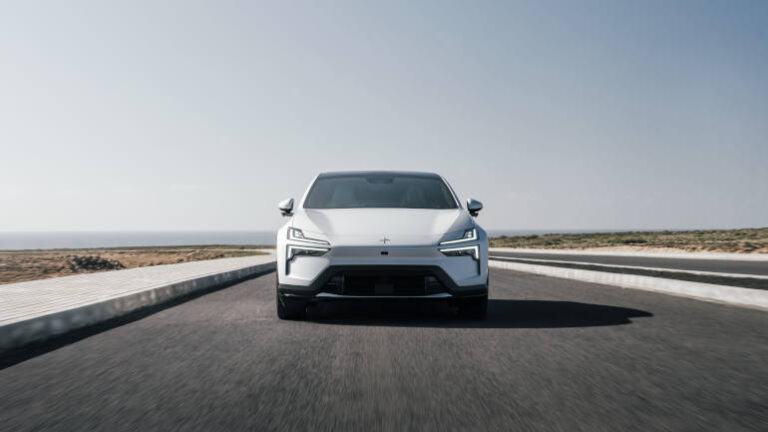
Polestar is demonstrating how electric vehicles can improve long after they leave the showroom, rolling out a major software update for the Polestar 4 that adds vehicle-to-load (V2L) capability, new digital key functionality, upgraded infotainment and additional driver assistance features.
The over-the-air (OTA) update introduces Android Automotive OS 15 and several practical features that expand the versatility of the electric SUV without requiring a visit to a dealership.
For fleet operators, it highlights an important benefit of software-defined vehicles: new functionality can be delivered throughout the ownership cycle, potentially improving vehicle usability and the driver experience without replacing the vehicle.
Vehicle-to-load adds practical capability
One of the most significant additions is vehicle-to-load (V2L) functionality, allowing the Polestar 4 to supply electricity directly from its battery to external devices.
Using a compatible adapter connected to the charging port, the vehicle can provide up to 3.3kW of power for equipment such as laptops, tools and other electronic devices.
For business users, this could be particularly useful for employees working remotely, attending events or operating away from traditional power supplies.
V2L is becoming an increasingly valuable feature in electric vehicles, providing an additional reason for fleet buyers to consider battery-electric models beyond emissions reduction and running costs.
Polestar is introducing V2L across most of its markets, although the functionality will not be available in the United States, Canada or South Korea.
Digital keys expand to more smartphones
The update also expands Polestar’s digital key capability to compatible Google and Samsung Android devices.
Apple iPhone users gained access to the feature in 2025, and the latest expansion means more drivers will be able to lock, unlock and start their vehicles using their smartphones.
For fleet operators managing shared vehicles or multiple drivers, digital key technology offers potential opportunities to simplify vehicle access and reduce reliance on traditional physical keys.
However, activation is being introduced progressively across different markets, and businesses will need to consider how smartphone-based access fits within their existing fleet management policies.
New valet and camping modes
Polestar has also introduced two new operating modes designed to improve convenience.
Valet mode allows owners to restrict certain vehicle functions, configure speed limits and lock the glovebox when handing the vehicle to another driver.
While primarily designed for customer convenience, these features could also have applications for businesses where vehicles are regularly handed between employees or third-party service providers.
Camping mode maintains cabin temperature, infotainment functionality and selected power outlets while the vehicle is stationary.
Combined with V2L, this provides additional flexibility for drivers spending extended periods away from conventional facilities.
Parking assistance and infotainment improvements
Polestar 4 vehicles from model years 2026 and 2027 equipped with the Pilot pack will also receive Park Assist Pilot.
The system can automatically steer and brake into selected perpendicular parking spaces after the driver confirms the manoeuvre.
Other improvements delivered through the P4.3.0 update include faster vehicle start-up, improved remote vehicle controls, enhanced climate settings and additional home-screen shortcuts.
Google Maps energy estimation has also been refined, along with digital key performance and several active safety and driver assistance functions.
The upgrade to Android Automotive OS 15 is intended to deliver a more responsive infotainment experience.
Software updates are changing fleet ownership
Johanna Bergh, Head of Product Management at Polestar, said the latest update demonstrates how vehicles can continue to improve after delivery.
“Over-the-air updates allow the Polestar 4 to continue to evolve long after delivery, and this latest update brings some of the most widely requested customer features. From V2L and Camping mode to digital key and Android 15, all Polestar 4 vehicles become even more capable, versatile, and connected through software alone.”
For fleet managers, the growing use of OTA updates introduces another consideration when evaluating vehicles.
Traditionally, a vehicle’s specification was largely fixed when it was purchased. Software updates now allow manufacturers to introduce new functions, improve existing systems and address usability issues throughout the vehicle’s operating life.
This could influence how organisations assess vehicle suitability, driver satisfaction and whole-of-life value.
It also creates new responsibilities for fleet managers, who need to understand software versions, feature availability and how updates may affect vehicle operating procedures.
All new Polestar 4 vehicles will be delivered with the P4.3.0 software already installed, while existing vehicles are receiving the update over the air.
As electric vehicles become increasingly software-driven, the ability to improve vehicle capability without hardware modifications is emerging as another point of differentiation between manufacturers.
For fleets planning to retain vehicles for several years, the vehicle delivered on day one may no longer be the same vehicle they are operating three years later.