

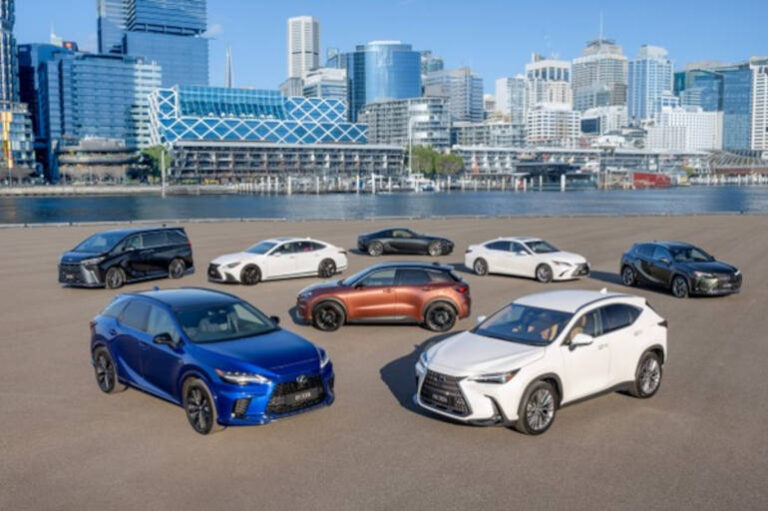
Electrification has become the dominant choice for Lexus buyers in Australia, with hybrid, plug-in hybrid and battery-electric vehicles accounting for 85 per cent of the luxury brand’s sales in the first ten months of 2026.
The milestone demonstrates how quickly electrified powertrains have moved into the mainstream luxury market, although conventional hybrids continue to account for the majority of Lexus electrified vehicle sales.
Lexus has also passed 70,000 cumulative hybrid sales in Australia, becoming the first luxury manufacturer to reach the milestone.
For fleet buyers and novated leasing customers, the figures highlight an important trend: the transition away from conventional petrol and diesel engines is progressing through several different technologies, rather than battery-electric vehicles alone.
Hybrid technology leads the transition
Lexus introduced hybrid technology to the Australian luxury market in May 2006 with the GS 450h sedan, followed by the RX 400h SUV.
Twenty years later, hybrid powertrains have become a central part of the Lexus product strategy.
The company now offers exclusively electrified powertrains across most of its model range, with exceptions for 4×4 and performance vehicles.
The NX has been the biggest contributor to hybrid sales, recording 23,309 deliveries, followed by the RX with 16,097.
Together, the two SUVs have accounted for more than half of all Lexus hybrid sales in Australia.
The rapid growth in hybrid demand is particularly evident in recent annual sales figures.
In 2022, Lexus sold 2,968 hybrids. That increased to 8,377 in 2023, followed by 9,506 in 2024 and 9,819 in 2025.
A further 6,406 hybrid vehicles were delivered in the first ten months of 2026.
Battery-electric and plug-in hybrid options expand
While conventional hybrids continue to dominate Lexus electrified sales, the manufacturer has gradually expanded its range of vehicles capable of operating on electricity alone.
The UX 300e became the brand’s first battery-electric vehicle in Australia in 2021, followed by the NX 450h+ plug-in hybrid in 2022.
These technologies offer different approaches to reducing vehicle emissions.
Conventional hybrids improve fuel efficiency by combining petrol and electric power without requiring external charging.
Plug-in hybrids provide the opportunity to complete shorter journeys using electricity, provided drivers regularly recharge the battery.
Battery-electric vehicles eliminate tailpipe emissions entirely but introduce additional considerations around charging access, infrastructure and driving range.
For fleet operators, the distinction matters because the most appropriate powertrain depends on vehicle utilisation, operational requirements and access to charging.
Electrification doesn’t always mean going fully electric
The Lexus sales figures provide an interesting perspective on Australia’s transition towards lower-emission vehicles.
With 85 per cent of Lexus sales now coming from electrified models, the brand has achieved a significant shift away from conventional internal combustion powertrains.
However, the continued popularity of hybrids also demonstrates that many customers are choosing incremental electrification rather than immediately transitioning to battery-electric vehicles.
For organisations developing fleet decarbonisation strategies, this presents both an opportunity and a challenge.
Hybrid vehicles can deliver fuel savings and lower emissions without requiring investment in charging infrastructure. They can also be introduced into existing fleets with minimal changes to driver behaviour or operating procedures.
However, hybrids still rely on petrol, and their ability to reduce emissions is limited compared with battery-electric vehicles powered by low-emission electricity.
Plug-in hybrids introduce another consideration because their environmental performance depends heavily on how frequently they are charged and how much driving is completed using electricity.
Fleet managers therefore need to look beyond the electrified label and assess real-world energy consumption, emissions and whole-of-life costs.
Lexus maintains a multi-powertrain strategy
Lexus Australia chief executive Jack Hobbs said the company’s approach to electrification reflected its long-standing commitment to combining performance and efficiency.
“At a time when performance and efficiency were often regarded as competing ideals, Lexus demonstrated that the two could coexist seamlessly. In doing so, we established a new benchmark in luxury mobility, one that continues to resonate with customers today,” Mr Hobbs said.
“With hybrid, plug-in hybrid, battery electric and internal combustion powertrain options, Lexus offers its customers the Luxury of Choice for the right powertrain to suit their needs and lifestyle.”
The strategy contrasts with manufacturers placing greater emphasis on a rapid transition to fully electric vehicles.
Rather than relying on a single technology, Lexus continues to offer different powertrains to suit customer requirements.
For fleet buyers, this approach provides flexibility, particularly where charging infrastructure or operational requirements make an immediate transition to battery-electric vehicles difficult.
What comes after hybrid?
The next challenge for Lexus will be converting its established electrified customer base into greater adoption of plug-in hybrid and battery-electric vehicles.
The success of conventional hybrids has demonstrated that Australian luxury buyers are willing to embrace alternative powertrains when they deliver a combination of efficiency, performance and convenience.
However, moving from a conventional hybrid to a plug-in hybrid or battery-electric vehicle requires different considerations, particularly around charging access and energy management.
As charging infrastructure improves and more battery-electric models become available, the balance between these technologies is likely to evolve.
For now, the Lexus milestone reinforces an important distinction in the Australian vehicle market.
Electrification is already mainstream at Lexus. Full electrification, where vehicles no longer rely on petrol, remains the next stage of the transition.
Alternative headlines for Fleet EV News
- 85% of Lexus buyers choose electrified vehicles, but hybrids still dominate
- Lexus proves electrification doesn’t have to mean going fully electric
- Lexus electrified sales hit 85% as hybrids lead the transition
- Luxury buyers embrace electrification, but aren’t ready to ditch petrol
- Lexus sells 70,000 hybrids as electrified vehicles take over
- Hybrids win the luxury EV transition as Lexus hits 70,000 sales
- Lexus shows why hybrids remain a major force in Australia’s EV transition
- 85% electrified: Lexus reveals a different path to lower emissions
Recommended headline: 85% of Lexus buyers choose electrified vehicles, but hybrids still dominate
This gives Fleet EV News a stronger editorial angle by distinguishing between electrification and full battery-electric adoption, while raising a relevant question about the future of hybrid technology in fleet decarbonisation.