


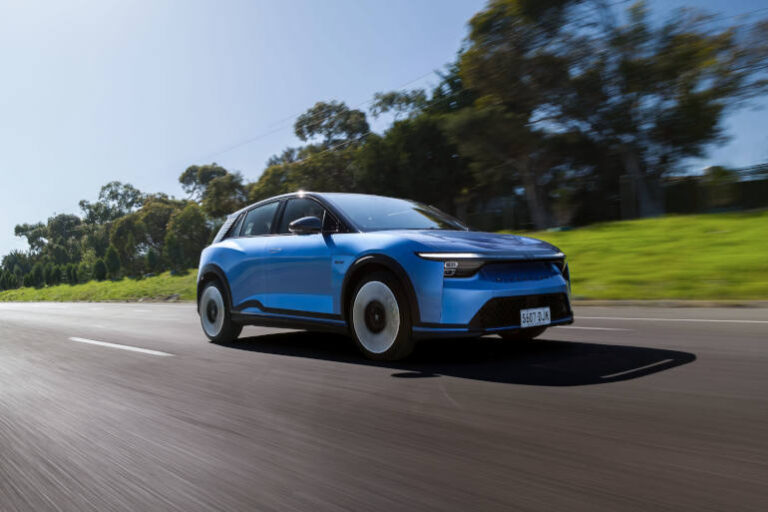
Mitsubishi will return to Australia’s battery electric vehicle market in late 2026 with the ASX VR-e, adding a new small SUV option for fleets considering the transition to electric vehicles.
The four-model range will comprise rear-wheel drive LS, ASPIRE and EXCEED variants, topped by a dual-motor, all-wheel drive GSR. All models will feature a 57.7kWh lithium iron phosphate (LFP) battery, vehicle-to-load capability and a suite of driver assistance technologies.
For fleet buyers, the announcement provides an early look at the vehicle’s charging capability, equipment and powertrain choices ahead of its arrival in showrooms.
A return to battery electric vehicles
Mitsubishi Motors Australia CEO Shunichi Kihara said the ASX VR-e would broaden the company’s powertrain offering.
“The ASX VR-e is part of our commitment to deliver customers a range of powertrains to meet ever-growing mobility requirements across Australia,” he said.
The launch marks a return to a segment Mitsubishi entered more than 15 years ago with the i-MiEV.
The new model combines Pininfarina styling with a compact footprint, measuring 4,315mm long, 1,885mm wide and 1,535mm high, with a 2,800mm wheelbase.
Its design includes an aerodynamic front duct, air curtains, active grille shutters and flush-fitting door handles to manage airflow.
Charging capability for fleet planning
All ASX VR-e variants support CCS2 DC charging at up to 134kW and Type 2 AC charging at up to 6.6kW.
For fleet operators planning workplace or home charging, the AC limit is an important consideration when matching charging windows to daily vehicle use. Installing a higher-output AC charger will not lift the vehicle’s charging rate above its onboard limit.
Vehicle-to-load functionality is also standard, allowing the traction battery to supply external equipment through the charging port.
Three rear-drive options and a performance flagship
The LS, ASPIRE and EXCEED use a single rear-mounted motor producing 171kW and 350Nm. Mitsubishi quotes a 0–100km/h time of 6.8 seconds.
The GSR adds a front motor, lifting combined outputs to 342kW and 700Nm and reducing the acceleration time to 3.9 seconds.
While the flagship delivers substantially more performance, fleets will need to assess whether its additional capability suits the intended application. The three rear-drive grades provide alternatives for buyers prioritising everyday transport and equipment requirements.
Five-stage regenerative braking adjustment, including a full single-pedal mode, is standard. Driver familiarisation will help employees understand how the different settings affect deceleration and low-speed manoeuvring.
Safety and cabin technology
Mitsubishi lists autonomous emergency braking, adaptive cruise control with lane following, driver monitoring, blind spot detection, rear cross traffic alert and traffic sign recognition among the ASX VR-e’s active safety features.
Tyre pressure monitoring also displays tyre temperature, providing additional information for drivers and fleet maintenance teams.
ASPIRE and higher grades add a 360-degree camera system, additional parking sensors and parking assistance.
Inside, every variant receives a 15.6-inch central touchscreen, a 9.2-inch digital driver display and wireless Apple CarPlay and Android Auto.
Physical switches remain available for key functions, including climate controls, hazard lights and demisters. A customisable favourites switch provides another shortcut to a preferred function.
Connected car services will be available from launch, while over-the-air updates will allow software capabilities to evolve over time.
What fleet buyers should assess next
The ASX VR-e gives fleet managers another battery electric small SUV to evaluate as Mitsubishi expands its Australian offering.
The next step will be to assess confirmed range, energy consumption, cargo capacity and fleet-specific servicing arrangements against operational needs.
For organisations considering the vehicle for pool fleets or employee transport, a practical trial should also examine driver acceptance, charging routines and the usability of its controls. Those factors will help determine how well Mitsubishi’s electric return translates into everyday fleet service.