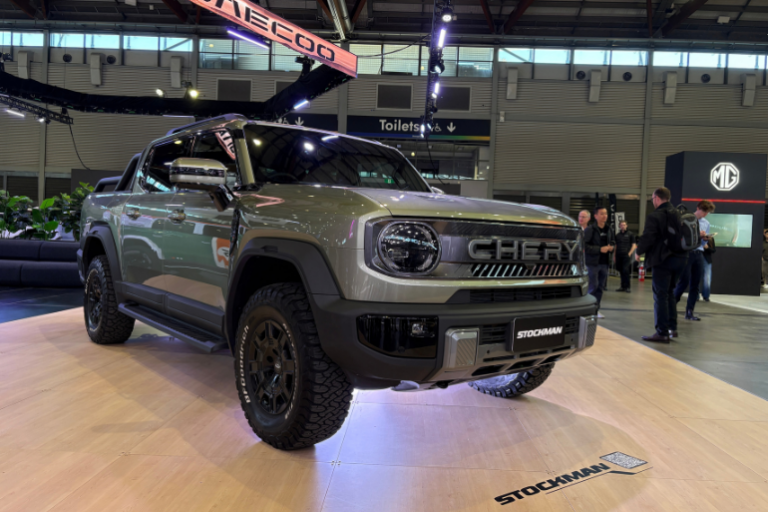
Chery believes its new Stockman could give trade and operational fleets a pathway to reduce fuel consumption without giving up the flexibility of diesel.
Unveiled at Everything Electric in Sydney, the Stockman combines a 2.5-litre turbo-diesel engine with a plug-in hybrid system, producing 350kW and 800Nm.
For fleet buyers, the more important number could be its electric driving capability. Chery is claiming up to 100km of electric range on the NEDC cycle, with a WLTP figure to be released closer to launch.
Lucas Harris, Chief Operating Officer at Chery Motor Australia & New Zealand, said the vehicle was particularly relevant to fleets that still relied on diesel because of the work they performed or the areas they operated in.
“I think it largely depends on the kind of fleet that we’re talking about,” Harris said.
“If we speak about you know small medium businesses and and you know trade orientated type fleets, I think the stockman’s the obvious the obvious standout product on the stand today.”

Electric driving without removing diesel
For fleets operating in construction, mining, farming and the trades, the transition to electrification can be more complicated than simply replacing a petrol passenger vehicle with a Battery Electric Vehicle.
Vehicles may travel between regional locations, tow equipment or operate well beyond predictable metropolitan routes.
Harris said retaining diesel capability could remove one of the barriers for those fleets while still allowing a significant proportion of everyday travel to be completed electrically.
“Especially at the moment, where you’ve got the cost of fuel is is is obviously very high, so if we can introduce a vehicle like the Stockman, still has diesel, so it can meet a lot of requirements that fleets do have around the fuel type they want to use, particularly as you get further out into the bush,” Harris said.
“But it has the electrified ability there means that you know fleets will be able to use electric power only for for a good portion of of the vehicle usage and still have diesel up their sleeves when they need it or need to go a little further.”
That combination creates an interesting fleet proposition. A vehicle returning to a depot or home each night could potentially complete a large portion of its normal daily operation using electricity, while diesel remains available when the duty cycle changes.
Designed around ute requirements
The Stockman has also been designed to maintain the capabilities fleet buyers normally expect from a work ute.
Chery says it will offer a 3.5-tonne towing capacity, 247mm of ground clearance, all-terrain tyres as standard and three selectable mechanical differential locks.
During the media presentation, Harris also highlighted the packaging of the spare wheel beneath the vehicle.
That detail matters because combining a mechanical all-wheel-drive system, a large battery and traditional ute packaging creates competition for underbody space.
According to Harris, engineering the vehicle as an electrified model from the outset allowed Chery to retain the spare wheel underneath rather than consuming load-space in the tray.
For fleet operators, those details may prove just as important as the headline power and range figures. A plug-in hybrid work vehicle still needs to meet operational requirements around towing, ground clearance, load area and regional travel if it is going to replace an existing diesel ute.
A potential fuel reduction opportunity
Harris sees the opportunity primarily in fleets where vehicles perform relatively predictable daily kilometres but occasionally need significantly greater range.
“For fleets looking to reduce their fuel consumption significantly, it’s I think a no-brainer, particularly for those workforce that are that are you know construction, mining, farming, and all of the trades,” he said.
The real fleet outcome will depend heavily on how the vehicle is used.
A plug-in hybrid that is regularly charged and operates most of its daily kilometres within the electric range could deliver a very different fuel result from one that is rarely plugged in.
That makes charging access, driver behaviour and duty-cycle analysis important considerations for Fleet Managers assessing the Stockman.
Early fleet interest is already building
Chery is already seeing interest from fleet operators ahead of the vehicle reaching the market.
Harris said close to 100 fleets had registered their interest in receiving a Stockman demonstrator.
“I think we’re up to just shy of 100 fleets now. It’s like 92 or 93 have put their names down to get a demo for the Stockman, so which is great early interest and you know obviously gives us a lot of confidence,” Harris said.
“We just now need to make sure we deliver a great product.”
That demonstration phase will be important.
Fleet buyers will want to see how the electric range performs under real operating conditions, how often the diesel engine is required, what happens when the vehicle is towing or carrying load, and whether the whole-of-life cost proposition stacks up against conventional diesel alternatives.
Regional support will matter
The Stockman is also likely to place greater emphasis on Chery’s regional support network.
Harris said having support outside metropolitan areas would be important for a vehicle expected to travel into regional and remote locations.
Chery had 99 dealers nationally at the time of the Everything Electric presentation and was targeting around 120 by the end of the following year, with greater regional and provincial coverage part of that expansion.
For Fleet Managers, that network will form part of the buying decision alongside vehicle capability.
The Stockman presents a different approach to reducing fuel use in operational fleets. Rather than asking buyers to move directly from diesel to a fully electric ute, Chery is betting that combining electric kilometres with familiar diesel capability will make electrification easier to introduce into some of the fleet segments that have been hardest to transition.