


Range tends to dominate conversations about electric vehicles, but a Fleet Manager evaluating a BEV needs to ask considerably more.
How quickly can it charge at the depot? What information can the organisation get from the vehicle? How will software updates be managed? What is the battery warranty? What happens when the vehicle is used in a field role rather than as a privately owned passenger car?
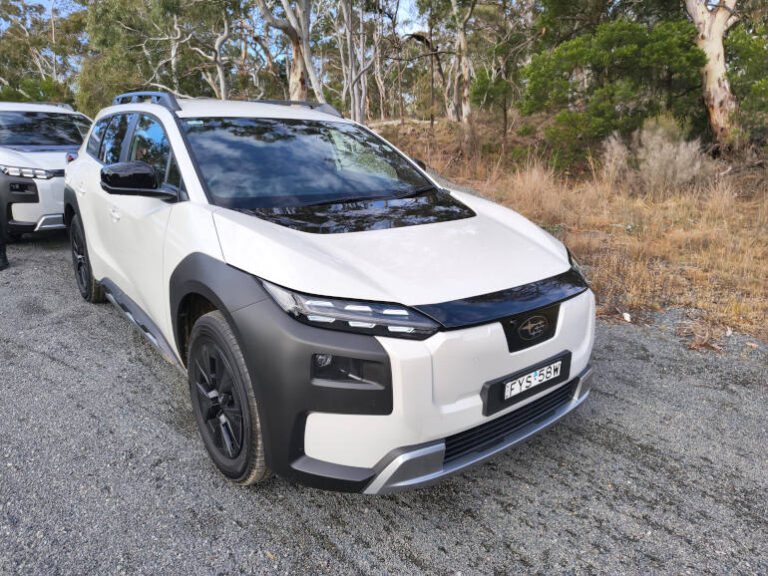
Subaru Trailseeker provides some strong answers to those questions — and a few areas fleets should investigate carefully.
Start with charging
Trailseeker uses a 74.7kWh CATL lithium-ion battery. The Trailseeker AWD is rated at up to 533km WLTP with energy consumption of 154Wh/km, while the AWD Touring is rated at up to 488km and 168Wh/km.
For a fleet, however, its AC charging capability may be every bit as important as maximum range.
Trailseeker supports up to 7kW single-phase AC charging and up to 22kW three-phase AC charging. Subaru quotes approximately 12 hours for a 0–100 per cent charge at 7kW and approximately four hours using suitable three-phase charging.
DC charging peaks at 150kW, with Subaru quoting approximately 30 minutes for 10–80 per cent under suitable conditions.
The 22kW AC capability is particularly interesting for fleets. Many commercial sites and depots already have access to three-phase power, and vehicles that return to base regularly may have little need to rely on public DC chargers.
Electricity can also come back out
The AWD Touring adds a 220V/1500W Vehicle-to-Load outlet. That allows the high-voltage battery to power equipment including small appliances, lighting, electronic devices and some power tools.
For a private buyer, that might mean powering camping equipment.
For an organisation, V2L could have a more practical role for staff working away from mains electricity, although the 1500W output means equipment requirements would need to be checked before relying on it.
What about vehicle data?
One of the most interesting conversations at the June launch had little to do with acceleration or off-road capability. It was about data.
During the Q&A, Subaru was asked what vehicle information could be transmitted directly to a maintenance provider, including odometer information, battery condition and state of charge.
The answer at launch was that this information was accessible through dealer diagnostic tools rather than transmitted remotely.
Asked whether any connected vehicle data was being sent outside the vehicle, Subaru’s representative replied: “No, there’s no connected services. There’s no data that’s being transmitted outside the vehicle.”
The panel was then asked whether software updates therefore needed to be performed through a dealer rather than over the air.
The answer was: “Correct, through the diagnostic tool.” That’s potentially significant for larger fleets.
Connected data is increasingly being used to automate odometer collection, schedule servicing, monitor EV charging and battery state and integrate vehicles into broader fleet-management platforms.
An organisation expecting those functions directly from the OEM should therefore establish what is available before procurement.
On the other hand, there may also be organisations where keeping vehicle information inside the vehicle prompts a different discussion around data governance and security.
Either way, it is something Fleet Managers should know before delivery, rather than discover afterwards.
Warranty conditions matter for fleet use
Subaru provides an eight-year/160,000km warranty for the Trailseeker high-voltage battery. Eligible MY26 Trailseeker models also have a five-year/75,000km capped-price servicing program, with scheduled servicing every 12 months or 15,000km.
But fleets should read the ownership conditions rather than relying on the retail headline.
Subaru’s standard new-vehicle warranty is five years/unlimited kilometres for private use, but the documentation states that vehicles used as hire cars, taxis, rideshare, rental, driving-school, delivery or courier vehicles have a five-year/150,000km limit.
The brochure also states that the complimentary roadside-assistance offer is available to eligible retail and novated lease customers, while Fleet, Government and Rental companies are excluded from that particular program.
These aren’t necessarily obstacles, but they demonstrate why fleet evaluation needs to go beyond the specification sheet.
Standard specification is strong
Both Trailseeker variants receive a broad suite of driver-assistance and safety equipment, including Subaru Safety Sense, Driver Monitor System, blind-spot monitoring, rear cross-traffic alert, a panoramic 360-degree view monitor and a Multi-Terrain Monitor.
The Trailseeker also holds a five-star ANCAP safety rating.
There’s also a digital rear-view mirror, dual wireless phone chargers, a 14-inch touchscreen, heated front and rear outboard seats and a hands-free power tailgate across the range.
For fleets, however, the best specification may not necessarily be the most highly equipped variant.
The standard AWD runs 18-inch wheels and delivers the longer 533km WLTP range, compared with 488km for the Touring on 20-inch wheels. It also has slightly more cargo capacity: 609 litres compared with 595 litres.
Those are small differences individually but exactly the type of detail that can matter across a fleet.
It’s about matching the vehicle to the job
At the launch, Lawrence made the point that Trailseeker was intended to sit alongside Subaru’s existing models rather than automatically replace them.
That is probably the best way for fleets to look at Subaru’s expanded EV range as well. The question isn’t whether Trailseeker is a better vehicle simply because it is electric.
The question is whether its 500km-plus range, fast AC charging, all-wheel drive, safety equipment and electric operating characteristics line up with the work being performed — and whether areas such as connectivity, spare-wheel requirements and fleet-specific ownership conditions fit the organisation’s policies.
That’s the assessment that turns an EV purchase into a fleet decision.




