


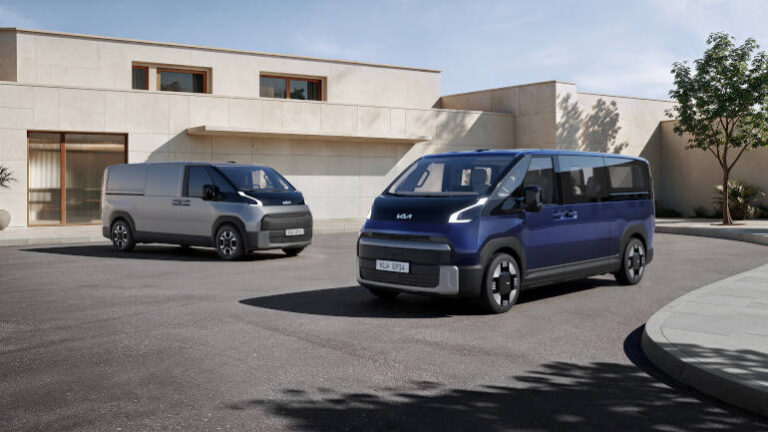
Kia is expanding its electric commercial vehicle strategy with the new PV7, a larger electric van designed to sit above the PV5 and target fleets requiring more payload, cargo capacity and operating range.
Unveiled at IAA Transportation 2026 in Hannover, the PV7 is the second model in Kia’s dedicated Platform Beyond Vehicle (PBV) range and will be offered in Cargo and Passenger configurations. Importantly for Australian fleets, Kia Australia has confirmed the PV7 will arrive locally in Q4 2027, with Australian vehicles to undergo the company’s local Ride & Handling program. Local variants, specifications and pricing will be announced closer to launch.
For fleet operators, the PV7 represents the next step beyond the smaller PV5. Kia says it has been developed for logistics, fleet, shuttle and small-to-medium business applications where greater capacity and flexibility are required.
“The PV7 marks the next step in our journey toward personalized mobility, building on the foundation established by the PV5,” said Ho Sung Song, President and CEO at Kia.
“By bringing together hardware developed for specific applications, business-tailored software and dedicated PBV services, the PV7 goes beyond the vehicle itself to deliver a complete business solution.”
Bigger batteries and more than 460km range
The PV7 will be offered internationally with 71.5kWh and 96.2kWh NCM battery packs, with the electric drivetrain producing up to 200kW and 420Nm.
Front-wheel drive will initially be standard, while Kia says an all-wheel-drive version will be added later.
The Long Range Cargo version is targeting more than 460km of WLTP driving range, although Kia notes the figure remains subject to homologation.
Charging could be equally significant for high-utilisation fleets.
The PV7 uses an 800-volt electrical architecture, with Kia targeting a 10-to-80 per cent DC charge in the mid-20-minute range when connected to a 350kW charger.
It will also introduce dual charging ports for Kia, with a front AC/DC port and an optional rear-side AC port. That could make depot charging easier where vehicles are parked in different orientations or charging infrastructure has already been installed around existing parking layouts.
Vehicle-to-Load functionality will also allow the PV7 to supply electricity to tools and other equipment, potentially adding another practical benefit for mobile workforces and service fleets.
Up to 8.0 cubic metres of cargo space
While electric range matters, Kia has clearly designed the PV7 around the fundamentals fleet operators expect from a commercial vehicle.
The Cargo Long version offers up to 6.1 cubic metres of cargo space, while a High Roof model increases capacity to 8.0 cubic metres.
Kia lists maximum payload at 1,165kg for the Long and 1,200kg for the Compact, while the Long version has a 550mm loading height and can accommodate three Euro pallets.
A heavy-load driving mode adjusts vehicle performance according to payload conditions, while operators will also be able to choose between twin swing rear doors and a conventional lift-up tailgate depending on the application.
Those specifications move the PV7 into a different operational space from the PV5 and should make it relevant to delivery fleets, trades, utilities and other organisations that need meaningful payload rather than simply an electric replacement for a smaller urban van.
Kia is treating software as part of the fleet product
Kia’s PBV strategy also goes beyond selling an electric van.
The company plans to support the PV7 through its Kia Business Solutions Portal, covering areas including fleet management, charging, maintenance and daily operations.
Fleet Management System interfaces and connected vehicle data APIs are intended to provide operators with greater visibility over their vehicles, while Kia’s Uptime services will incorporate real-time monitoring, predictive diagnostics and proactive maintenance management.
That approach will be increasingly important as electric commercial vehicles become a larger part of mainstream fleets. Fleet managers will be looking not just at battery range and purchase price, but also vehicle availability, charging utilisation, maintenance scheduling and how easily vehicle data can be integrated into existing fleet systems.
Designed around the working day
There are also several smaller details that suggest Kia has spent time considering how a commercial vehicle is actually used.
The driver’s area incorporates an A-pillar grab handle, revised step geometry and seating designed around people repeatedly entering and leaving the vehicle during the working day.
Kia has also retained physical controls for frequently used functions alongside its Pleos Connect digital interface.
The Cargo cabin uses what Kia calls a “Mobile Workspace”, with accessible storage areas and, on three-seat models, a centre seatback that folds down to create an additional work surface.
Replaceable bumper corners, wheelarch sections and door cladding have also been incorporated into the design to simplify repairs and potentially reduce downtime after minor damage — another detail likely to interest commercial fleets.
More PV7 versions are coming
Kia intends to take the same modular approach it introduced with the PV5 much further with the PV7.
Globally, the company says the range will eventually expand to 23 variants, including Compact, Long and High Roof Cargo models, Compact and Long Passenger versions, a dedicated Chassis Cab and a range of conversions.
Kia is also developing a common interface that will allow conversion equipment to be controlled through the vehicle itself.
That breadth could become particularly important in Australia, where fleet requirements stretch from metropolitan delivery vans to utilities, councils, service vehicles, accessible transport and specialist body conversions.
Kia has already established the first stage of its electric commercial vehicle strategy with the PV5. The PV7 makes the ambition considerably clearer: rather than competing with a single electric van, Kia is building an entire commercial vehicle family around a dedicated EV platform, connected fleet services and multiple body configurations.
For Australian fleet managers, the wait now moves to Q4 2027 — and to the local specifications Kia chooses from what is shaping up to be a very broad PV7 range.




