


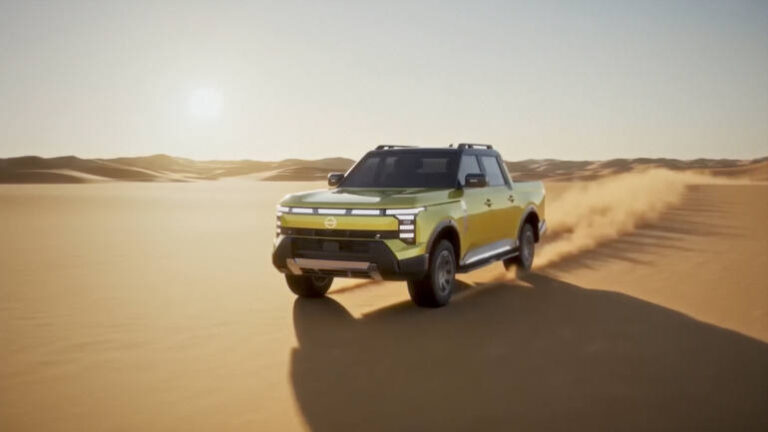
Nissan will bring a plug-in hybrid Navara to Australia in 2027, giving fleet buyers another electrified option for work that demands towing capacity, payload and four-wheel-drive capability.
The all-new Navara Pro PHEV will be Nissan’s first plug-in hybrid model in Australia and its first electrified ute globally. Australia and New Zealand will become the first right-hand-drive markets to receive the vehicle.
For fleets exploring how to reduce emissions across their light commercial vehicles, the announcement adds another model to consider in future replacement planning. However, key details needed to assess its operational suitability—including battery capacity and electric-only driving range—will be announced closer to launch.
Local requirements shape the powertrain
Nissan has selected a 2.0-litre turbocharged petrol engine paired with an electric motor integrated into an eight-speed automatic transmission for the Oceania model.
Preliminary combined outputs are 300kW and 800Nm, subject to final homologation.
The decision followed local evaluation of both the globally announced 1.5-litre plug-in hybrid drivetrain and the larger 2.0-litre alternative. Nissan says towing, payload and sustained performance requirements influenced the selection.
“Australia wasn’t simply where we tested Navara Pro PHEV. It was one of the markets helping shape it,” said Steve Milette, Managing Director, Nissan Oceania.
“The depth of local evaluation and the collaboration between our teams in Australia, Japan and China reflect the importance of Oceania to the development of this vehicle.”
Five development and prototype vehicles have collectively travelled more than 20,000 kilometres in Australian conditions, with testing continuing.
The program has assessed powertrains, suspension, driver assistance calibration, tyres, terrain modes, differential-lock configurations, towing and load performance.
Work capability remains central
The Navara Pro PHEV will feature a mechanical four-wheel-drive system, low-range capability and mechanical differential-lock capability.
Nissan is targeting up to 1,000kg payload and 3,500kg braked towing capacity, subject to final homologation. Actual load and towing capability will depend on vehicle configuration, passengers, accessories, towball download and applicable mass limits.
For fleet managers, those figures provide an initial indication of suitability for existing ute applications. Final specifications will be needed to establish how individual grades perform once fitted with the equipment required for work.
Nissan has evaluated both leaf-spring and multi-link coil-spring rear suspension. The Australian suspension configuration will be confirmed closer to the start of sales.
Available vehicle-to-load capability will also provide access to electrical power away from fixed infrastructure, potentially supporting tools and equipment at work sites. Details of the system’s output have yet to be announced.
Charging will determine the fleet opportunity
A plug-in hybrid ute gives fleets the opportunity to use electric driving for suitable journeys while retaining a petrol engine for longer trips.
Realising that opportunity will depend on matching the vehicle to its duties and providing regular charging access. Daily distance, depot or home charging availability, towing requirements and driver behaviour will all influence how much work can be completed using electricity.
The Navara’s electric-only range will therefore be a key figure for fleet buyers when it is released. It will help determine whether routine journeys can be covered electrically and how the vehicle fits into broader emissions reduction plans.
Nissan will announce final Australian specifications, equipment, pricing and estimated electric-only range closer to the Navara Pro PHEV’s arrival in 2027.
For now, the announcement gives fleets planning their next ute replacement cycle another reason to assess where plug-in hybrid technology could fit their operations.