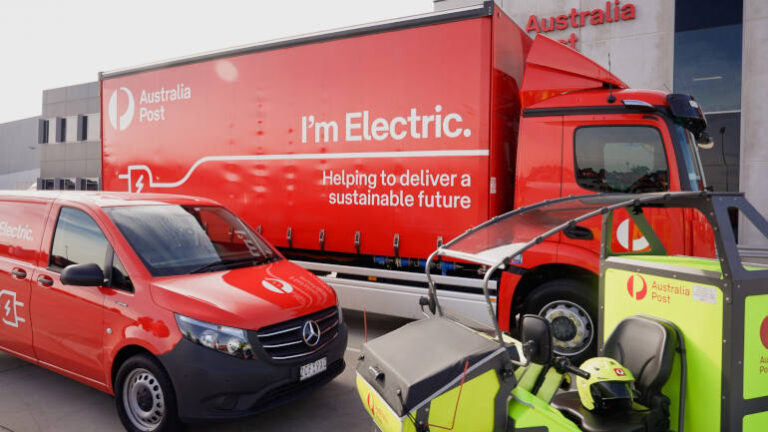
Australia Post is preparing to move fleet electrification beyond postie bikes and small delivery vehicles, with a $40.5 million Federal Government investment supporting the rollout of electric vans, trucks, prime movers and depot charging infrastructure.
The one-off funding will be delivered during the 2026–27 financial year and is intended to accelerate Australia Post’s existing fleet decarbonisation plans.
While Australia Post already operates one of the country’s largest electric fleets, most of its current electric vehicles are smaller last-mile delivery vehicles, e-bikes and motorcycles. The next phase will focus more heavily on the larger vehicles that move parcels between depots, distribution centres and communities.
Electric trucks move into the network
The expanded program will cover a broad range of vehicle types, including electric vans, light and heavy rigid trucks, and prime movers.
Work is now underway to identify suitable vehicles available in the Australian market and prepare relevant Australia Post facilities for their arrival.
That preparation will involve more than installing a few chargers. The investment will also support switchboard upgrades, new distribution boards, load-management systems and other electrical works needed to operate larger electric fleets at scale.
For Fleet Managers, this is an important part of the announcement. Vehicle availability often attracts the headlines, but site capacity, charging design and energy management can determine whether an electric truck deployment works in daily operations.
One million litres of diesel targeted
Australia Post currently operates more than 5,000 electric vehicles nationally, travelling more than 29 million kilometres each year.
The additional electric vehicles are expected to reduce diesel consumption by approximately one million litres annually.
Beyond lowering emissions, Australia Post and the Federal Government are positioning the investment as a fuel-resilience measure. Reducing diesel demand across a large national fleet could lower exposure to fuel price volatility and supply disruptions while leaving more fuel available for transport tasks that are harder to electrify.
Minister for Communications Anika Wells said the investment would support the future of Australia Post’s national delivery network.
“The Albanese Government’s $40.5 million investment to accelerate Australia Post’s rollout of EVs will support the future of the national delivery network, reducing reliance on diesel and increasing resilience in the event of external shocks,” Wells said.
Trials provide confidence to scale up
Australia Post Group CEO and Managing Director Paul Graham said the organisation’s early electric truck trials and existing electric van fleet had produced promising results.
“Australia Post has been at the forefront of electric vehicle adoption for over a decade, and this investment allows us to go further faster,” Graham said.
“We’ve seen promising results from our early electric truck trials and existing electric van fleet, and this next phase allows us to scale that across heavier vehicle types.”
The rollout represents a significant step beyond last-mile electrification, where smaller vehicles generally travel predictable routes and return to the same depot each day.
Larger trucks can present a more complicated fleet challenge. Payload, route length, charging time, depot demand, vehicle utilisation and operational contingencies all need to be considered before diesel vehicles can be replaced.
Australia Post’s network provides a major real-world test of how electric commercial vehicles can be introduced across a geographically dispersed operation.
A fleet transition with national scale
Australia Post delivered 2.2 billion parcels and letters to 12.8 million delivery points during the last financial year, meaning even modest changes in vehicle energy use can produce significant savings when applied across the network.
The organisation is targeting net zero emissions by 2050, with fleet electrification forming a central part of its sustainability strategy.
For the broader fleet industry, the announcement also highlights the next stage of Australia’s electric vehicle transition. Electric passenger cars and last-mile delivery vehicles are now relatively familiar. The harder work involves integrating larger vans and trucks while upgrading the depots, electrical systems and operational processes that support them.
Australia Post will now begin sourcing additional vehicles and completing site upgrades, with the expanded electric fleet expected to enter service as soon as suitable vehicles and infrastructure are available.
- Home Charging Enters a New Growth Phase
 Evnex has passed 20,000 connected charger installations across Australia and New Zealand, with rapid growth reflecting the shift of home EV charging from an early-adopter product to mainstream infrastructure. The Christchurch-based manufacturer shipped its first charger in 2017. While reaching the first 10,000 installations took eight years, the next 10,000 were added in just nine
 - Ampol’s $225 million Evie deal puts a new value on public EV chargingAmpol’s proposed $225 million acquisition of Evie Networks could prove to be a significant milestone for Australia’s EV charging sector, putting a substantial transaction value on a public charging network that was built well before electric vehicles became a mainstream consideration for Australian fleets. Ampol Energy has entered into an agreement to acquire 100% of
- A Charger That Powers Up Isn’t Finished: Why Commissioning Matters for Fleet EV ChargingAn EV charger can be installed, connected and apparently operating — and the charging system can still be wrong. That is one of the more important lessons from the Local Council EV Integration Project involving Wyndham, Brimbank and Moonee Valley councils. As fleet charging installations become larger, depots are adding not only chargers but load
- NSW Expands Support for Electric FleetsThe NSW Government has announced a further $16.5 million in funding to expand electric vehicle charging and help businesses, councils and not-for-profit organisations transition their fleets to EVs. The package includes $11.5 million to support eligible organisations purchasing electric vehicles and installing workplace or depot charging infrastructure. The grants target businesses, non-government organisations and councils
- Sunshine West Ready for Next Wave of Electric BusesKinetic has completed a major electrification upgrade at its Sunshine West bus depot in Melbourne’s west, preparing the site to operate 60 zero-emission buses by the end of 2026. The project increases the number of electric buses that can be charged at the depot from 24 to 66, while the underlying infrastructure has been designed