


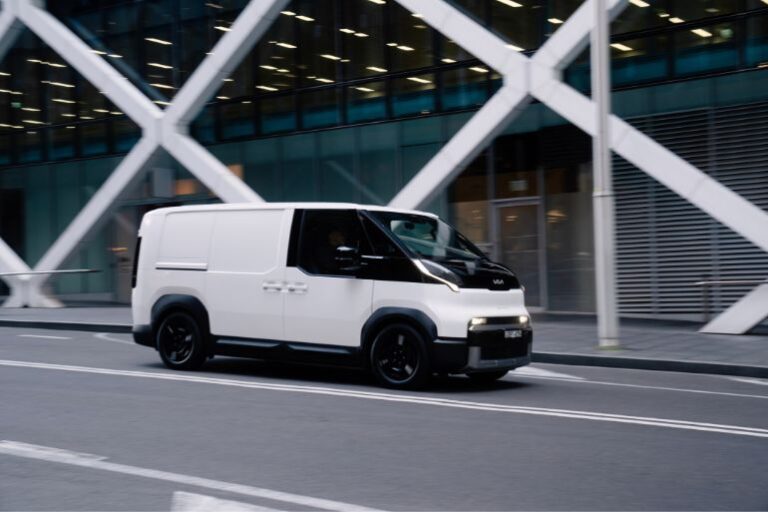
The Kia PV5 is finding traction beyond small businesses and tradies, with Kia targeting government, utilities, larger corporates and last-mile delivery operators as key customers for its first dedicated electric commercial vehicle.
Since its Australian launch earlier this year, the PV5 has been well received, with sales exceeding Kia’s initial expectations and strong demand across fleet segments.
That response reinforces comments made by Kia Australia General Manager of Fleet Chris Forbes at the launch, when he identified a much broader potential customer base than the traditional owner-driver van market.
While Kia dealers were already seeing interest from trades, Forbes said the fleet team was concentrating on organisations operating larger numbers of vehicles.
“For us in the fleet teams, it’s probably more important to look at the larger organisations, the larger corporates, utility companies, governments,” Forbes said.
He also identified “last mile delivery” and general cargo applications as areas where fleets now had an electrified option available.
For Fleet Managers working towards emissions-reduction targets, that availability is important. Vans can represent a significant proportion of operational fleet kilometres, but they have traditionally been more difficult to electrify than passenger vehicles because range, payload and cargo capacity all need to work together.
A new option for predictable fleet duty cycles
The PV5 Cargo uses a dedicated electric vehicle platform and combines a 71.2kWh battery with a claimed 416km WLTP driving range.
It provides 4.4 cubic metres of cargo volume and a maximum payload of 740kg, while a front-mounted electric motor produces 120kW and 250Nm. The PV5 Cargo S launched at $55,990 RRP.
Those numbers make it particularly relevant for fleets operating predictable metropolitan and suburban routes.
Government service vehicles, utility fleets, maintenance crews and last-mile delivery vans often return to the same depot or operating base each day, creating an opportunity for overnight charging rather than relying heavily on the public charging network.
For a Fleet Manager, the question therefore becomes less about whether an electric van can match the theoretical driving range of a diesel and more about whether it can comfortably complete the organisation’s actual daily duty cycle.
The PV5’s claimed 416km range gives fleets considerably more room to make that calculation.
Tradies are interested too
Kia’s fleet ambitions don’t mean it is ignoring smaller businesses.
Forbes said feedback from Kia dealers before the vehicle went on sale suggested strong interest from trades, particularly businesses already connected with electrification.
“Based on our dealers’ information, it seems that there’s a lot of tradies that are very much looking at the van for their businesses, especially on the lines of electricians and also installers for solar and batteries,” Forbes said.
Kia had also displayed the PV5 at the Smart Energy Expo in Sydney before launch, giving the company an opportunity to gauge reaction from businesses involved in solar, batteries and alternative-energy products.
“There were a number of businesses, and yes, sure, they’re aligned with alternative fuels and looking at batteries and solar, but a lot of interest from those guys looking to get into a van,” Forbes said.
Forbes argued that an electric van gives these businesses the opportunity to align the vehicle arriving at a customer’s premises with the products and services they sell.
“It’s not great for a battery supplier or installer to turn up in a diesel van,” he said. “So this now gives an opportunity to look elsewhere and to turn up in an appropriate vehicle.”
It’s a simple point, but it highlights why commercial vehicle electrification isn’t being driven by one type of fleet customer.
For some organisations, the motivation will be emissions targets. For others it will be operating costs, corporate sustainability commitments or customer expectations.
Built around commercial use
The PV5 also has features that give Fleet Managers reasons to consider it beyond the electric drivetrain.
Its dedicated EV architecture creates a relatively low floor, with 4.4m³ of cargo capacity despite an overall vehicle length of 4,695mm. The cargo area is 2,255mm long, 1,565mm wide and 1,520mm high.
Dual sliding side doors and twin-swing rear doors provide cargo access, while the van includes eight rear tie-down points and a solid partition between the cabin and cargo area.
There is also vehicle-to-load capability, allowing the traction battery to supply power to electrical equipment. That has obvious potential for electricians, maintenance crews and mobile service fleets using tools or equipment during the working day.
For delivery fleets, the driving environment may be just as important. The PV5 includes a surround-view monitor, blind-spot view monitor, adaptive cruise control, autonomous emergency braking and a range of lane and parking assistance systems.
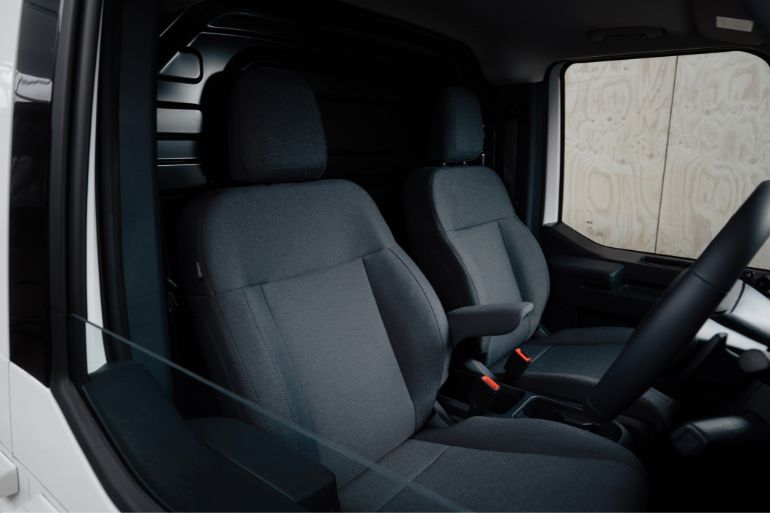
Kia has also approached the cabin more like a mobile workplace, with multiple storage areas, wireless smartphone connectivity and a 12.9-inch infotainment display.
Fleet demand will be the real test
Electric vans remain a relatively small part of the Australian commercial vehicle market, so one new model isn’t going to replace diesel overnight.
But the response to the PV5 so far suggests there is a larger pool of fleet customers ready to consider an electric van than previous sales volumes might indicate.
The important point is that Kia isn’t pitching the PV5 at one narrow EV niche.
Tradies and small businesses are part of the opportunity, but Kia’s fleet team is also pursuing the government departments, utilities, corporates and delivery operations that collectively operate thousands of commercial vehicles.
Forbes’ comments in June showed where Kia thought the opportunity would come from. The sales response since then suggests those customers are listening.