


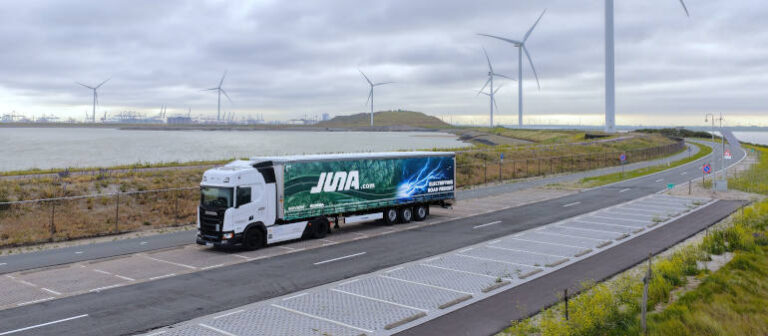
JUNA has passed 100 electric trucks operating on European roads, with the Scania and sennder joint venture showing how alternative fleet models could make heavy vehicle electrification more accessible to transport operators.
The electric-truck-as-a-service business now has around 110 vehicles operating across Germany, Italy, Poland and the Netherlands, with the fleet expected to reach approximately 150 trucks by the end of 2026.
Since its first electric trucks entered service just over two years ago, the fleet has travelled 3.9 million kilometres across a mix of international transport routes and shorter daily shuttle operations.
The scale of the operation is significant, but the model behind it is arguably more important for fleets considering the transition to electric heavy vehicles.
Rather than requiring carriers to purchase an electric truck outright, JUNA works with shippers and freight forwarders to identify routes suitable for electrification before supporting the transport operators that will run those services.
Vehicles are then provided through a flexible pay-per-use model, supported by route analysis and technical expertise.
The approach is designed to address one of the biggest barriers to electric truck adoption — the higher upfront cost.
JUNA says battery-electric trucks can cost two to three times more than comparable diesel vehicles, creating a significant capital hurdle for many transport businesses.
That challenge is particularly relevant in Europe, where around 70 per cent of trucks are operated by carriers with fewer than 10 vehicles.
For smaller businesses, purchasing an electric truck can mean taking on vehicle finance, technology, utilisation and residual value risks at the same time.
JUNA’s model seeks to reduce some of those barriers by separating access to the truck from outright ownership.
Gustaf Sundell, Executive Vice President and Head of Ventures and New Business at Scania Group, said the business was created to demonstrate that electric trucks could work commercially.
“When we set out to build JUNA with sennder, our goal was to show that electric trucks could work commercially for carriers while helping shippers decarbonise the transport networks they rely on,” Sundell said.
“Reaching 100 trucks across four markets shows that this proof point is real and gives us a strong foundation for continued growth.”
Start with the route, not the truck
JUNA’s approach also reflects an important change in the way fleets are thinking about electrification.
Instead of starting with the vehicle, the business begins with the transport task.
Routes, daily kilometres, payload requirements, charging opportunities and operating schedules are analysed before an electric truck is introduced.
For fleet operators, this is becoming an increasingly important part of the transition to electric vehicles.
The question is no longer simply whether an electric truck can replace a diesel equivalent.
Fleets need to understand where electrification works operationally, where charging can be incorporated into the working day and whether the vehicle will achieve sufficient utilisation to support the business case.
David Nothacker, Co-founder and CEO of sennder, said electric trucks needed to fit within existing transport networks.
“The transition to electric road freight requires solutions that fit real transport networks and can be deployed across carrier and subcontractor operations,” Nothacker said.
“JUNA connects shipper demand with the operational reality of carriers, helping integrate electric trucks into everyday logistics at scale.”
The model is already being used by major shippers, including Nestlé, while JUNA is also supporting regional logistics operations for Beiersdorf in Hamburg.
For those organisations, the model provides another way to address transport emissions without owning the trucks themselves.
It also highlights the growing role that large freight customers can play in accelerating fleet electrification by identifying suitable transport tasks and supporting carriers through the transition.
Electric trucks move beyond trials
JUNA’s 3.9 million kilometres of operation provides another indication that electric heavy vehicles are moving beyond demonstration programs.
The vehicles are being used across several countries and transport applications, providing operational data that can help determine where battery-electric trucks offer a viable alternative to diesel.
Matteo Oberto, Managing Director and CEO of JUNA, said the combination of operational analysis, technical support and a flexible commercial model was helping transport operators adopt electric vehicles.
“By combining route analysis, technical expertise and a flexible commercial model, we are helping carriers of all sizes integrate electric trucks into their everyday operations in a way that is both economically viable and sustainable,” Oberto said.
For Australian fleets, there are obvious differences in transport distances, charging infrastructure and operating conditions, but the broader lesson is relevant.
Fleet electrification does not necessarily require every organisation to purchase and own electric vehicles in the same way it has traditionally acquired diesel trucks.
Leasing, subscription, truck-as-a-service and pay-per-use models could become increasingly important as electric commercial vehicles enter more fleet applications.
They may be particularly valuable during the early stages of the transition, when fleets are still building knowledge around battery performance, charging infrastructure, utilisation and residual values.
JUNA’s expansion to more than 100 electric trucks suggests the next phase of commercial fleet electrification may be as much about developing new operating and funding models as it is about launching new vehicles.