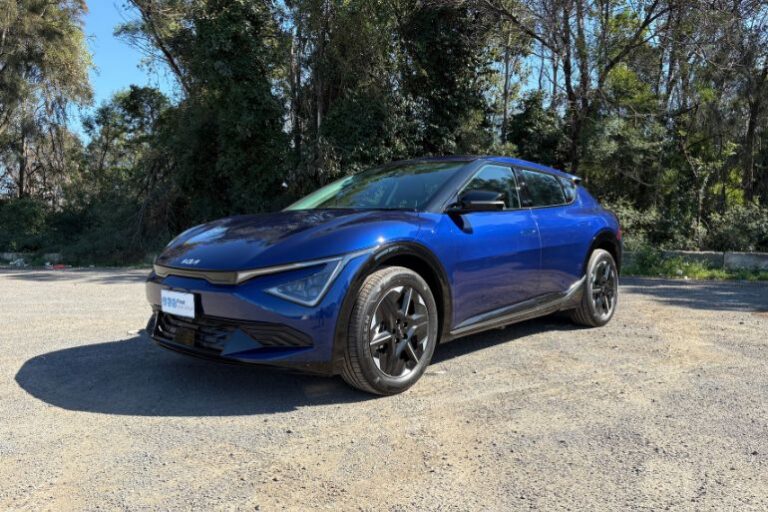
There is something slightly ironic about revisiting the Kia EV6 in 2026.
When it arrived in Australia in 2022, it felt like one of the cars defining the electric vehicle market. It was futuristic without being strange, quick without being difficult to live with, and it came from a manufacturer that already understood what Australian drivers and fleets expected from a vehicle.
Four years later, the EV6 has not suddenly become a worse car. If anything, driving the MY26 EV6 Air again highlights just how much Kia got right from the beginning.
The problem is that the market around it has changed dramatically.
The benchmark moved
The EV6 arrived before the current wave of lower-priced electric SUVs and crossovers transformed the value equation for Australian EV buyers.
At the time, an electric vehicle with strong range, rapid charging capability, plenty of interior space and a well-established dealer network was relatively unusual.
Today those attributes are almost expected.
The entry-level EV6 Air now sits in a market where customers can find newer EVs offering long equipment lists and increasingly competitive range figures for considerably less money.
That makes the EV6 an interesting test of how fleets should judge established electric vehicles in a rapidly changing market.
Because judged purely as a car, the EV6 remains very convincing.
It still feels like it was designed for the driver
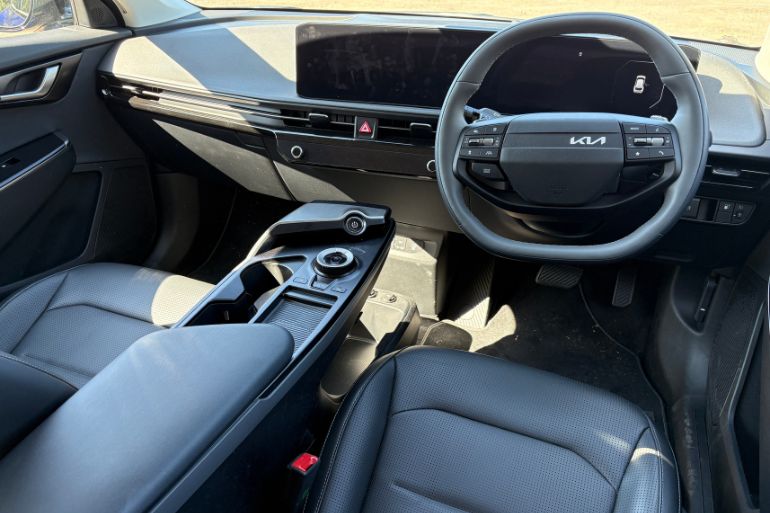
One of the strongest impressions from returning to the EV6 was how conventional it feels to operate.
That isn’t meant as criticism.
Many newer electric vehicles have embraced enormous centre screens and moved basic functions into increasingly complicated menus. The EV6 takes a different approach.
There are still large digital displays — a pair of 12.3-inch screens form the curved instrument and infotainment display — but Kia combines them with controls that are easy to understand and use while driving.
The clever touch-sensitive panel beneath the infotainment display can switch between climate and audio controls, reducing the number of buttons without making frequently used functions difficult to find.
The result feels more like driving a car than an “iPad on wheels”.
For fleet users spending hours behind the wheel, that matters.
User interfaces are becoming a workplace ergonomics issue as much as a design feature. A system that is easy to understand reduces distraction and makes it easier for multiple drivers to move between vehicles.
The Air has the range without chasing performance
The EV6 Air uses an 84 kWh battery with a single electric motor driving the rear wheels.
Output is 168 kW and 350 Nm, with Kia quoting 0–100 km/h in approximately 7.7 seconds. More importantly for most fleet applications, the Air has a claimed 582 km WLTP combined range and official energy consumption of 159 Wh/km.
Those figures make more sense for a fleet vehicle than chasing the extraordinary acceleration offered by the EV6 GT.
There is still plenty of immediate electric torque, but the rear-wheel-drive layout gives the Air a character that is becoming surprisingly rare as EV specifications increasingly focus on power figures.
The steering is direct, the vehicle feels balanced and the chassis encourages you to actually enjoy driving it.
That’s one of the EV6’s enduring strengths.
It doesn’t feel like Kia started with an electric powertrain and then built a technology product around it. It feels like the company started with the idea of building a good car and happened to power it with electricity.
Fast charging remains a genuine advantage
One specification that has aged particularly well is the EV6’s charging architecture.
The EV6’s 800-volt electrical architecture is one of its strongest features, allowing very fast DC charging while remaining compatible with more common 400-volt charging infrastructure. With Kia quoting approximately 18 minutes for a 10–80 per cent charge using a 350 kW DC charger.
That remains a significant advantage for fleets operating vehicles beyond predictable metropolitan commuting.
A long range is useful, but charging speed can be just as important when an electric vehicle is expected to cover significant kilometres during the working week.
For a driver who can recharge overnight at home or at a depot, the Air’s 582 km WLTP figure offers considerable flexibility. For drivers relying on public infrastructure during longer trips, the rapid DC charging capability reduces downtime.
Those are meaningful operational benefits rather than specification-sheet decoration.
It also works as a mobile workplace
The EV6’s size contributes to its fleet appeal.
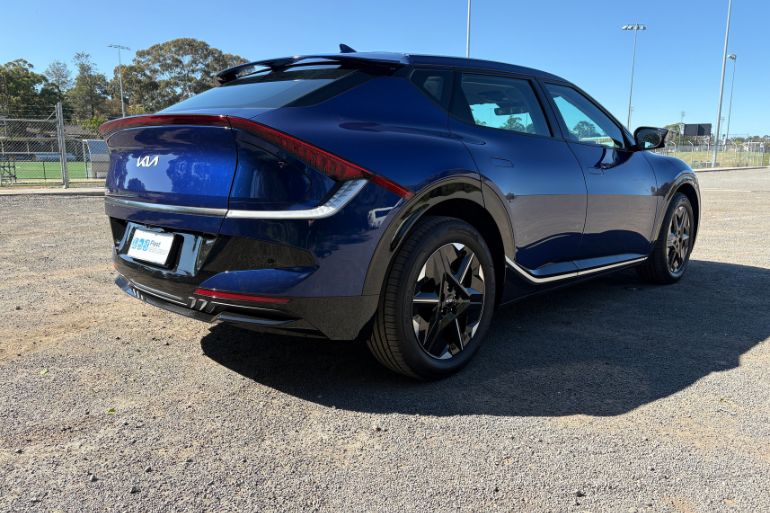
A 2,900 mm wheelbase provides generous rear-seat accommodation, while the Air offers 490 litres of rear cargo space and a 52-litre front storage compartment.
There is also an interior Vehicle-to-Load socket.
For employees who spend much of the day on the road, being able to power or charge laptops and other equipment directly from the vehicle’s high-voltage battery adds genuine usefulness.
The Air does not receive the external V2L adaptor supplied with higher variants, but the interior power outlet still strengthens the case for treating the EV6 as a mobile workplace rather than simply transport.
That was one of the strongest practical impressions from the review.
Where the price starts to hurt
The difficulty comes when you compare the Air’s specification with its price.
It misses a number of features available further up the EV6 range, including heated front seats, ventilated front seats, a heated steering wheel, Surround View Monitor and Blind Spot View Monitor.
None of those omissions fundamentally affects the way the EV6 drives or its ability to perform fleet duties.
But they become much harder to ignore when newer competitors are offering extensive comfort and technology packages at lower purchase prices.
That’s the EV6’s real challenge in 2026. Not range. Not charging. Not build quality. Not driving dynamics. Value.
Fleet buyers need to separate price from product quality
For Fleet Managers, the temptation may be to dismiss the EV6 simply because other electric vehicles appear cheaper on the acquisition spreadsheet.
That would also be too simplistic.
Kia brings an established dealer network, fleet support structure, parts distribution and manufacturer backing that can influence downtime, servicing and whole-of-life costs. The review also highlights Kia’s established fleet team and pricing discipline as strengths.
Those factors deserve to be included when comparing the EV6 with newer market entrants. But they don’t remove the need for the numbers to stack up. And that’s where the EV6 Air becomes difficult.
At around $79,000, it is now competing against electric vehicles that have benefited from four years of falling prices, increasing competition and rapidly improving standard equipment.
Perhaps this is what a mature EV market looks like
The EV6 provides an interesting lesson about the Australian electric vehicle market. A few years ago, simply being a good EV was enough to stand out. In 2026, that isn’t enough.
Fleet buyers can now compare electric vehicles on purchase price, workplace ergonomics, charging speed, manufacturer support, driver acceptance, specification, resale assumptions and whole-of-life costs in much the same way they would compare petrol or diesel vehicles.
That is ultimately a sign of progress. And judged on many of those criteria, the Kia EV6 still performs extremely well.
It is comfortable, spacious, efficient and exceptionally fast to charge. It has an established manufacturer behind it, and perhaps most importantly, it remains one of the electric vehicles that gets the basic act of being a car right.
The heart says the EV6 Air deserves serious consideration. The practical fleet brain looks at the purchase price, looks at what else is now available, and starts reaching for the calculator.
For Kia, that’s the challenge.
The EV6 hasn’t fallen behind because it stopped being a great electric car. The electric vehicle market simply caught up — and then became much more competitive around it.