

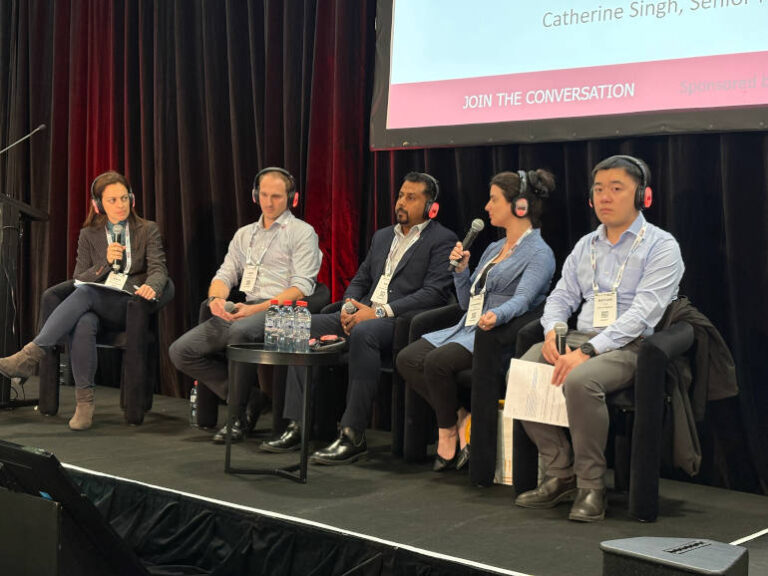
Fleet electrification is progressing, but charging infrastructure, funding and organisational confidence remain hurdles to wider adoption. For fleet managers attending MOVE Australia, a panel discussion offered practical advice from people already working through those challenges—and a clear invitation to learn from each other.
Moderated by Anna Martinis, the session brought together Nathan Duong, Catherine Singh, Kris Nair and Alex Killeen to discuss how councils and government fleets are moving from early trials towards broader implementation.
Their experiences differed, but a common message emerged: start with suitable applications, measure the results and build on what works.
Infrastructure remains a constraint
For Nathan Duong, identified during the session as working with the City of Sydney, charging infrastructure is fundamental to getting electric vehicles into service.
“Without the infrastructure, without the backbone, essentially we could have trucks here tomorrow, but it’s not going anywhere without a significant charge,” he said.
Catherine Singh described a similar challenge at the City of Port Phillip. While the council had made progress electrifying passenger vehicles, expanding into heavy vehicles presented additional demands on charging capacity and depot locations.
“We’re at capacity at the moment, unfortunately, and we’re limited in the locations we can use,” she said.
Her experience highlighted a challenge for inner-city fleets: introducing more electric vehicles can require power upgrades involving third parties, alongside decisions about vehicles and chargers.
Killeen explained that passenger vehicle charging and heavy vehicle depot charging can involve very different requirements. Office locations may offer opportunities to charge overnight using load management, while depots can combine limited electrical capacity with substantial vehicle energy needs.
His advice was to plan for the eventual fleet requirement, then work towards it in stages. A depot might initially support six electric trucks while upgrades are planned for a larger deployment.
“It doesn’t mean you have to stop and wait for the gold standard,” he said.
Turn fleet data into decisions
Nair described how his fleet’s transition planning exposed a gap between having data and being able to use it.
“We’ve had spreadsheets of a spreadsheet of a spreadsheet, and none of them helped my department or myself make any informed decisions,” he said.
The response was to examine vehicle applications more closely, combining information such as road gradients, operating speeds and bin collections to identify which vehicles should be targeted first.
That approach also helped move conversations about range away from assumptions and towards evidence.
For fleet managers, the lesson is practical: understanding the work a vehicle actually performs provides a stronger foundation for selection, charging plans and discussions with drivers.
Give pilots a pathway to implementation
The panel also explored why some organisations struggle to move beyond trials.
Duong said a trial should establish whether a vehicle suits the intended application. His experience included electric trucks that worked in some teams but proved unsuitable for others—useful findings when deciding what to do next.
Killeen argued that planning for implementation should begin before a successful pilot finishes.
“You have to know what happens next and have that plan in place,” he said.
Waiting until the end of a lengthy trial to consider infrastructure, funding and further procurement risks losing momentum. Clear objectives and an agreed pathway help turn a demonstration into an operational change.
Build support through evidence and experience
Funding and executive support were another recurring theme.
Nair said showing the budget impact of moving from diesel to electric over a 10-year forecast helped attract executive attention. Giving decision-makers an opportunity to drive electric vehicles also helped address uncertainty.
Singh described a different starting point at Port Phillip, where senior leaders already supported sustainability initiatives. The challenge was delivering that ambition within infrastructure and market constraints.
Together, the examples showed why transition plans need to reflect each organisation’s circumstances. Some fleet managers must first build support; others need practical solutions to deliver an existing commitment.
The next useful conversation could be at a fleet event
The panel’s closing advice reinforced the value of connecting with the fleet community.
“If you’ve not started yet, go and talk to someone who has,” Killeen said. “Go and get some numbers, go and get some lived experience.”
Singh extended an equally direct invitation.
“Use us as a case study if you want. We’re all a bit different, so we’ve all done different things,” she said.
For readers who missed MOVE Australia, that willingness to share was one of the session’s strongest takeaways. Fleet events provide access to people who can explain what worked, what failed and what they would change.
A presentation can introduce an idea. A conversation afterwards can help a fleet manager understand whether it could work in their own operation.
Making time to attend, ask questions and build those relationships can bring fresh knowledge and greater confidence to the next fleet decision.