


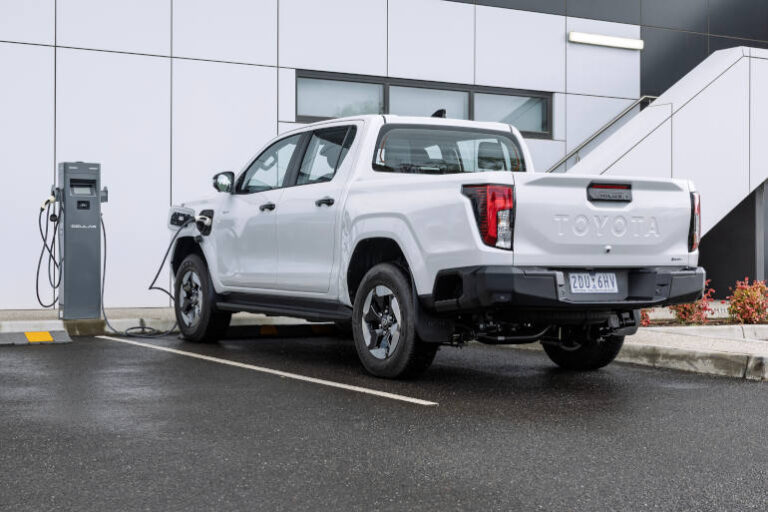
Australia’s electric vehicle market has moved decisively beyond the early-adopter phase in 2026, with EVs accounting for more than one in four new vehicle sales in the first half of the year.
But the Electric Vehicle Council’s latest State of EVs 2026 report also reveals a much more complicated picture for Fleet Managers. While passenger vehicle choice and charging infrastructure continue to expand, vans and trucks remain well behind passenger cars, and organisations planning fleet electrification will need to focus increasingly on infrastructure, policy and operational planning rather than simply waiting for more vehicles to arrive.
The report, now in its tenth year, combines sales and registration data with public charging figures to 30 June 2026 and an assessment of government EV policy. This year, the focus has shifted from establishing the early foundations for EV adoption towards the conditions required to sustain the transition at scale.
EVs reach one in four new vehicle sales
The headline number is 25.8%.
A total of 157,957 EVs were sold during the first six months of 2026, compared with 72,758 during the equivalent period reported for 2025 — an increase of 117.1%.
This included approximately 104,000 battery electric vehicles and 54,000 plug-in hybrids. The Electric Vehicle Council projects EVs could account for 29% of new vehicle sales across the full year. State-of-EVs_2026_FINAL
Vehicle choice is expanding at the same time. The report identifies 196 EV models available in 2026, compared with 153 in 2025.
For Fleet Managers developing emissions reduction strategies, the growth in model availability should make it easier to identify suitable replacements across more passenger vehicle applications.
However, it doesn’t remove the need to understand how vehicles are actually being used.
Range, payload, charging opportunities, daily kilometres, vehicle location and operational downtime remain important inputs when determining whether an EV is suitable for a particular fleet task.
Passenger cars race ahead of commercial vehicles
One of the most important findings for fleets is the difference in electrification rates between vehicle segments.
Passenger cars reached approximately 26% EV market share during the first half of 2026, while electric buses reached 32%. Vans were around 1% and trucks just 0.6%.
The Electric Vehicle Council describes this as a “multi-speed transition” and argues that freight electrification needs to move beyond pilots and trials towards larger-scale deployment.
For organisations operating mixed fleets, these figures reinforce the need for a segmented fleet transition plan.
An organisation may be able to electrify passenger vehicles relatively quickly while retaining diesel vehicles in operational categories where suitable zero-emission alternatives, charging infrastructure or business cases are not yet available.
Rather than applying one electrification target across every asset category, Fleet Managers can identify where the technology is ready today, where further operational analysis is required and where replacement may need to wait for the market to develop.
Charging becomes a fleet planning issue
Australia had around 11,600 public AC and DC charging connectors across 4,268 locations at 30 June 2026. The report also identifies 5,417 public DC connectors, up 31% from July 2025.
But public charging numbers only tell part of the fleet story.
As more organisations electrify vehicles, workplace and depot charging will become increasingly important. The report specifically raises questions around incentives for businesses installing charging, charging at government workplaces and the time and cost involved in securing grid connections for fleet depots.
This means charging infrastructure should increasingly form part of the fleet replacement planning process rather than being treated as a separate project after vehicles have been ordered.
For Fleet Managers, this requires collaboration with Sustainability Managers, Finance Managers, property teams, electricity providers and senior management.
Electric trucks create a much bigger infrastructure challenge
The report highlights an even larger planning challenge for heavy vehicles.
Depot charging is expected to remain important for vehicles returning to base, but shared charging hubs and en-route infrastructure will also be needed as electric trucks move into longer-distance applications.
Australia is likely to require a combination of private depots, shared hubs, truck charging facilities, charging at ports and intermodal terminals, and infrastructure along major freight routes.
Significantly, the report argues that infrastructure planning cannot wait for electric truck volumes to increase.
AEMO forecasts road transport electricity consumption reaching 61 TWh by 2050, with approximately 31 TWh coming from corporate fleets and commercial vehicles. The report says land, grid connections and network investment need to be secured before that demand arrives.
That’s an important message for organisations planning to electrify trucks, vans and other high-utilisation fleet assets: the lead time for the infrastructure may ultimately be longer than the lead time for the vehicle.
Queensland provides a fleet case study
One of the most relevant sections of the report for Fleet Managers is the experience of Queensland Government fleet manager QFleet.
QFleet increased its battery electric fleet from 102 vehicles in January 2022 to more than 2,400 by mid-2025, with BEVs eventually representing 21% of the fleet.
Rather than simply establishing an EV target, QFleet made BEVs the default replacement for eligible vehicles at the end of their lease. It also identified charging as a major constraint and worked with the Queensland Government Accommodation Office to incorporate charging into new and renewed property leases.
Driver education was another part of the transition, with drive days, information sessions, inductions and an all-BEV car-share pool used to build familiarity.
The experience also illustrates the importance of maintaining organisational support. Following a change in strategy in March 2025, the report says fewer than 50 additional BEVs were added in the following financial year, compared with an average of more than 650 annually over the previous three years. Charging infrastructure funding also ended in June 2026.
For other organisations, the lesson is broader than electrification.
Successful fleet transition requires policy, funding, infrastructure, procurement, property and operational teams to move together.
Fleet maturity will matter more as EV adoption accelerates
The rapid growth in EV sales means Fleet Managers no longer need to treat electrification as a distant technology issue.
But buying an electric vehicle is the relatively simple part.
Organisations still need reliable utilisation data, replacement policies, whole-of-life cost modelling, charging strategies, driver education, asset categorisation and a clear understanding of operational requirements.
For organisations with a lower level of fleet management maturity, developing those foundations may be one of the most important steps towards electrification.
The State of EVs 2026 report shows that the Australian vehicle market is changing quickly. The challenge for fleets is making sure their management practices, policies and infrastructure are developing quickly enough to take advantage of it.