


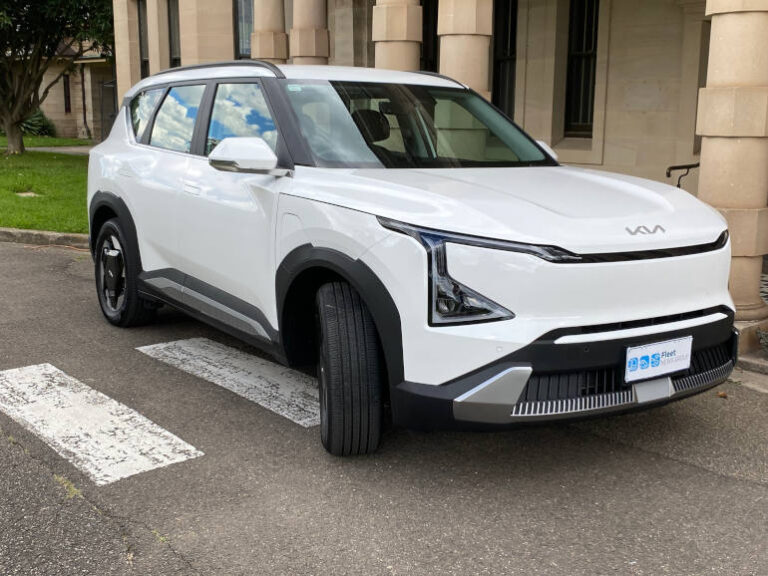
The Fringe Benefits Tax exemption for eligible electric vehicles has changed the economics of novated leasing and helped make battery electric cars a more serious consideration for Australian employees.
For manufacturers such as Kia, that change is also creating a different type of EV customer — one who is researching charging, running costs, specifications and resale values before deciding what to put in the driveway.
Speaking with Fleet News Group, Roland Rivero, General Manager, Product Planning & Training at Kia Australia at the time of the interview, said novated lease customers were approaching the EV decision with a high level of knowledge.
“We are finding with novated buyers, they’re pretty savvy. They do a lot of their own homework, and they’re very astute customers,” Rivero said.
FBT changed the EV calculation
Under the current Australian tax rules, eligible electric cars and associated car expenses can be exempt from FBT when the requirements are met, including vehicles provided through salary packaging arrangements such as novated leases.
That can materially change the cost comparison between an EV and an equivalent petrol vehicle for an employee.
The exemption has applied since July 2022 and has been an important part of the Federal Government’s Electric Car Discount.
The policy is also evolving. The Government announced in May 2026 that the existing full FBT discount will continue until the end of March 2027. From 1 April 2027, the full exemption is planned to continue for eligible EVs costing $75,000 or less, while eligible vehicles above that amount but below the relevant Luxury Car Tax threshold will receive a reduced concession.
That makes vehicle price increasingly important for manufacturers targeting the novated leasing market.
EV buyers are doing their homework
Rivero said novated lease customers often approach EV ownership differently from employees simply being allocated a company vehicle.
“They’ve already done their homework, and they they know whether they have got the capacity for in-home charging, or they need to utilise public public charging infrastructure,” he said.
That consideration is becoming part of the vehicle purchasing process.
Kia offers home charging hardware through its dealer network, and Rivero said demand for bundled charging solutions had been increasing as EV sales grew.
“The popularity of our charging hardware is suggesting that there’s favourability in that regard as well,” Rivero said.
“There’s more and more buyers that are looking at bundling it together with everything else.”
He said the trend was particularly evident among private buyers and employees selecting vehicles through salary packaging rather than larger corporate and government fleets, which often have their own charging infrastructure.
Specification matters in novated leasing
There is also an important difference between traditional fleet procurement and novated leasing.
A Fleet Manager may prioritise whole-of-life cost, safety, operational suitability and manufacturer support when selecting a standard vehicle for hundreds of employees.
A novated lease driver is spending their own salary package on a vehicle they will use personally, so equipment levels, design and features can carry greater weight.
That presents manufacturers with a challenge: offering enough equipment to attract a private user-chooser while keeping the vehicle within the price thresholds that make novated leasing attractive.
Rivero said Kia was conscious of this with models such as the EV3, EV4 and EV5.
“For novated in particular, all of our respective top of line GT Lines all fall under the luxury car tax,” Rivero said.
“So when they start to calculate the overall packaging, we think we’ve got a well specified and well priced, and a positive total cost of ownership experience for novated customers.”
Running costs still matter
The FBT exemption may attract an employee to consider an EV, but it does not remove the need to examine the complete cost of owning one.
Servicing, energy costs, tyres, insurance, residual values and charging arrangements can all influence whether the numbers work over a three, four or five-year lease.
Rivero said resale value was becoming particularly important as EV buyers watched some manufacturers change prices and specifications relatively quickly.
“We we don’t like to chop and change. We like to keep things fairly steady, so that the vehicle, as you know it in 2026, fundamentally carries over into 2027, unless there’s a a facelift or a full model change,” he said.
For a novated lease customer, residual value matters because it forms part of the lease calculation and ultimately influences the financial outcome when the lease ends.
Novated leasing is introducing more drivers to EVs
The significance of the FBT exemption goes beyond reducing the cost of one particular vehicle.
It has given employees who might previously have selected a petrol or diesel vehicle another reason to investigate an EV and work through questions about home charging, range, servicing and resale value.
For manufacturers, that means the novated leasing market has become an important battleground for EVs.
Rivero said Kia was already seeing that distinction between the vehicles preferred by traditional fleets and those attracting user-choosers.
“We do find from a fleet perspective, EV5 is the more popular choice,” he said. “But notwithstanding, from a novated perspective, from a user chooser perspective, EV3 is also equally popular.”
The FBT exemption won’t make an EV suitable for every employee. Access to charging, annual kilometres, driving patterns, vehicle requirements and the structure of the salary package still need to be considered.
But it has fundamentally changed the financial comparison.
Instead of asking whether an employee is prepared to pay more to drive an electric car, novated leasing increasingly allows buyers to ask a different question: which vehicle delivers the best overall outcome once the tax treatment, running costs and ownership experience are taken into account?





