

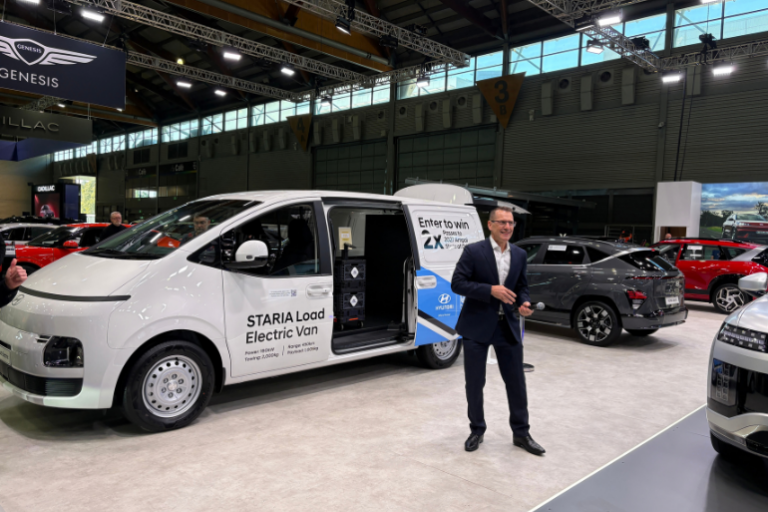
Hyundai Australia says the thinking behind the new STARIA Load Electric was relatively simple: electrification shouldn’t turn a working van into a compromised commercial vehicle.
Speaking with Fleet News Group at Everything Electric Sydney, where the STARIA Load Electric made its official Australian debut, Hyundai Motor Company Australia Chief Operating Officer Gavin Donaldson said maintaining the fundamental capability of the van was central to the product.
“For us, we’re giving you a true commercial vehicle,” Donaldson said.
That distinction matters for Fleet Managers assessing electric vans. Range and charging performance attract plenty of attention, but payload, cargo volume and the ability to complete the same job as an existing diesel vehicle ultimately determine whether an EV can make it onto a fleet replacement list.

More than a tonne of payload
The STARIA Load Electric carries a 1,005kg payload, which actually puts it slightly ahead of the diesel STARIA Load at 997kg and close to the Hybrid’s 1,039kg.
Donaldson highlighted that figure when discussing the new model.
“The payload’s about just over around 1,000 kilos. It’s slightly more than what the diesel does,” he said.
Hyundai has also retained the same 4,935-litre cargo capacity offered by the diesel and Hybrid versions, with an internal cargo area measuring 2,607mm long, 1,640mm wide and 1,436mm high.
That means moving to the battery-electric powertrain hasn’t required fleets to surrender the working space they already expect from STARIA Load.
Donaldson was equally clear about the vehicle’s positioning.
“It is a full-size van,” he said.

V2L turns the van into a mobile power source
One feature Donaldson was particularly enthusiastic about was Vehicle-to-Load.
The STARIA Load Electric includes a V2L outlet in the cargo area, allowing the 84kWh traction battery to provide electricity through a conventional three-pin outlet.
“What I really do like about it is the vehicle-to-load aspect of it,” Donaldson said.
For commercial fleets, that creates some interesting possibilities.
Trades, maintenance teams, field-service technicians and other mobile workers can potentially use the vehicle to run tools and equipment without needing a separate generator or another source of mains power.
During a media presentation at Everything Electric, Donaldson pointed to applications ranging from trades and food businesses to florists and mobile services, highlighting the flexibility Hyundai sees in the product.
For Fleet Managers, V2L is therefore more than another item on the EV specification sheet. Depending on the application, it could become part of the vehicle’s productivity proposition.
450km range without downsizing the van
Hyundai has paired that commercial capability with an 84kWh battery and a 160kW/350Nm electric motor driving the front wheels.
The claimed WLTP range is up to 450km.
That range should make the STARIA Load Electric relevant to more than short inner-city delivery routes.
The fleet question will still be whether 450km is enough for the actual duty cycle once payload, weather, driving conditions and auxiliary loads are taken into account. But on paper, Hyundai has given fleets a useful operating envelope without shrinking the van to achieve it.
Hyundai wanted current EV technology, not yesterday’s
The other major specification decision was charging.
The STARIA Load Electric uses Hyundai’s 800V electrical architecture and can accept DC charging at up to 350kW, with Hyundai quoting a 10–80 per cent charging time of around 20 minutes under suitable conditions.
Donaldson said Hyundai wanted the van to arrive with technology that reflected current expectations for an EV.
“I think everyone now expects to have the best architecture you can get when you’re bringing in an EV nowadays,” he said.
“We wanted to make sure we brought it in so that it was seen to be leading in technology when it arrived in the country.”
For depot-based fleets, overnight charging will probably remain the preferred approach. But high-power DC charging provides another option when vehicles need to get back into service quickly or operate outside their normal schedule.
That is particularly important for commercial vehicles, where charging time can quickly become downtime.
Capability comes with a price
Delivering this level of specification hasn’t produced a cheap electric van.
The STARIA Load Electric is priced from $70,990 Manufacturer’s List Price, compared with $49,990 for the diesel and $53,490 for the Hybrid.
Asked about that premium, Donaldson said Hyundai believed the launch pricing was competitive but would continue to watch the market and demand.
“At this stage, we think the pricing is on the money, but we’ll continue to review what we need to do,” he said.
That means the purchasing decision will need to move beyond acquisition price.
Fleet News Group’s Whole of Life Cost modelling over four years and 100,000km estimated annual WOLC at $15,225 for the diesel, $15,115 for the Hybrid and $16,978 for the Electric. The Electric therefore remained more expensive in the model, but the gap was considerably smaller than the initial purchase-price difference suggested.
An EV that still needs to do the job
For Fleet Managers, the STARIA Load Electric is interesting because Hyundai hasn’t asked buyers to redefine what they expect from a commercial van simply because the drivetrain has changed.
There is still around a tonne of payload. The cargo area hasn’t disappeared beneath a battery. The vehicle can tow up to 2,000kg braked. There is enough stated range for many fleet applications, and the 800V architecture offers rapid charging when it is required.
The higher acquisition price remains the hurdle.
But Hyundai’s approach to the STARIA Load Electric suggests the conversation around electric commercial vehicles is moving on. Instead of asking fleets to accept major compromises in exchange for zero tailpipe emissions, manufacturers are increasingly being judged on whether an EV can simply replace the vehicle already doing the job.
And that is exactly where Donaldson says Hyundai wanted the STARIA Load Electric to sit: as a true commercial vehicle first, and an EV second.