

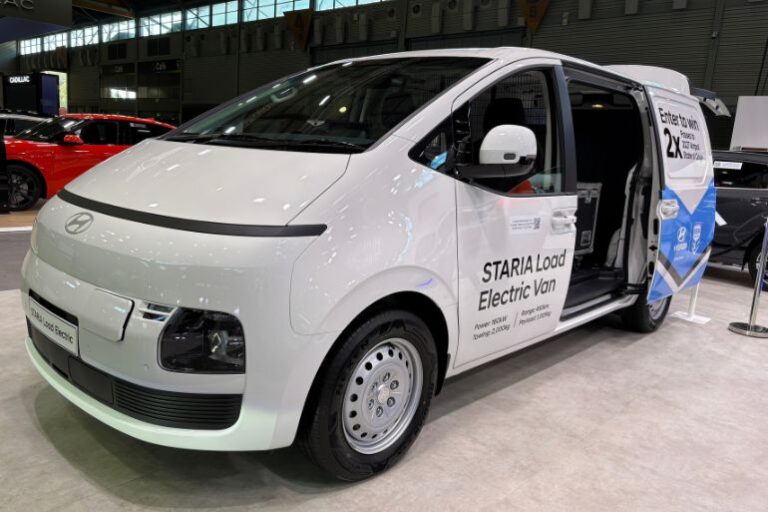
The specifications of the new Hyundai STARIA Load Electric will attract plenty of attention from Fleet Managers: 450km of WLTP range, a payload of more than a tonne and 800V architecture capable of very fast DC charging.
But Hyundai Australia Chief Operating Officer Gavin Donaldson argues that the commercial vehicle proposition extends well beyond what buyers can see on the specification sheet.
Speaking at Everything Electric Sydney, where Hyundai officially launched the STARIA Load Electric, Donaldson pointed to Hyundai’s national dealer and parts network as an important part of the ownership equation.
For fleets relying on a van to earn money or deliver services every day, that support can be every bit as important as range and charging speed.

What you don’t see on the show stand
During a media tour of Hyundai’s display at Everything Electric, Donaldson talked through the STARIA Load Electric’s payload, range and Vehicle-to-Load capability.
Then he shifted the conversation to something that wasn’t sitting on the stand.
“What I think is more important on our stand is what you don’t see,” Donaldson said, referring to Hyundai’s dealer and aftersales infrastructure.
According to Donaldson, Hyundai has a network of 168 dealers around Australia supporting its customers.
For a private buyer, dealer coverage can mean convenience.
For a fleet, particularly one operating vehicles across metropolitan and regional locations, it becomes part of the risk assessment.
A commercial vehicle that is unavailable isn’t simply inconvenient. It can mean a missed delivery, an employee unable to reach a job, another vehicle being redeployed or a replacement vehicle having to be sourced.
The Hyundai journey starts after purchase
Donaldson said Hyundai sees the relationship with the customer extending well beyond the initial sale.
“We look at the journey with Hyundai starts after you buy,” he said.
That is an important point as more fleets begin considering electric commercial vehicles.
Fleet Managers assessing an EV will naturally spend time looking at battery capacity, real-world range, charging infrastructure and payload. But eventually these vehicles will also need servicing, repairs, replacement parts and technical support.
That is when the strength of the network behind the vehicle becomes important.
Donaldson said Hyundai was confident in the support available through its national dealer footprint.
“Where you might not have a problem, but if you do, doesn’t matter where you run the state, you can be supported by the Hyundai dealer network,” he said.
For fleets with vehicles spread across multiple locations, that has obvious relevance.
Parts availability is part of fleet uptime
Donaldson also highlighted Hyundai’s parts operation.
He said Hyundai holds around 1.3 million parts in warehouses at any given time, with approximately 38,000 parts moving around the country to support customers.
Those numbers aren’t as eye-catching as a 20-minute fast-charging claim, but Fleet Managers understand why they matter.
The cost of a vehicle being off the road can quickly exceed the cost of the repair itself.
Parts availability, workshop capacity and the ability to diagnose problems therefore form part of whole-of-life fleet management, particularly for vehicles performing operational roles.
The electric powertrain may reduce some traditional servicing requirements, but it doesn’t eliminate the need for an aftersales network.
Tyres, suspension, brakes, body damage, electrical systems and safety technology still require support, while EVs introduce their own specialist systems and diagnostic requirements.
Established infrastructure meets a new powertrain
Hyundai’s advantage with the STARIA Load Electric is that it is introducing a new powertrain through an existing automotive network.
Donaldson pointed to Hyundai’s 40-year history in Australia as part of the broader proposition behind the vehicle.
That could become increasingly relevant as Fleet Managers compare electric commercial vehicles from a growing range of manufacturers.
The comparison can’t simply be about which vehicle has the largest battery or longest claimed range.
Fleet procurement also needs to consider where the vehicle can be serviced, whether technicians are trained to support the technology, how quickly parts can be supplied and what happens when a vehicle breaks down hundreds of kilometres away from the fleet’s head office.
For commercial fleets, those questions can influence availability and therefore whole-of-life cost.
STARIA Load Electric still needs to earn its keep
Hyundai has given the STARIA Load Electric serious commercial specifications.
It offers more than a tonne of payload, 450km of WLTP range and an 800V architecture that allows a 10–80 per cent DC charge in around 20 minutes under suitable conditions.
Donaldson also highlighted the Vehicle-to-Load function, which allows operators to use the traction battery to power equipment and tools at a worksite. He described the van as suitable for applications ranging from trades and food businesses to florists and mobile services.
But a commercial vehicle isn’t purchased to demonstrate impressive technology. It is purchased to work. That makes the infrastructure surrounding the vehicle part of the product proposition.
Fleet Managers considering the STARIA Load Electric will still need to model charging, utilisation, range, payload and whole-of-life costs against their individual duty cycles.
They should also ask the questions they have always asked when buying a working vehicle: Who will support it, where can it be repaired, how quickly can parts arrive and how do we minimise downtime?
As Donaldson’s comments at Everything Electric highlighted, sometimes the most important part of the new electric van isn’t sitting on the show stand at all.