

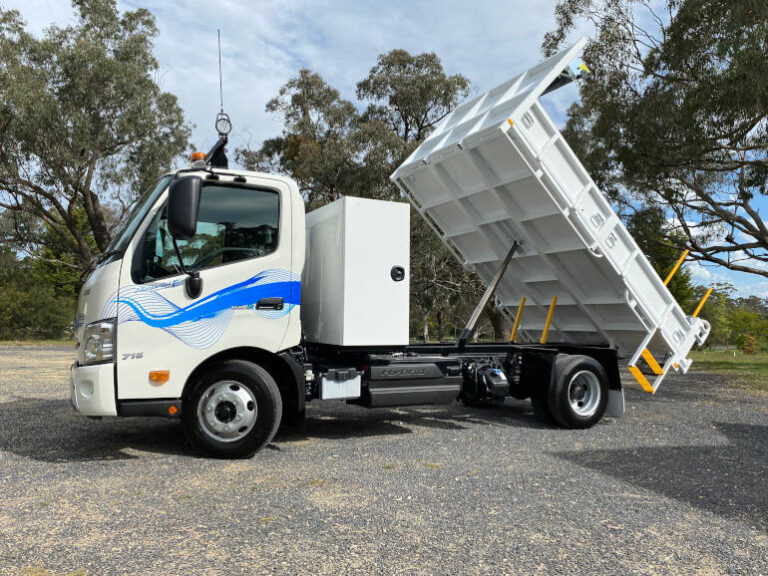
Hino Australia says customer adoption of its 300 Series Hybrid Electric has grown over recent years, although uneven demand and an extended production interruption have limited sales momentum.
Fresh Euro 6 hybrid stock is now arriving following the resumption of production in June 2026, giving dealers an opportunity to reconnect with customers who could not secure their preferred specification during the supply gap.
Speaking with Fleet News Group during the Hino 300 Series Euro 6 launch and drive, Hino Australia President and CEO Richard Emery said hybrid demand continued to fluctuate.
“We’ve also seen growth over the last years. But it has been in fits and starts,” said Emery.
Hino did not provide a separate hybrid sales total or its share of 300 Series deliveries at the briefing. The update instead highlighted a product gaining customers, but with adoption influenced by fuel prices, dealer engagement and vehicle availability.

Adoption varies across the dealer network
Emery said some Hino dealerships had been particularly successful selling the hybrid, while others had experienced less consistent demand.
“We’ve got some dealers that have been really successful with hybrid, and others that maybe [have been] not so successful,” he said.
“That seems to be to do with their geography and the sort of industries that they sell into.”
His comments suggest customer adoption is developing differently across locations and applications, rather than following a uniform national pattern.
Emery also acknowledged that selling the hybrid required sustained effort. Even when demand gathered pace, it could soften again without an obvious explanation.
For fleet managers, that makes an assessment against their own operating requirements more useful than relying on broader market momentum. The relevant question is how the hybrid fits the work, utilisation and replacement needs of the fleet.
Hybrid production also stopped
The hybrid was affected by the production interruption accompanying the 300 Series transition to Euro 6.
Asked whether the absence of fresh diesel production had created an opportunity to promote the hybrid more strongly, Emery explained that Hino could not build those trucks either.
The answer is important when interpreting sales performance. The hybrid was not continuously available as an alternative while diesel supply was interrupted. Both faced constraints, limiting Hino’s ability to convert customer interest into deliveries.
Stock remained, but the mix became uneven
Hino had built trucks ahead of the production pause to support its dealer network through the transition. However, stock did not sell evenly across the available specifications.
Brian Wright, General Manager – Sales & Supply Chain at Hino Australia, explained some car-licence models remained available longer, while heavier GVM variants sold through more quickly.
“The heavier GVM classes disappear very quickly,” he said.
That left an imbalance in the remaining stock and affected the company’s sales potential.
For customers, the distinction was between finding a hybrid in stock and finding one with the specification required for the job. Availability of one GVM variant could not necessarily satisfy demand for another.
The supply gap therefore affected more than overall vehicle numbers. It also constrained the range of customer requirements dealers could meet.
Fuel prices could renew interest
With fresh stock arriving, Hino is watching whether higher diesel prices translate into stronger hybrid demand.
Emery said fuel prices had influenced customer interest previously, although the relationship had not produced consistent sales growth.
He questioned whether the latest increase in diesel prices would generate another lift as availability improved.
For fleet buyers, fuel expenditure can prompt a fresh look at vehicle options. However, the purchasing case still needs to account for acquisition cost, expected fuel use, operating conditions and the planned ownership period.
A period of higher diesel prices may start the conversation, but a fleet-specific assessment provides a stronger basis for the decision.
Better supply creates a clearer opportunity
The return of production gives Hino a better opportunity to establish how much demand exists when dealers can offer a more suitable selection of hybrid trucks.
It also provides a clearer picture of adoption after a period in which sales were shaped by both customer sentiment and an inability to replenish particular models.
Hino’s experience shows that interest in the 300 Series Hybrid Electric is growing, but the path has been uneven. With production restored and fresh vehicles arriving, the next test is whether improved availability and sustained dealer engagement can turn that interest into more consistent fleet orders.