


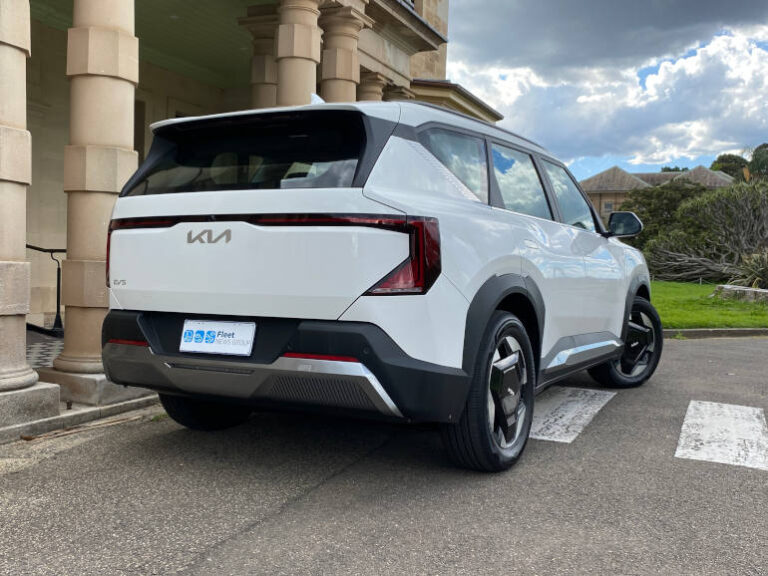
Australian fleet buyers have more EV brands and models to choose from than ever, and some newer entrants are competing aggressively on purchase price and standard equipment.
Kia Australia argues Fleet Managers need to look beyond the specification sheet and compare what a vehicle will cost — and how reliably it can be supported — across its entire fleet life.
Roland Rivero, General Manager, Product Planning & Training at Kia Australia at the time of the interview, told Fleet News Group that the rapid expansion of competition had made whole-of-life cost analysis increasingly important.

More competition changes the purchasing equation
Rivero acknowledged that some competitors are offering extensive equipment in their entry-level vehicles while maintaining aggressive purchase prices.
“The the competition has never been so so vast. The the market’s never been so fragmented,” he said.
For Fleet Managers comparing an entry-level Kia Air variant against those vehicles, Rivero said purchase price and equipment needed to be considered alongside costs that appear later in the ownership cycle.
“Sometimes that lower initial initial purchase price, you know, from the the cut price competition can be quickly eroded by poor residual values, and that’s that’s an important element that needs to be considered, obviously, by fleets from a whole of life perspective,” he said.
Price stability matters to residual values
Rapid price reductions and frequent specification changes have become a concern for some EV owners because of their potential impact on used vehicle values.
Rivero said Kia’s approach was to maintain greater product and pricing consistency.
“We we don’t like to chop and change. We like to keep things fairly steady, so that the vehicle, as you know it, you know, in 2026, fundamentally carries over into 2027, unless there’s a a facelift or a full model change,” he said.
Kia provides a seven-year unlimited-kilometre vehicle warranty along with an eight-year, 160,000-kilometre high-voltage battery warranty.
The remaining factory warranty is also transferable when the vehicle moves to its next owner.
For fleets forecasting residual values, those factors can become part of the disposal calculation rather than focusing solely on the original capital cost.
Maintenance costs need to be predictable
Rivero said maintenance schedules for Kia EVs were transparent, while fewer moving parts compared with an internal combustion vehicle could reduce servicing costs.
Kia also offers prepaid EV servicing. Rivero said the objective was to give fleet and leasing customers greater certainty about expenditure.
“That’s all about you know allowing the fleet and lease buyers giving that that full transparency so that they know the exact maintenance outgoings to the dollar before the vehicle has actually even left the showroom floor,” he said.
That predictability is particularly relevant for Fleet Managers preparing operating budgets across three, four or five-year replacement cycles.
Downtime can change the TCO calculation
Whole-of-life cost is not only determined by depreciation, energy and servicing. A fleet vehicle that cannot work because a replacement component is unavailable creates another cost that is harder to see on the original quotation.
Rivero said Kia’s related company Mobis had invested in Australian warehousing and inventory for frequently required components including windscreens, bumper covers, structural parts and sensors.
“And this is this is all about you know aiming to mitigate off road downtime,” he said. “For fleet operators, reps on the road, downtime is the enemy, and we at Kia Australia we recognise that.”
Kia also has 147 dealers nationally, providing fleets with access to servicing and EV-trained technicians across a wider geographical footprint.
Look at the complete fleet cost
Rivero’s argument is not that Kia will always offer the cheapest purchase price or the longest list of equipment. Instead, Kia wants fleet buyers to compare the complete operating equation.
“When a fleet manager does calculate that holistic, three to five year total cost of ownership, factoring in cap price servicing, availability of the Kia network in in regional or remote areas of Australia, the minimal downtime, and and the significantly higher resale value, I think that the air specifications in in totality, still remains a pretty smart and safe, and and very commercially viable choice for for an Australian business,” Rivero said.
For Procurement Managers and Fleet Managers, that is ultimately the comparison that matters. An EV that appears cheaper on day one is not necessarily the vehicle that will deliver the lowest cost per kilometre by the time it leaves the fleet.