

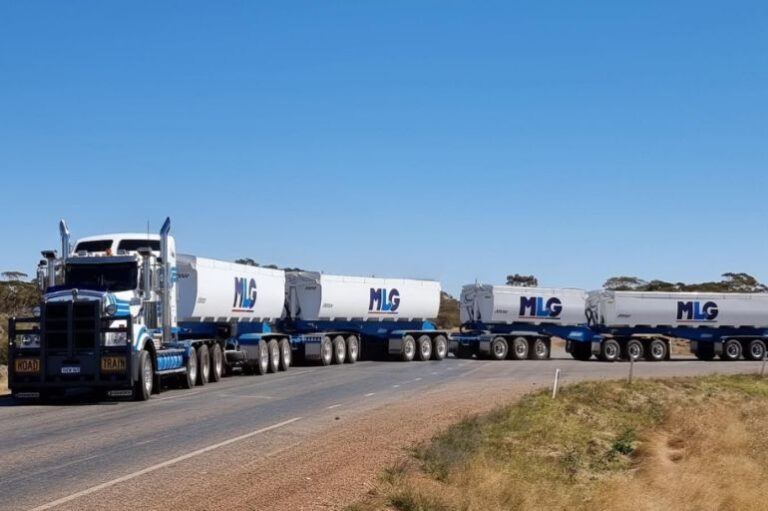
MLG Oz has entered a 50/50 joint venture with long-standing manufacturing partner Mick Murray Welding NT to develop and commercialise a hybrid and battery-electric power-trailer system for Australian mining operations.
The proprietary Hybrid Road Train, known as the HRT, is being designed to increase payload capacity while reducing fuel consumption and emissions per tonne hauled.
MLG said the technology could improve operating margins by allowing more material to be transported with each movement. Over time, the additional payload capacity could also reduce the number of vehicles needed to complete some haulage tasks.
The agreement has been executed through MLG’s wholly owned subsidiary, IMS Oz Ventures Pty Ltd.

Electric axles support the prime mover
The HRT combines a purpose-built power trailer with three heavy-duty electric drive axles and a 200kWh buffer battery.
The initial prototype will use onboard diesel generation to supply electrical power, avoiding the immediate need for fixed charging infrastructure at remote mine sites.
The development program is intended to progress from this diesel-electric configuration towards a fully battery-electric road train as battery technology and supporting infrastructure advance.
This phased approach could give mining operators an earlier opportunity to reduce fuel use and emissions without waiting for large-scale charging networks to be installed.
However, the payload, efficiency and emissions benefits remain development targets. The prototype has not yet completed operational testing under mine-site conditions.
Testing scheduled for 2026
Construction of the first prototype is well advanced, with in-house testing scheduled to begin during the third quarter of 2026.
MLG plans to deploy the system at one of its haulage operations in the Northern Territory following initial testing, subject to standard mine-site approval processes.
Each stage of the program will require approval against defined phase-gate criteria before further capital is committed.
MLG has invested approximately $1.2 million in the first phase, funded from existing cash reserves. Any additional investment will be considered by the joint venture board after the relevant development milestones have been met.
The joint venture will also assess government grant and co-funding opportunities that could support further development.
Mining partnership built over 15 years
Mick Murray Welding NT is an Australian-owned heavy trailer manufacturer with more than 35 years of experience producing transport and mining equipment.
The manufacturer has worked with MLG for approximately 15 years and supplies equipment used across the company’s Western Australian and Northern Territory operations.
Under the new arrangement, the intellectual property developed through the HRT program will be consolidated within the joint venture.
MLG will receive priority access to purchase and deploy the technology across its fleet on preferred commercial terms. It will also receive 50 per cent of the profit generated through third-party sales into the broader Australian resources sector.
Payload and emissions linked
MLG Chief Executive Officer Mark Hatfield said the joint venture was focused on two major pressures facing mining haulage operators.
“We are investing alongside one of Australia’s most respected trailer manufacturers to build proprietary technology that aims to materially improve payload and emissions performance, two key drivers of efficiency and value within our haulage operations,” Hatfield said.
Mining companies are increasingly seeking practical ways to reduce Scope 1 emissions generated directly through their operations.
While the HRT’s first stage will continue to use diesel generation, MLG believes the electrically driven trailer axles could reduce fuel consumption per tonne hauled and provide a staged pathway towards fully electric haulage.
“Our vision is that the Hybrid Road Train could offer a direct pathway to reducing their Scope 1 emissions from heavy haulage, supporting the decarbonisation commitments many have made to their own stakeholders,” Hatfield said.
“The technology also has the potential to reduce the number of assets required to perform haulage tasks on site, improving operational efficiency.”
The commercial case will ultimately depend on whether testing confirms the targeted payload, reliability, fuel-efficiency and emissions improvements under demanding remote operating conditions.
If the development milestones are achieved, the system could give MLG both an operational advantage within its own fleet and a separate revenue stream through sales to other mining operators.