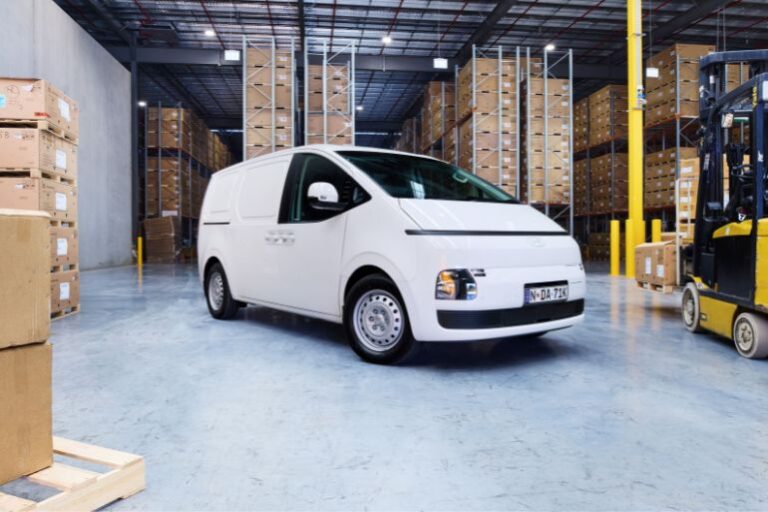
Hyundai has confirmed pricing and specifications for the 2027 STARIA Load Electric, and for Fleet Managers the numbers tell two quite different stories.
On specification, Hyundai has produced an electric van that sits remarkably close to its diesel and hybrid siblings where commercial operators care most: payload, cargo capacity and usable daily range.
On price, however, the transition to electric still requires a significant upfront investment.
The new STARIA Load Electric will be priced from $70,990 Manufacturer’s List Price, regardless of whether buyers choose Liftback or Twin Swing rear doors. That compares with $49,990 for the diesel STARIA Load and $53,490 for the Hybrid.
That makes the Electric $21,000 more than the diesel and $17,500 more than the Hybrid before delivery and on-road costs.
For fleets already convinced that an electric commercial vehicle can work operationally, the bigger question will therefore be whether lower energy and operating costs can justify the extra capital over the planned replacement cycle.
An electric van without the usual payload compromise
The more interesting part of the STARIA Load Electric story is what Hyundai has managed to retain.
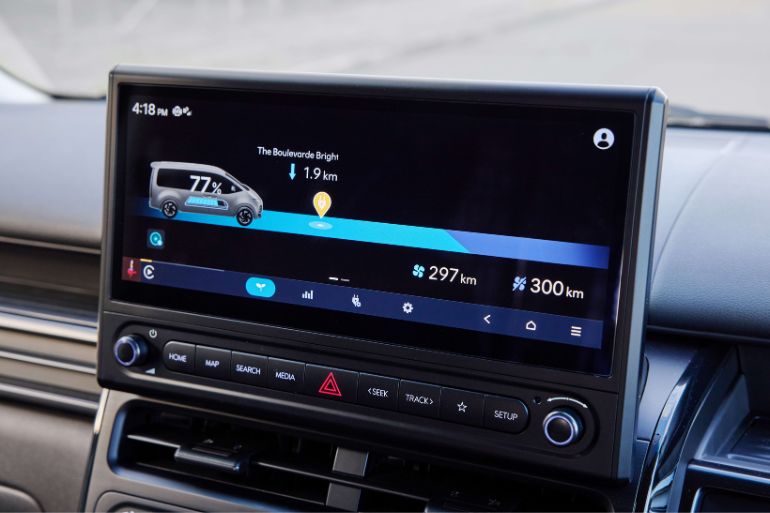
An 84kWh battery feeds a 160kW and 350Nm front-mounted electric motor, delivering up to 450km of WLTP driving range. Hyundai quotes combined electricity consumption of 20.7kWh/100km.
More importantly for a commercial vehicle, payload is 1,005kg.
That is actually 8kg more than the 997kg payload quoted for the diesel STARIA Load and only 34kg below the Hybrid’s 1,039kg.
Cargo volume is unchanged across all three powertrains at 4,935 litres, with the same internal cargo dimensions of 2,607mm long, 1,640mm wide and 1,436mm high.
Those numbers matter because one of the challenges Fleet Managers have faced when assessing electric vans has been determining what has been sacrificed to accommodate the battery.
With the STARIA Load Electric, there is very little penalty in the load area.
Hyundai Motor Company Australia Chief Operating Officer Gavin Donaldson said the company had focused on maintaining the commercial capability customers expected from the model.
“With up to 450 kilometres of range, ultra-fast 800-volt charging, a payload of more than a tonne and innovative features such as Vehicle-to-Load, 2027 STARIA Load Electric gives Australian businesses a highly capable all-electric workhorse.”
Towing capacity is also relatively strong for an electric van. Hyundai rates the Electric at 2,000kg braked and 750kg unbraked, compared with 2,500kg braked for the diesel. Hyundai’s specification table lists no towing capacity for the Hybrid.
800V charging could change how fleets use an electric van
Another specification that separates the STARIA Load Electric from many commercial EVs is its 800V electrical architecture.
Hyundai says the van can accept DC charging at up to 350kW, taking the battery from 10 to 80 per cent in around 20 minutes under suitable conditions.
For a depot-based fleet, overnight AC charging will still be the normal operating model. But fast DC charging gives operators another option when a vehicle needs to complete additional shifts, travels beyond its normal route or simply hasn’t spent enough time plugged in overnight.
That flexibility becomes increasingly important as electric commercial vehicles move beyond predictable metropolitan delivery applications.
Hyundai has also positioned the charging port centrally at the front of the vehicle, which should make accessing different charger layouts easier than locating the socket along one side of a van.
V2L gives the battery another job
The STARIA Load Electric also includes an interior Vehicle-to-Load outlet in the cargo area.
The system allows the traction battery to supply electricity through a conventional three-pin outlet, opening up opportunities for trades, maintenance crews, utilities and mobile service fleets to power tools and equipment directly from the vehicle.
There is also a battery heating system and heat pump, while a 23.9-litre front storage compartment provides some additional space outside the main cargo area.
The Electric receives a 12.3-inch instrument display and 12.3-inch multimedia screen, satellite navigation, Shift-by-Wire drive selection and Lane Following Assist 2.
Hyundai’s Bluelink connected services and over-the-air software updates are also included.
The price is where the fleet calculation starts
At $70,990, Hyundai is not pretending that battery technology comes without a cost.
The STARIA Load Electric carries a substantial premium over the conventional models:
- STARIA Load diesel: $49,990
- STARIA Load Hybrid: $53,490
- STARIA Load Hybrid Premium: $61,240
- STARIA Load Electric: $70,990
All are Manufacturer’s List Prices and exclude delivery and on-road costs.
For Fleet Managers, that means the business case can’t stop at comparing purchase prices.
The Electric needs to be modelled against electricity versus fuel costs, kilometres travelled each year, charging arrangements, scheduled maintenance, utilisation and the expected replacement period. Residual value will also become increasingly important as electric commercial vehicles enter the used-vehicle market in larger numbers.
Hyundai lists electric servicing at 30,000km/24 months and 60,000km/48 months, priced at $645 and $667 respectively, which at least gives fleets some visibility over scheduled maintenance costs.
The specification hurdle is getting smaller
The significance of the STARIA Load Electric isn’t simply that Hyundai now sells another electric van.
It is that the specification is becoming much easier to compare directly with an internal-combustion commercial vehicle.
A 450km WLTP range will cover the daily task of many metropolitan fleets. A one-tonne payload means operators aren’t giving away much carrying capacity. The cargo area remains unchanged. There is meaningful towing capability. And 800V charging provides a rapid recovery option when vehicles need to get back to work.
For many fleets, those numbers remove several of the operational objections that previously made electric vans difficult to consider.
The $70,990 price tag is the reminder that removing the specification compromises doesn’t remove the financial challenge.
That leaves Fleet Managers with a more conventional fleet-management exercise: identify which vehicles have the utilisation profile to take advantage of electric running costs, calculate whole-of-life cost rather than acquisition price, and deploy the technology where the numbers work.