

MG Motor Australia says the rapid growth in electric vehicle sales doesn’t mean every Australian buyer — or every fleet — is ready to make the same transition at the same time.
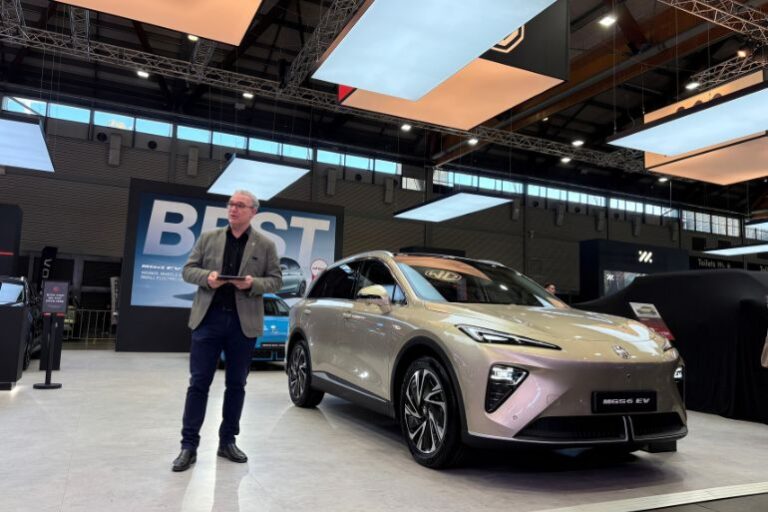
Speaking at Everything Electric in Sydney, MG Motor Australia Marketing Director Dimitri Andreatidis outlined a multi-powertrain strategy that will see the company continue offering petrol, hybrid, plug-in hybrid and battery electric vehicles.
The approach reflects a market where electrification is accelerating, but vehicle application, charging access and budget will continue to influence which technology suits each buyer.

EVs move beyond the niche
Andreatidis pointed to August sales as an indication of how quickly the Australian market is changing.
“In August, battery electric vehicles outsold both petrol and diesel vehicles in Australia for the very first time,” Andreatidis said. “More than 27,000 battery electric vehicles were sold in a month, representing almost 25% of the new vehicle market.”
For MG, the significance isn’t simply the sales volume. Andreatidis believes it demonstrates that EVs are increasingly being considered alongside established powertrains.
“Electric vehicles are no longer a niche part of the market. Australians are considering them as a real option,” he said.
MG is seeing that shift within its own business, with Andreatidis reporting the company’s electric vehicle sales increased by almost 42% from July to August. He also cited Google Trends data showing searches for the MG4 EV had increased 90% year-on-year.
Not everyone is ready for a BEV
Despite the growth, MG isn’t treating battery electric as the only pathway.
“Some customers are ready to make the move to a battery electric vehicle today. Others may be looking at a hybrid or plug-in hybrid, and for some, petrol is still the right choice,” Andreatidis said. “That is why MG is taking a multi-powertrain approach.”
It’s an argument that also applies to fleets, where the suitability of a powertrain can change significantly depending on duty cycle, kilometres travelled, vehicle utilisation and access to workplace or home charging.
Andreatidis said those differences are central to MG’s strategy.
“The right choice depends on how people drive, where they live, access to charging, and what they have to spend,” he said. “Our role is to give Australians that choice.”
An expanding electrified range
MG’s stand at Everything Electric demonstrated how that strategy is developing.
The MG4 EV remains part of the company’s electric offering, while the MGS5 EV has recently been refreshed and the MGS6 EV expands MG’s presence in the electric SUV market.
The HS Super Hybrid provides another electrified pathway for buyers who aren’t ready or able to operate a battery electric vehicle.
MG is also using the Cyberster to demonstrate what electrification can deliver at the performance end of the market.
More than adding models
Andreatidis said the company’s Australian plans aren’t simply based on introducing more nameplates.
“The next chapter for MG is not simply about adding more models; it’s about giving Australians more choice across vehicle types, price and powertrain, while continuing to build our capability in electrification,” he said.
MG is part of SAIC Motor, which Andreatidis said gives the Australian operation access to the technology, engineering and manufacturing capability required to expand its electric offering.
“This gives us access to technology, engineering and production capability at a scale that allows us to bring new electric vehicles to Australia quickly and at a competitive price point,” he said.
For Fleet Managers, the expanding choice creates another consideration when developing replacement strategies.
Rather than treating electrification as a single technology decision across an entire fleet, the growing availability of BEVs, PHEVs and hybrids allows organisations to assess individual applications and determine which powertrain works for each task.