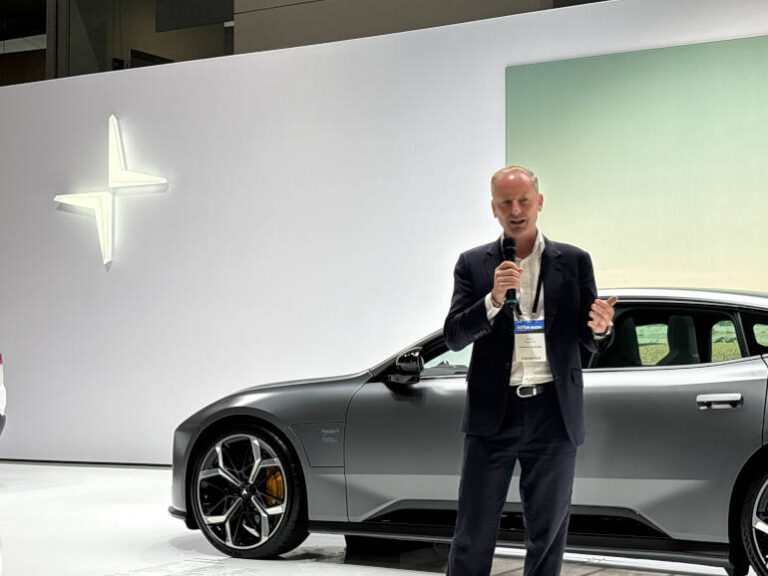
Polestar used the Melbourne Motor Show to reinforce its position in Australia’s growing electric vehicle market, with Managing Director Scott Maynard linking rising demand for EVs to fuel security concerns, household cost pressures, and a strengthening product pipeline.
Speaking to media and industry stakeholders, Maynard said external events and rising fuel prices have sharpened the conversation around energy independence and operating costs—factors that are increasingly influencing vehicle purchasing decisions across both private and fleet markets.
“We’re riding a surge in demand at the moment, as many electric brands in Australia are, so the tragedy of overseas conflict has really thrown a light on Australia’s fuel security situation,” Maynard said.
He added that awareness of fuel supply risks is changing behaviour, with more Australians considering electric vehicles as a practical alternative rather than a niche technology.
“The days of supply are now etched in the minds of many Australians, and that’s really pushing more and more people to now consider quite seriously the benefits of electric vehicles,” he said.

Cost of ownership emerging as a key driver
A consistent theme in Maynard’s comments was the economic case for EVs, particularly as fuel prices remain volatile. For fleet buyers and Procurement Managers focused on Whole-of-Life Cost (WOLC), this message aligns with the broader shift toward operating efficiency and emissions reporting requirements.
Maynard referenced research commissioned by Polestar that highlights ongoing operating savings for households transitioning to electric vehicles.
“We released a study that was commissioned by Polestar and Centre Media during this week that confirms that there’s a saving on the table of at least $100 a month for Australian families, and that was calculated before the current lift in fuel prices,” he said.
He argued that the economic case is now well established, particularly when combined with environmental and health considerations.
“So electric vehicles are now quite firmly proven to be easy to own, cheaper to run, cheaper to live with, along with the health benefits, and particularly in Polestar’s instance, the benefits to climate, sustainability and environment,” Maynard said.
For fleet decision-makers, this reinforces a familiar pattern: the transition to electrification is increasingly being driven by operating cost and risk management rather than policy alone.
Strong start to 2026 for Polestar in Australia
Maynard also pointed to positive sales momentum for the brand, noting that global results released during the same week showed strong performance in the Australian market.
“Polestar released its global results this week and showed record demand and record lifting sales for quarter one of the year in Australia,” he said.
While premium EV brands typically operate in segments outside traditional fleet procurement, their growth signals broader market confidence in electric technology. This can influence resale values, infrastructure investment, and product availability across the wider vehicle ecosystem.
Polestar 5 positioned as a technology flagship
The centrepiece of Polestar’s display at the Motor Show was the new Polestar 5, a high-performance electric grand touring vehicle designed to showcase the brand’s engineering capability and future direction.
Maynard described the vehicle as both a performance statement and a symbol of the brand’s expanding model range.
“This is a true supercar, a four door Grand Touring vehicle. It boasts Polestar’s furthest range so WLTP rating in excess of 680 kilometres,” he said.
He emphasised that the vehicle complements the broader portfolio now available to Australian customers.
“So on stand now we have Polestar’s three latest releases, the three, the Polestar four, and now this Polestar five,” Maynard said.
For fleet professionals, vehicles like the Polestar 5 are less about direct procurement and more about signalling technology direction. Advances in battery performance, charging capability, and software platforms introduced in premium models often flow into mainstream fleet vehicles over time.
Product pipeline signals continued investment
Looking ahead, Polestar confirmed further product development activity for the Australian market, including updates to existing models and new technology introductions.
While the company continues to operate primarily in the premium segment, its expanding portfolio reflects a broader industry trend toward electrification across multiple vehicle classes.
For Fleet Managers and Fleet Coordinators, the key takeaway is not necessarily the individual model launch, but the pace of product development. More vehicle options typically lead to improved competition, stronger resale value data, and greater confidence in long-term fleet planning.
What it means for fleets
Maynard’s comments highlight three practical signals for fleet buyers:
- Energy security and fuel price volatility are becoming operational risks, not just economic variables
- Operating cost savings remain the most persuasive argument for electrification
- Product availability and technology development are accelerating across the EV market
These factors are increasingly shaping procurement strategies in 2026, particularly as organisations balance cost control, emissions reduction, and vehicle availability under the New Vehicle Efficiency Standard (NVES).
The Melbourne Motor Show provided a platform for Polestar to reinforce those themes—linking global technology development with local market conditions that are becoming more relevant to fleet operations every month.