

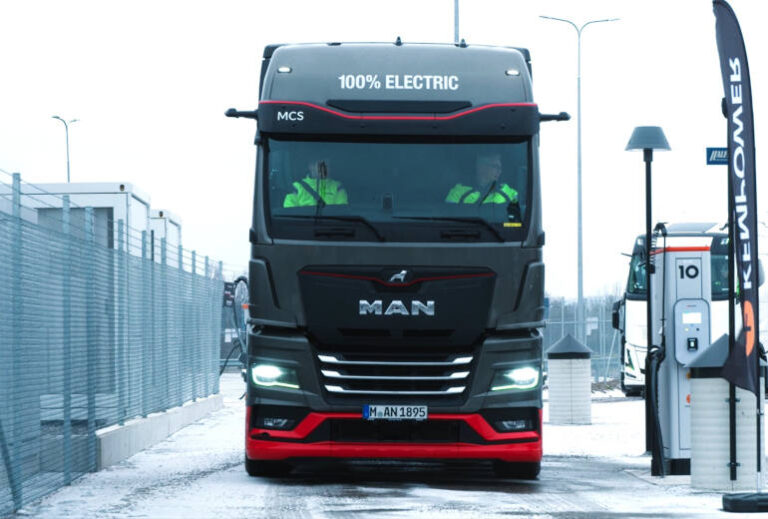
MAN Truck & Bus has successfully demonstrated megawatt-level charging for its electric trucks during a winter test in Sweden, highlighting how the next generation of heavy-vehicle charging infrastructure could significantly reduce downtime for fleets.
The demonstration took place at the Kempower MCS Live Winter Days 2026 in Norrköping, where a MAN eTGX electric truck charged at around 750 kW using the Megawatt Charging System (MCS) under sub-zero conditions. The test showed the vehicle could charge from 10% to 90% in approximately 30 minutes, a milestone for long-distance electric freight operations.
For heavy transport fleets, charging speed is critical to maintaining utilisation rates and driver schedules. Megawatt charging is designed to address this challenge by delivering significantly higher charging power than today’s DC fast chargers.
Designed for long-distance freight
The demonstration focused on interoperability between the truck and charging infrastructure, which is essential for the industrial rollout of megawatt charging across Europe and other global markets.
MAN is working with multiple charging-station manufacturers to ensure its electric trucks can operate reliably across different charging networks. Testing in winter conditions was deliberate, as cold weather presents additional technical challenges for batteries, power electronics and charging hardware.
Sven Steckhan, Program Lead Charging at MAN Truck & Bus, said the trials confirmed the robustness of the technology.
“The MAN eTruck has proven the stability of the MCS charging process during the live demonstrations in Sweden, including controlled charging performance and secure communication between vehicle and charger,” said Steckhan.
“All our tests confirm the robustness of hardware and software integration and underline the maturity of MCS technology for future series production.”
MCS option available from 2026
MAN confirmed that its new electric truck models — the MAN eTGX and MAN eTGS — can already be ordered with the Megawatt Charging System option. Production of trucks equipped with the MCS interface is expected to begin in the second quarter of 2026.
The availability of MCS is seen as a key step in enabling battery-electric trucks to compete with diesel in long-haul freight operations. Faster charging reduces vehicle downtime and improves fleet productivity, making electric trucks more viable for transport operators running tight delivery schedules.
Implications for fleet operators
For organisations planning the transition to zero-emission heavy vehicles, megawatt charging could play an important role in operational planning.
High-power charging allows electric trucks to replenish large battery packs during driver rest breaks, helping fleets maintain vehicle availability while complying with work-time regulations. It also reduces the number of chargers required at depots and public charging sites because vehicles spend less time connected to infrastructure.
Events such as the Kempower MCS Live Winter Days bring together truck manufacturers, charging providers and industry stakeholders to test these systems in real-world conditions. According to MAN, the results demonstrate how megawatt charging can expand the operational possibilities of electric trucks while improving charging efficiency and fleet economics.
As production of MCS-equipped trucks begins in 2026, the technology is expected to become a key enabler of the electrification of long-distance freight transport.
- Origin partners with EVDealer Group to accelerate fleet transition
 Origin and EVDealer Group have partnered to give Australian businesses a single, end-to-end path to electric vehicles (EVs) – from planning and charging through to vehicle delivery and driver handover – so fleet managers no longer have to coordinate it all themselves. Origin’s Group Manager Sales, E-mobility, David Helmy, said, “Businesses tell us the hardest
 - Volkswagen ID. Buzz Cargo wins 2026 Fleet EV of the YearThe Volkswagen ID. Buzz Cargo has been named the 2026 Fleet EV of the Year in the Fleet News Group Awards, finishing ahead of two very different electric fleet propositions after assessment by fleet industry judges using Best Value Analysis. The Volkswagen ID. Buzz Cargo BEV 550 competed against the Toyota HiLux SR BEV 4×4 Double Cab Pickup and Kia EV5 Air
- Kia PV5 wins 2026 Fleet LCV of the YearThe Kia PV5 Cargo has been named the 2026 Fleet LCV of the Year in the Fleet News Group Awards, giving Kia an important win as electric commercial vehicles move further into mainstream fleet consideration. The Kia PV5 Cargo S 4D LR finished ahead of the Hyundai STARIA Load Hybrid and Isuzu D-MAX SX 2WD Single Cab, giving judges three very different
- Toyota Camry wins 2026 Fleet Car of the YearThe Toyota Camry Ascent Sport has been named the 2026 Fleet Car of the Year in the Fleet News Group Awards, reinforcing the continuing role hybrid vehicles can play in helping fleets reduce fuel use and emissions. The Camry finished ahead of the MG ZS Vibe CVT and Subaru Forester Hybrid AWD after assessment by fleet industry judges and Fleet News
- Can an electric van really be better to drive all day? Kia thinks soFor Fleet Managers considering electric vans, range, payload and charging usually dominate the discussion. But there is another factor that can have just as much influence on whether a new vehicle succeeds in a fleet: what drivers think of it after spending an entire working day behind the wheel. That was one of Kia’s priorities