


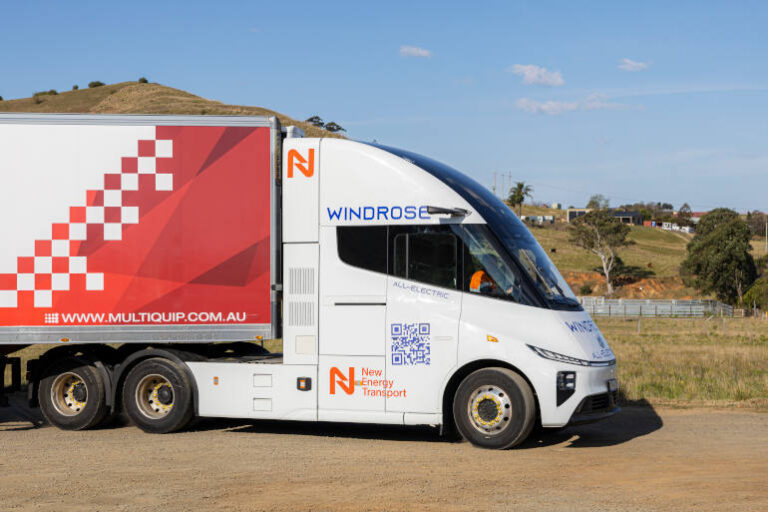
Electric trucks are shifting from small-scale pilots to more meaningful, real-world deployment, as fleets begin to test the technology under operational pressure rather than controlled conditions.
Speaking at the Smart Energy Council Conference and Exhibition in Sydney, Alex Grant, Director at ARENA, said the industry is moving beyond early experimentation into a phase where projects are designed to deliver practical insights for broader rollout.
“Over the last couple of years, we’ve funded trials with larger groups where it’s meaningful enough to hurt if it doesn’t go well,” Grant said.
“That Goldilocks zone of being big enough to get meaningful insights, small enough so you can take what you learn and pivot when you start to electrify the rest of your fleet.”
This approach reflects a more mature stage of fleet electrification, where organisations are no longer just proving the concept but actively testing how electric trucks perform across different duty cycles, routes and operational constraints.

From pilots to practical insights
A key feature of these projects is the requirement to share outcomes with industry — including what doesn’t work.
“It’s a warts and all report, and this is not a marketing document,” Grant said. “It’s we tried this and it failed because of that. You don’t have to make those same mistakes as well.”
For Fleet Managers, this growing body of real-world data is critical. It reduces the risk of early adoption by providing evidence on vehicle performance, charging requirements, maintenance impacts and operational fit.
It also supports a more structured approach to improving fleet management maturity, where decisions are based on data rather than assumptions.
Early adopters are taking on real risk
Grant highlighted that the organisations leading these projects are not just testing technology — they are committing capital and accepting both operational and financial risk.
“These are the people that are leaning in. They’re taking operational risk, they’re taking financial risk,” he said.
In many cases, these projects involve partnerships across the value chain, including vehicle suppliers, energy providers, charging infrastructure specialists and financing partners.
This collaborative model is becoming essential, particularly in the freight sector where margins are tight and internal capability is often limited.
Focus shifts to heavy vehicles and complex use cases
While early EV adoption has been concentrated in passenger vehicles and light commercial fleets, the next phase is clearly focused on heavier vehicles and more complex operations.
“ARENA loves electric trucks. We want to do more in this space, and we’ve got to double down on that,” Grant said.
The priority is not just increasing volume, but pushing the boundaries of what is technically and operationally possible.
“We want to see groups who are testing the furthest duty cycles or the heaviest duty cycles… anyone looking at line haul or any of these beyond-the-envelope challenges, we want to hear from you,” he said.
For fleet operators, this signals a shift from “if” electric trucks can work, to “where” and “how” they can be deployed effectively.
Building scalable models for broader adoption
A critical challenge now is ensuring that the lessons from large organisations can be applied across the broader market — particularly for small and medium-sized fleets.
“If you have a scalable model that can access small, rigid articulated trucks, if you can make it easy for others who don’t have to do the brain damage on how to figure out all this stuff, we think we’ve got a role to play,” Grant said.
This highlights an important gap in the market. While large fleets may have the resources to trial and optimise EV deployments, most operators need simpler, repeatable solutions that reduce complexity and risk.
For organisations with lower fleet management maturity, scalable models — including packaged vehicle, charging and financing solutions — will be essential to accelerate adoption.
Industry moving towards execution
The shift from trials to scaled deployment marks an important milestone in the electrification journey. The technology is no longer the primary barrier — the focus is now on execution, integration and commercial viability.
For Fleet Managers, the implications are clear. The window to observe from the sidelines is closing, as more organisations generate real-world data and build operational capability.
The next step is not to run a pilot for the sake of it, but to design trials that deliver actionable insights and support a structured transition plan.
Electric trucks are no longer just a future consideration — they are becoming part of today’s fleet decisions.