


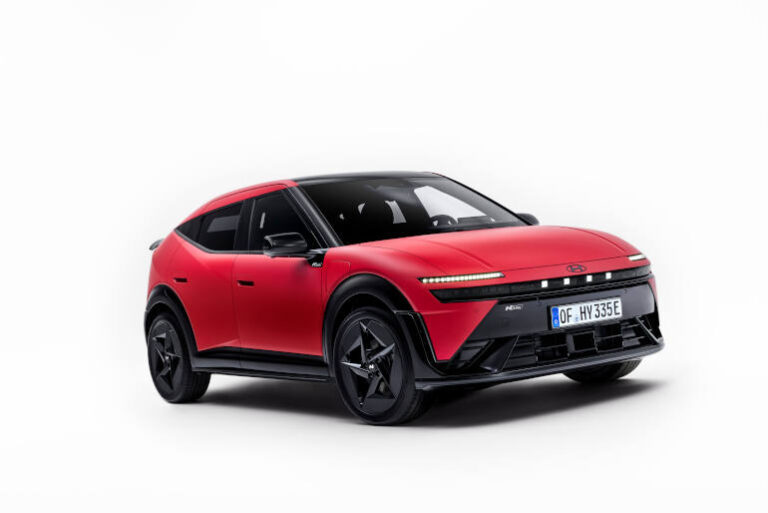
Hyundai has unveiled the new Hyundai IONIQ 3, a fully electric small car designed to make EV ownership simpler, more practical and more accessible for everyday drivers and fleet buyers.
Positioned as the newest member of Hyundai’s growing IONIQ range, the compact hatch introduces a new “Aero Hatch” design focused on efficiency, interior space and usability. While initially targeted at the European market, Hyundai has confirmed the IONIQ 3 will arrive in Australia in early 2027, with local specifications and pricing to be announced closer to launch.
For fleet managers and novated lease buyers, this model signals Hyundai’s continued push to fill gaps in the small-car EV segment — an area where affordability, practicality and whole-of-life cost will ultimately determine adoption.
A compact EV designed around everyday practicality
Hyundai says the IONIQ 3 has been developed to balance aerodynamic efficiency with interior space — two factors that directly influence range, driver comfort and operating costs.
The new “Aero Hatch” shape features a low front profile and a straight roofline that extends over rear passengers before tapering into the rear spoiler. This design helps maximise cabin room while maintaining efficiency, with a targeted drag coefficient of 0.263.
Inside, the vehicle uses a flat-floor layout typical of modern EV platforms, delivering five-seat capacity and a luggage space of 441 litres, including an under-floor storage area known as the “Megabox.”
That combination of interior flexibility and compact external dimensions is likely to appeal to fleets running urban pool vehicles, local government passenger transport, or organisations looking to transition from small petrol hatchbacks.
Range and charging aimed at real-world use
The IONIQ 3 will be offered with two battery options, allowing buyers to match range capability with operational needs.
Key performance figures include:
- Standard Range: 344 km (WLTP)
- Long Range: 496 km (WLTP)
- DC fast charging: 10–80% in approximately 29 minutes
- AC charging: Up to 22 kW capability
- Drive system: Front-wheel drive
- Maximum torque: 250 Nm
These specifications place the vehicle firmly in the practical daily-use category rather than long-distance touring — a positioning that aligns well with typical fleet duty cycles such as commuting, inspections and service calls.
The vehicle is built on Hyundai Motor Group’s Electric-Global Modular Platform (E-GMP) with a 400-volt architecture designed to deliver efficient performance and straightforward charging capability.
Technology focused on usability rather than complexity
One of the more notable features is the debut of Hyundai’s new Pleos Connect infotainment system, based on Android Automotive OS. The system includes large display options and integrated EV tools such as route planning and Plug & Charge capability.
Other technology features include:
- Digital Key smartphone access
- Vehicle-to-Load (V2L) power capability
- Remote Smart Parking Assist
- Highway Driving Assist 2
- Blind-Spot View Monitor
These features are increasingly becoming baseline expectations for fleet safety policies and driver-assistance programs, particularly as organisations adopt more advanced telematics and risk management frameworks.
Safety and comfort designed for daily fleet use
Hyundai has equipped the IONIQ 3 with its SmartSense safety suite and seven airbags as standard, supporting the broader shift toward higher safety benchmarks across fleet procurement policies.
Comfort features such as heated and ventilated seating, dual-zone climate control and a premium sound system reflect the growing importance of driver satisfaction — particularly in novated lease and employee-choice programs where retention and productivity are influenced by vehicle quality.
What it means for fleets and novated leasing
From a fleet strategy perspective, the IONIQ 3 sits in an emerging category: compact EVs designed to replace traditional small petrol cars rather than SUVs.
That matters because many organisations are now reassessing vehicle size, utilisation and emissions reporting requirements. Smaller vehicles typically deliver:
- Lower acquisition costs
- Reduced energy consumption
- Easier parking and urban operation
- Lower total cost of ownership in city-based fleets
For novated lease buyers, the model is likely to be positioned as an entry-level EV option once pricing is confirmed — particularly relevant while the Electric Car Discount remains a key driver of EV affordability.
The bigger picture
The launch of the IONIQ 3 reinforces a broader trend across the industry: manufacturers are moving beyond premium EVs and focusing on practical, everyday vehicles that can scale across fleet operations.
For Fleet Managers planning replacement cycles into 2027 and beyond, the IONIQ 3 is another signal that the small-car segment is about to become far more competitive — and that competition typically drives better pricing, improved range and stronger whole-of-life value.
In short, this is not just another EV launch.
It’s part of the gradual shift toward mainstream electrification in the vehicles fleets rely on every day.