

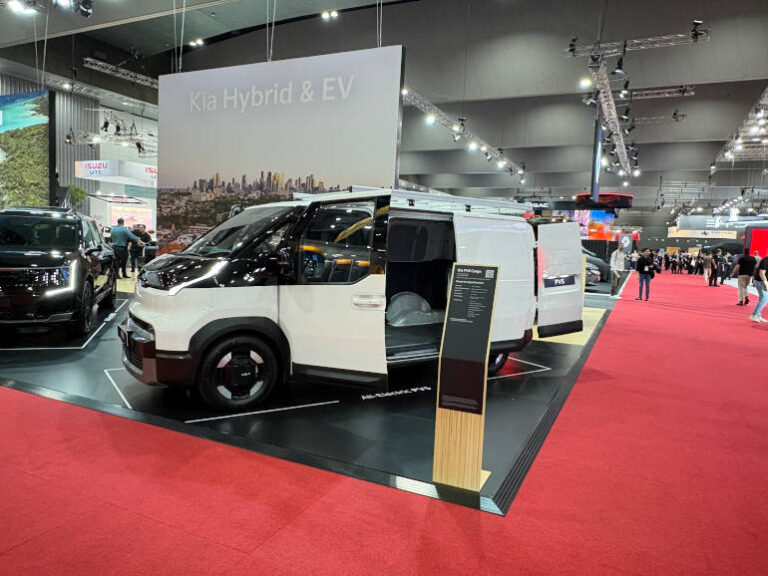
Kia used the Melbourne Motor Show in April to formally introduce the new PV5 electric van to the Australian market, positioning the model as a practical and competitively priced option for fleet buyers looking to transition to lower-emission transport.
The PV5 Cargo arrives with a recommended retail price of $55,990 plus on-road costs and is scheduled to reach dealerships from late May. The model is built on Kia’s dedicated electric commercial vehicle platform and offers a WLTP driving range of 416 kilometres from a 71.2 kWh battery.
But beyond the headline specifications, Kia executives were clear that the real focus is on creating a new opportunity in a segment that has traditionally been dominated by larger diesel vans.

A New Segment, Not Just Another Van
Speaking to Fleet News Group, Dean Norbiato, General Manager – Marketing at Kia Australia, said the early response to the PV5 has been encouraging, particularly from fleet buyers assessing new operational models.
“The retail pricing at $55,990, plus on roads. It’s been exceptionally well received in terms of its competitiveness in market.”
Dean Norbiato, General Manager – Marketing at Kia Australia
He noted that while early interest has been strong, the long-term success of the vehicle will depend on how it performs in real-world applications.
“The proof will be in the pudding when we get people driving it, showcasing its utility, especially for fleet buyers, which is where it’s really positioned this vehicle.”
This emphasis on fleet suitability reflects a broader shift in the market, where operational requirements such as utilisation, payload, and running costs are becoming more important than traditional brand loyalty.
Designed for Urban Delivery and Mobile Work
The PV5 is positioned as a compact commercial vehicle with enough capability to support common fleet applications such as parcel delivery, trade services, and mobile businesses.
According to Kia, the van offers approximately 660 kilograms of payload capacity and 4,400 litres of cargo space, providing flexibility for a range of operational tasks.
This capability allows the vehicle to power tools or equipment directly from the battery, which could be relevant for trades and field service teams.
“If you’re a mobile office, a mobile hairdresser, it’s going to have a utility,” Norbiato added.
Challenging Established Buying Habits
One of the key questions facing the PV5 is whether Australian fleets are ready to adopt a smaller van format, particularly in a market where a single size and configuration has traditionally dominated purchasing decisions.
Norbiato believes the shift towards electrification could create an opportunity to rethink vehicle selection.
“I think this is a sleeping giant category for us, the electric van. We’ve got phenomenal product at what we feel is a really competitive price, and we’re keen to work with fleets on the utility and different type of use case that this van can provide,” he said.
For Fleet Managers, this reflects a familiar challenge: balancing operational requirements with the need to reduce emissions and manage whole-of-life costs.
As many organisations revisit vehicle specifications under new emissions and reporting requirements, the traditional default choice is being questioned more frequently.
Fleet Adoption Will Take Time
Despite the positive early interest, Kia acknowledges that fleet sales cycles are typically long and influenced by existing contracts, asset replacement schedules, and internal approval processes.
Norbiato said the company is prepared to take a patient approach to building market share in the fleet sector.
“In the fleet business, you have existing relationships and contracts, which means that until they come up, we can’t get into those conversations. We always knew with fleet, it was going to be a long game, and we’re prepared to go the distance with that product and the fleet in particular.”
This perspective aligns with the reality that fleet transitions—particularly to electric vehicles—are rarely immediate and often depend on infrastructure readiness, utilisation patterns, and total cost modelling.
The Bigger Picture for Fleet Buyers
The launch of the PV5 is part of Kia’s broader strategy to offer fleets multiple powertrain options within a single supplier relationship, including internal combustion, hybrid, and fully electric vehicles.
This flexibility can simplify procurement and support gradual transitions rather than large-scale, one-off changes.
For Fleet Managers evaluating the PV5, the key considerations will likely include:
- Fit-for-purpose capability for urban operations
- Charging infrastructure availability
- Whole-of-life cost compared to diesel alternatives
- Driver acceptance and operational reliability
The arrival of the PV5 does not replace existing van choices overnight. However, it does add another credible option to the decision set—particularly for organisations exploring new ways to reduce emissions without compromising service delivery.
As Norbiato summarised, the opportunity lies in matching the vehicle to the right application.
“We’re keen to work with fleets on the utility and different type of use case that this van can provide, not only delivery, but mobile office in particular as well.”
- Parramatta found a simple way to tackle EV resistance
 Range anxiety isn’t always solved with another spreadsheet. Sometimes you need to hand someone the keys. That’s one of the lessons from City of Parramatta’s fleet electrification program, where an EV drive week has become an important tool for building employee support for the transition. Speaking at Everything Electric Sydney during a panel featuring finalists
 - Ausgrid’s charging strategy goes well beyond the depotInstalling chargers at the depot might be the obvious starting point for fleet electrification. For Ausgrid, it wasn’t going to be enough. As the electricity network continues electrifying passenger vehicles, vans and trucks, it has developed a charging strategy designed around how employees actually use fleet vehicles. Speaking during the Fleet News Group Awards finalists
- For Allianz, EVs are now business as usualFor many organisations, fleet electrification still means pilots, trials and discussions about what might happen next. At Allianz, the conversation has moved on. After starting its transition with a small pilot of 12 vehicles two years ago, the insurer has reached the point where electric vehicles are becoming part of its normal fleet replacement process.
- A Charger That Powers Up Isn’t Finished: Why Commissioning Matters for Fleet EV ChargingAn EV charger can be installed, connected and apparently operating — and the charging system can still be wrong. That is one of the more important lessons from the Local Council EV Integration Project involving Wyndham, Brimbank and Moonee Valley councils. As fleet charging installations become larger, depots are adding not only chargers but load
- How to Install EV Charging Without Shutting Down the DepotBuying electric vehicles may be the visible part of fleet electrification, but much of the hard work can happen underground. Trenching, conduits, electrical upgrades, switchboards, charger foundations, communications, traffic management and electrical shutdowns all need to be completed while the depot continues doing its normal job. Experience from the Local Council EV Integration Project involving