


The economics of long-haul road transport are being challenged by a new set of numbers that are difficult for fleet operators to ignore.
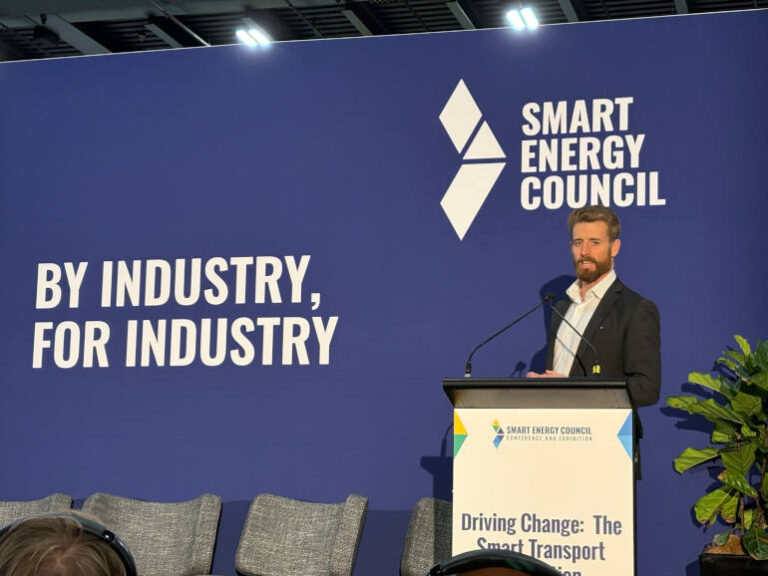
Speaking at the Smart Energy Conference in Sydney, Daniel Bleakley, Co-founder and Co-CEO at New Energy Transport, outlined early operational results that show electric prime movers are already outperforming diesel across cost, productivity and energy efficiency.
“Running on low cost renewable energy, that Sydney to Canberra trip would have cost around $50 in electricity costs,” Bleakley said. “The equivalent diesel trip on current diesel prices would have cost over $300… that was a saving of around 84%.”
Even under pre-crisis fuel pricing, the savings were still significant, sitting closer to 70%. But cost is only part of the story.
Bleakley highlighted a less expected benefit: time.
“We also saved around 25 minutes of time on that trip… electric prime movers are able to hold the speed limits going uphill, unlike diesel trucks which slow down.”
For operators running high-frequency freight corridors like the Hume Highway, these gains translate directly into improved asset utilisation and delivery performance.
Where the real opportunity sits
While electric vehicles have dominated headlines in metro delivery, Bleakley made it clear that the strongest business case sits in long-haul freight.
“In heavy road freight operations… diesel makes up 30–35%, even up to 40% of the cost stack,” he explained. “That’s really where the major competitive advantage of electric trucks is at its highest.”
This is a critical distinction for Fleet Managers. In last-mile delivery, labour dominates cost. On the highway, energy dominates.
New Energy Transport is deliberately targeting that segment.
“We’re not interested in running around the city. We want to get out onto the freeway… because that’s where the big efficiency gains come from.”
A small part of the fleet doing most of the work
Bleakley also pointed to a structural imbalance in the freight task that reinforces the opportunity.
“Articulated trucks make up just 3% of all commercial vehicles, but they account for 79% of the ton kilometres.”
That statistic is central to the strategy. Heavy vehicles may be a small part of the fleet, but they carry most of the load—and consume a disproportionate share of fuel.
“They’re using around half of all the diesel imported into Australia,” Bleakley said.
For fleet operators, this reframes electrification. The biggest gains don’t come from replacing light vehicles—they come from targeting high-utilisation heavy assets.
Productivity and driver benefits
Beyond cost and emissions, driver experience is emerging as a secondary advantage. Bleakley shared feedback from early trials, including a 480km run where drivers reported noticeable improvements.
“They become evangelists after driving these trucks… you can see it in their eyes,” he said.
One driver reported being pulled into a weighbridge simply for maintaining consistent highway speeds—something unusual for diesel trucks on steep grades.
There are also health implications.
“He suffers from industrial deafness… sitting on top of a loud diesel engine for 12 hours a day has damaged his hearing,” Bleakley said. “He was extremely excited about the prospect that future truck drivers won’t be exposed to that level of noise.”
Reduced fatigue and quieter cabins may become important factors in driver attraction and retention—an ongoing challenge for the industry.
Australia’s unique position
Bleakley argued that Australia is particularly well suited to lead heavy vehicle electrification.
“We’re the second most road freight dependent country in the world… but we also import around 90% of our diesel.”
At the same time, Australia operates some of the heaviest trucks globally, up to 85 tonnes on key corridors—conditions that favour electric drivetrains.
“The economics of electric trucking get better with heavier and longer operations,” he said.
Combined with access to low-cost renewable energy, the case becomes compelling.