


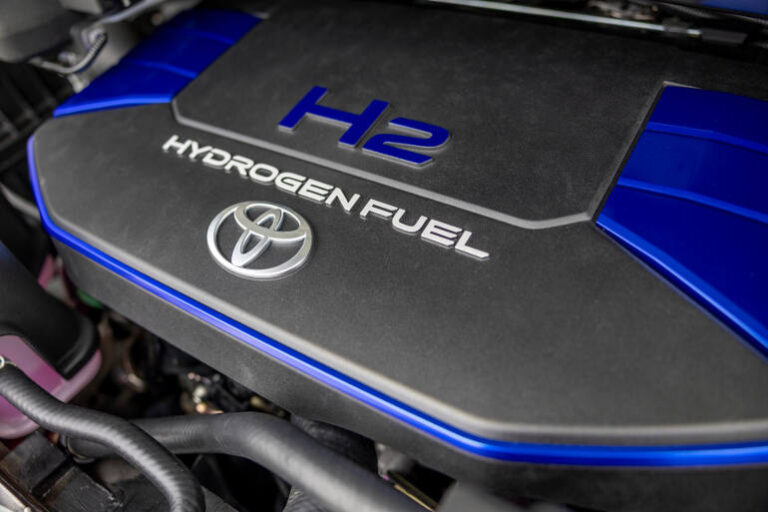
Isuzu and Toyota have confirmed plans to jointly develop a next-generation light-duty hydrogen fuel cell truck, signalling that hydrogen remains firmly on the roadmap for zero-emission freight — particularly for fleets operating under high-utilisation conditions.
The new vehicle will be based on the existing Isuzu ELF EV battery-electric platform but will integrate Toyota’s third-generation fuel cell system. Mass production is targeted for the 2027 financial year.
For readers of Fleet EV News, the significance isn’t just the vehicle itself — it’s the continued investment by two major manufacturers in hydrogen technology alongside battery-electric vehicles. That reinforces the reality that the transition to zero emissions will be shaped by operational needs rather than a single technology winner.

Hydrogen targets the jobs batteries struggle with
Battery-electric trucks are already proving effective for many urban delivery tasks. But there are still applications where charging time, payload, and utilisation patterns create operational challenges.
Hydrogen fuel cell vehicles are being developed specifically to address those gaps. Light-duty trucks used for supermarket and refrigerated deliveries often:
- Operate for extended hours each day
- Travel long distances between stops
- Carry auxiliary loads like refrigeration units
- Require fast turnaround times
In those scenarios, refuelling speed becomes critical.
Hydrogen vehicles can be refuelled in minutes rather than hours, while still delivering zero tailpipe emissions. That combination makes them particularly attractive for fleets that cannot afford extended downtime.
This is why manufacturers continue to position hydrogen not as a replacement for battery-electric vehicles, but as a complementary technology.
Built on a familiar commercial platform
The decision to base the hydrogen truck on the existing ELF EV platform is a practical one.
For fleet buyers, it means the vehicle will leverage an established chassis, safety systems, and service architecture rather than introducing an entirely new design. That reduces development risk and improves the likelihood of predictable maintenance and lifecycle performance — both critical considerations in fleet procurement.
Toyota’s third-generation fuel cell system is expected to deliver improvements in:
- Durability
- Efficiency
- Reliability
- Service life
These factors matter more than headline range figures in commercial operations, where uptime and total cost of ownership drive decision-making.
Cost remains the biggest hurdle
Both companies have openly acknowledged that vehicle cost remains the primary barrier to widespread hydrogen adoption.
That transparency is important. Fleet buyers are less interested in technology demonstrations and more focused on whether a vehicle can compete on whole-of-life cost.
Isuzu is working to reduce costs by optimising vehicle structure and manufacturing processes, while Toyota is targeting production efficiencies in fuel cell design and assembly.
The message is clear: hydrogen will only scale when the economics work.
Until then, deployment is likely to be targeted at specific use cases where operational benefits justify the investment.
Infrastructure will determine the pace
Technology development is only one part of the hydrogen equation.
Infrastructure availability will ultimately dictate how quickly fuel cell trucks can be deployed at scale. Governments and industry are already investing in hydrogen production and refuelling networks, but progress varies significantly by region.
For Australian fleets, the early opportunities for hydrogen adoption are likely to mirror global trends:
- Depot-based delivery fleets
- High-utilisation urban operations
- Heavy vehicle applications
- Fixed-route logistics
These environments allow infrastructure to be concentrated in predictable locations, reducing operational risk.
Another sign of a multi-pathway future
The collaboration between Isuzu and Toyota highlights the strategic shift underway across the commercial vehicle industry.
Manufacturers are no longer betting on a single solution. Instead, they are building portfolios of technologies designed to suit different operational requirements.
Battery-electric vehicles will dominate many light-duty applications. Hydrogen will likely emerge in high-utilisation and long-range scenarios. Diesel and alternative fuels will continue to play a role where infrastructure or duty cycles demand it.
For Fleet Managers planning replacement cycles into the late 2020s and early 2030s, the takeaway is straightforward:
Hydrogen trucks are moving from pilot projects toward production — but their adoption will be driven by operational fit, infrastructure readiness, and whole-of-life cost, not technology alone.




