


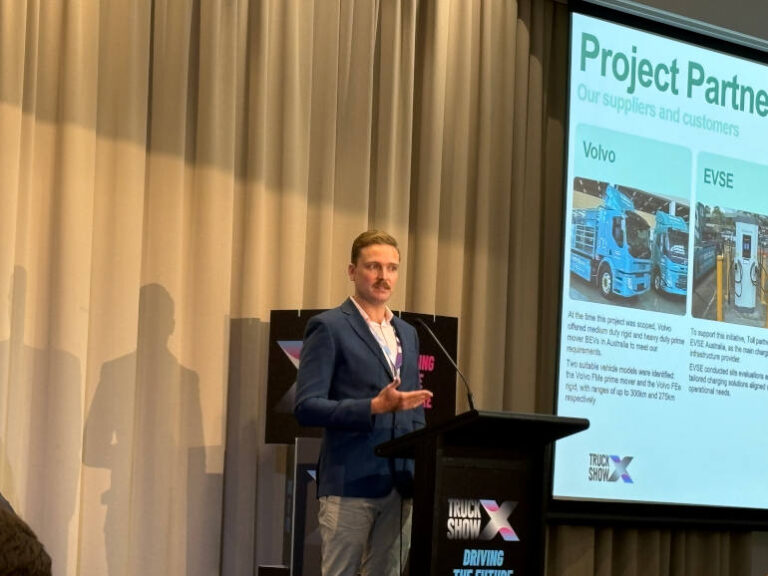
Wayne Schoenauer, Electric Vehicle Implementation Manager at Toll Group, says the biggest barriers to scaling electric trucks in Australia are no longer the vehicles themselves—they are the inconsistent regulations, permit processes and infrastructure approval requirements that vary across states and local councils.
Presenting a case study on Toll’s national electric truck rollout at TruckShowX, Schonenauer shared lessons from a two-year project supported by the Australian Renewable Energy Agency (ARENA), which funded the deployment of 10 battery-electric prime movers and 18 electric rigid trucks across three states and nine customer sites.
The project represents one of the largest electric truck rollouts undertaken by a transport operator in Australia and has provided valuable insights into both the opportunities and challenges of fleet electrification.

Partnerships critical to success
Schoenauer said collaboration was a key ingredient in getting the project off the ground, not only with ARENA but also with vehicle manufacturers, charging providers and customers willing to participate in the transition.
“The customers that we’ve partnered with here, they were all proactive and positive on taking this journey on,” he said. “Understanding that there were potential unknowns and risks involved in rolling out this technology.”
Toll partnered with Volvo Trucks for the supply of 10 FM Electric prime movers and 18 FE Electric rigid trucks. Charging infrastructure was primarily delivered by EVSE, while JET Charge was engaged for the purpose-built Woolworths distribution facility.
Customer partners included Coca-Cola Europacific Partners, BlueScope, Coles, Woolworths, Origin and Asahi. The diversity of customers and operating environments provided a broad test of how electric trucks perform across different freight tasks.
One of the more complex deployments involved transporting gas cylinders for Origin, requiring extensive risk assessments and consultation because charging infrastructure was being installed at a hazardous facility.
“There was a lot of work that went on into the risk analysis and engage with third parties to make that come to fruition,” Schoenauer explained.
Infrastructure rollout reveals hidden challenges
While much of the industry discussion focuses on vehicle costs and range, Schonenauer said installing charging infrastructure often uncovered unexpected challenges.
Even after detailed planning and energy assessments, some sites revealed electrical constraints once installation work commenced.
“Despite doing all the energy measurement requirements prior and doing all the research, once you went to do the install physically and started pulling some things apart, we had to overcome some problems during the installations,” he said.
Toll worked closely with charging providers to redesign some installations as new information emerged, highlighting the importance of flexible partnerships during large-scale electrification projects.
The company primarily adopted a return-to-base charging strategy, using overnight charging windows of around 10 hours rather than relying on public fast charging infrastructure. This approach suited the operational requirements of many urban delivery routes.
Regulation now the biggest roadblock
According to Schoenauer, the most significant challenge facing electric truck deployment is regulatory inconsistency across Australia.
While national frameworks such as the Heavy Vehicle Regulator’s road network provide a foundation, electric trucks operating on last-mile delivery routes often require additional permits and approvals.
“The major roadblock at the moment” is the regulatory environment, he said.
Permit approval timeframes vary significantly between local councils. Some applications are processed within 30 days, while others can take several months.
“We’ve had some that haven’t responded within five or six months,” Schoenauer said.
The uncertainty creates operational challenges for transport operators trying to expand electric truck utilisation or add new delivery locations.
“You can’t give a defined timeframe back to a customer when you’ll be able to make those deliveries,” he said.
The problem is compounded by different requirements in each state.
“When you go to look at something, implement something in New South Wales, it’s slightly different for Queensland, it’s different again for WA,” Schonenauer said. “It’s not as though you can create a template [and] follow the same process.”
For a national operator such as Toll, these differences increase administrative costs, slow deployment and reduce fleet flexibility.
National alignment needed
Schoenauer argued that Australia needs greater consistency in both vehicle access regulations and charging infrastructure approval processes if electric trucks are to be deployed at scale.
Charging infrastructure approvals often involved different building requirements, approval pathways, engineering assessments and fire safety reports depending on the location.
“If you had a clear line and pathway and guideline on how to install charging infrastructure, it also would reduce the overall cost of those installations,” he said.
Despite the challenges, Toll’s experience demonstrates that battery-electric trucks are already capable of handling many metropolitan freight tasks. The company is successfully operating the vehicles today, but Schonenauer believes regulatory reform is now essential to unlock their full potential.
“If we want to really push this industry forward, we need to at least get a line on how we’re going to get these things on the road, utilise them to their full payload and their full capability,” he said.
The message from Toll’s rollout is clear: partnerships can solve many operational challenges, but without nationally aligned regulations, the transition to electric freight will remain slower and more complex than it needs to be.




