

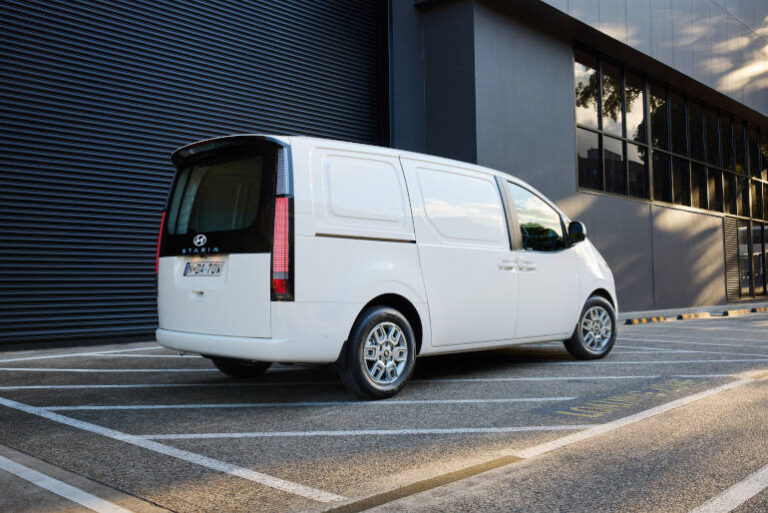
One of the biggest questions fleet buyers are likely to ask about Hyundai’s new STARIA Load Hybrid is simple: Why can’t it tow?
For many commercial vehicles, towing capacity is a key part of the purchasing decision. Whether it’s a tradesperson hauling a trailer, a council towing equipment or a service contractor moving machinery, towing capability often determines which vehicle makes the shortlist.
Hyundai has taken a different approach with the STARIA Load Hybrid.
Rather than offering a reduced towing capacity, the company has elected not to rate the hybrid for towing at all, leaving the diesel as the choice for fleets that regularly tow trailers.
For Fleet Managers, understanding why Hyundai made that decision is just as important as knowing the specifications.

Different powertrains for different jobs
The updated STARIA range gives buyers more choice than ever before.
The diesel remains the workhorse of the range, while the hybrid targets fleets seeking lower fuel consumption and smoother urban driving. Later in 2026, Hyundai will add a battery-electric STARIA Load, further expanding the powertrain options.
Towing capacities across the range are:
| Model | Braked towing |
|---|---|
| STARIA Load Diesel | 2,500kg |
| STARIA Diesel | 2,500kg |
| STARIA Petrol | 2,500kg |
| STARIA Load Hybrid | 0kg |
| STARIA Lounge Hybrid | 0kg |
| STARIA Load Electric | 2,000kg |
The specification immediately raises eyebrows. Why can the electric version tow 2,000kg while the hybrid cannot tow at all?
Preserving payload and durability
During the Australian media launch, Hyundai engineers addressed the question directly. Tim Rodgers, Product Development Manager at Hyundai Motor Company Australia, explained that the decision was driven by durability and the intended commercial application rather than a limitation of the hybrid system itself.
“It’s to preserve the payload management. Really, we had to manage the thermal limits of the car. This preserves that, but towing is a restriction on that.”
He said Hyundai’s customer research also influenced the decision.
“When we survey our consumer data, where we look at the model lineup in totality, we’re not too concerned that this car doesn’t have the towing capacity. We don’t find too high a proportion of our consumers actually towed with STARIA, and there’s an alternative option there for those who really prioritise towing.”
Designed for commercial use
Rodgers said the hybrid has been engineered differently to Hyundai’s passenger vehicle hybrids because of the demands commercial vehicles place on their powertrains.
“Obviously we have to warrant this thing for eight years, and it’s a commercial offering, not a passenger car offering.”
“The way we target that on an R&D level is a little bit different to say what a Palisade or a Santa Fe might see.”
He emphasised that Hyundai does not consider the towing restriction to be a weakness.
“I wouldn’t say it’s an issue. It’s just about how we want to bring the car to market and what they’re happy to warrant safely over that eight-year lifetime.”
That engineering philosophy reflects a conservative approach. Rather than offering a modest towing rating that could compromise long-term durability under heavy commercial use, Hyundai has chosen to optimise the hybrid for payload, fuel efficiency and reliability.
Understanding your fleet application
The decision highlights an important lesson for Fleet Managers. Choosing the right commercial vehicle isn’t simply about selecting the newest powertrain—it starts with understanding how the vehicle will actually be used.
Questions worth asking include:
- Does the vehicle tow regularly?
- Is towing occasional or part of the daily workload?
- Could another vehicle in the fleet perform towing duties?
- Is fuel efficiency a higher priority than trailer capability?
- Will the vehicle spend most of its time in metropolitan traffic?
For many urban service fleets, tradespeople and delivery businesses, towing is rarely part of normal operations. In those applications, the hybrid’s quieter operation, lower fuel consumption and smoother driving characteristics may outweigh the absence of towing capability.
Conversely, fleets that routinely tow trailers, plant, generators or equipment should continue to specify the diesel model.
Diesel remains the fleet workhorse
Hyundai’s own sales forecasts reflect this thinking.
The company expects the diesel to remain the most popular STARIA Load powertrain, accounting for around 50% of sales, while the hybrid is forecast to represent 45% of deliveries. The battery-electric model is expected to make up the remaining 5% once it arrives later in 2026.
Those figures suggest Hyundai sees the hybrid as complementing—not replacing—the diesel.
Fleet takeaway
The STARIA Load Hybrid isn’t trying to be everything to everyone.
Instead, Hyundai has developed three distinct commercial powertrains, each aimed at a different operating profile:
- Diesel for fleets that need maximum towing capability and long-distance flexibility.
- Hybrid for urban operators prioritising fuel efficiency, refinement and lower emissions without requiring trailer towing.
- Battery electric for fleets ready to transition to zero tailpipe emissions while still retaining a useful 2,000kg towing capacity.
Rather than viewing the hybrid’s zero towing rating as a compromise, fleet managers should see it as a reminder that successful vehicle selection begins with understanding the job the vehicle is expected to perform. Hyundai has engineered each STARIA variant for a specific application, leaving fleets to choose the one that best matches their operational requirements.