Hydrogen fuel cell trucks are already demonstrating the range and performance required for heavy-duty transport, but lower fuel prices and targeted government support will be essential before operators can adopt them at scale.
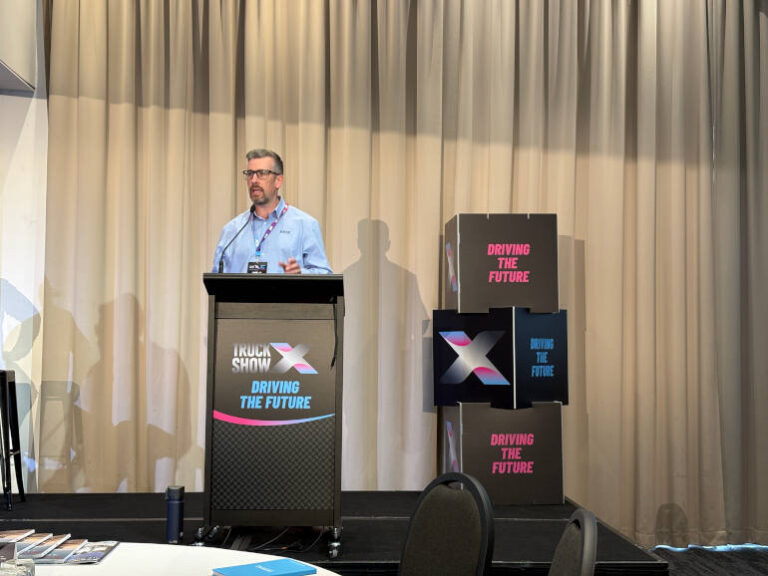
That was the central message from Iain Dorward, Sales Manager Heavy Vehicles at Foton Mobility, during his presentation at TruckShowX.
Dorward outlined Foton Mobility’s expanding Australian zero-emissions vehicle portfolio, which includes battery electric light trucks, buses, concrete agitators and hydrogen fuel cell prime movers.
While the technology is operating successfully, he said the commercial challenge remains significant for transport operators working with tight margins.
“We believe others talk, we deliver,” Dorward said, pointing to vehicles already operating with Australian fleets rather than relying solely on future product announcements.

Hydrogen delivers heavy-duty range
Foton Mobility’s hydrogen fuel cell electric prime mover uses a 240kW fuel cell system and carries approximately 60kg of usable hydrogen.
During a customer trial at a gross combination mass of 46 tonnes, the truck averaged hydrogen consumption of 12.4kg per 100 kilometres across a journey of more than 300 kilometres.
Based on that result, Dorward said operators could confidently expect approximately 500 kilometres of range while continuously operating at 46 tonnes.
Where the truck travelled loaded in one direction and returned empty, its range could potentially extend towards 600 kilometres.
That operating range gives hydrogen an advantage in applications where battery weight, charging time or daily distance make a battery electric truck more difficult to deploy.
“You add a bit of hydrogen, you let it go a bit further,” Dorward said.
However, refuelling infrastructure remains limited. Dorward described refuelling the demonstration truck at Coregas’ Port Kembla facility, where hydrogen was available but the station’s storage and transfer process extended the overall refuelling time.
His message was that hydrogen could already be sourced in some locations, but the infrastructure was not yet equivalent to the speed, convenience or coverage of diesel.
The hydrogen price decides the business case
Dorward said total cost of ownership was currently the greatest barrier to selling hydrogen trucks.
Based on Foton Mobility’s estimates for a truck travelling 250,000 kilometres over five years, a fuel cell vehicle could cost approximately $88,000 more to maintain than a comparable diesel truck.
Fuel costs then created a much larger variation depending on the price of hydrogen.
At approximately $20 per kilogram, Dorward estimated hydrogen could add around $250,000 to operating costs over five years compared with diesel.
At $12 per kilogram, the fuel cost approached parity, although the operator would still need to absorb the higher maintenance cost.
The equation changed substantially as hydrogen moved below that level.
At $6 per kilogram, the estimated fuel saving over five years was approximately $150,000. At $3 per kilogram, it could rise to around $225,000.
Those figures show why hydrogen production scale and infrastructure investment will be as important as the truck itself.
“At $12 a kilo over five years, it’s about parity,” Dorward said. “But we’re still paying more for maintenance, so we need to bring the cost of hydrogen down.”
Funding is needed to close the early gap
Dorward argued that governments and funding organisations such as ARENA had an important role to play during the early stages of the market.
The objective was not to permanently subsidise hydrogen transport, but to close the initial cost gap while vehicle volumes increased, infrastructure expanded and the cost of hydrogen declined.
Operators were unlikely to take on substantial additional costs simply to trial new technology, particularly when reliability, payload and utilisation remained critical to profitability.
“We need governments and the likes of ARENA and these funding people to step in and cover that gap, so we can get the technology out there to operators in an already low-margin business,” Dorward said.
He compared the current hydrogen market with the earliest days of the motor vehicle, when petrol stations did not exist and fuel distribution had to develop alongside the new technology.
“New technology is not perfect now, but with volume and patience and practice, we’ll get there,” he said.
Battery electric is already proving its value
Although hydrogen was the focus of the session, Dorward also highlighted the progress being made with battery electric commercial vehicles.
Foton Mobility has supplied hundreds of electric T5 light trucks, including a major deployment with Woolworths Group, as well as vehicles for councils, logistics businesses and last-mile delivery fleets.
Drivers had reported quieter operation, improved comfort, reduced fatigue and better performance in urban traffic.
The company has also deployed a battery electric concrete agitator in Western Australia.
During its first 12 months of operation, the truck was estimated to have avoided the use of 12,665 litres of diesel and reduced energy costs by approximately $14,000.
Payload remained a challenge because the electric agitator was heavier than its diesel equivalent, but Foton Mobility was working on suspension, axle and vehicle configuration changes to improve productivity.
The results reinforced Dorward’s broader message that zero-emissions trucks should be assessed according to the application rather than treated as a single technology contest.
Battery electric vehicles were already suitable for many urban and return-to-base operations, while hydrogen offered potential for heavier vehicles requiring longer range and faster refuelling.
Early adopters can build a competitive advantage
Dorward encouraged fleets to consider the strategic benefits of early deployment, even while the economics continued to evolve.
Operators that introduced electric or hydrogen vehicles could develop technical knowledge, train drivers and maintenance teams, improve emissions reporting and become better positioned for future tenders requiring low- or zero-emissions transport.
They could also strengthen relationships with customers seeking measurable reductions in their supply-chain emissions.
“Be the market leaders. Lead it, don’t follow it,” Dorward said.
For hydrogen trucks, the remaining challenge is no longer simply proving that a fuel cell prime mover can carry a heavy load over a practical distance.
The technology can perform the task. The next phase will depend on lowering the price of hydrogen, expanding refuelling infrastructure and providing enough early support to make deployment commercially realistic for Australian fleets.