


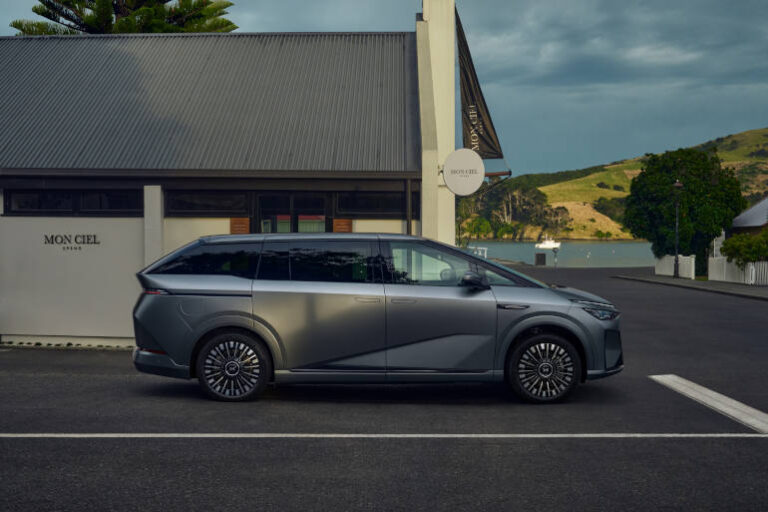
XPENG is adding a three-row electric people-mover to its Australian line-up, giving fleet operators another battery-electric option for executive transport, airport transfers, tourism and other passenger-carrying applications.
The X9 will be offered with front-wheel-drive and all-wheel-drive powertrains, with claimed WLTP range of up to 580km. Australian deliveries are expected to begin shortly.
Two configurations for different duty cycles
The front-wheel-drive X9 uses a 94.8kWh lithium iron phosphate battery and has a claimed range of up to 535km.
The all-wheel-drive version uses a larger 110kWh nickel cobalt manganese battery and extends claimed range to 580km. Its dual-motor drivetrain produces up to 370kW and 640Nm.
Both versions are based on an 800-volt electrical architecture. The all-wheel-drive model can accept up to 542kW from a compatible DC charger, with XPENG claiming a 10 to 80 per cent charge time of as little as 12 minutes under test conditions.
The X9 also supports 11kW AC charging and 6kW vehicle-to-load capability.
Rear-wheel steering improves manoeuvrability
Large people-movers can be difficult to operate in tight urban environments, but XPENG has fitted active rear-wheel steering across the X9 range.
The company claims a 5.4-metre turning radius, which could make the vehicle easier to use in hotel driveways, airport pickup areas, loading zones and multi-storey car parks.
Dual-chamber air suspension is also standard, working with an electronically controlled chassis system intended to support ride comfort and stability.
Seven seats with luggage capacity
The X9 has a flat-floor cabin with seating for seven occupants and 721 litres of cargo space with all seats in use.
The second and third rows use a 60/40 split-folding arrangement, allowing the cabin to be configured with four, five, six or seven seats. Maximum cargo capacity is listed at 2554 litres.
That flexibility may suit fleets that need to alternate between passenger and luggage duties, particularly in airport transfer, community transport, tourism and executive transport operations.
The second row includes electrically adjustable seats with heating, ventilation and massage functions, while the third row also receives seat heating.
Driver assistance and parking technology
The X9 is the first XPENG model offered in Australia with the company’s Turing AI chip, which supports vehicle systems including infotainment, navigation, voice controls and driver assistance.
XPILOT assistance features include adaptive cruise control, lane centring, autonomous emergency braking and blind-spot monitoring.
Parking technology includes automatic and remote parking, a 360-degree camera and a transparent chassis view. These systems may help reduce low-speed manoeuvring risks for drivers operating a large vehicle in confined spaces.
XPENG says the X9 has been engineered to meet five-star safety standards, although the launch material does not confirm an independent Australian safety rating.
A new fleet segment for electric vehicles
The X9 enters a relatively narrow part of the Australian EV market, where there are still limited battery-electric choices for fleets requiring seven seats, substantial luggage capacity and long-distance range.
Its relevance will depend on operating requirements, charging access and whole-of-life cost, but the combination of three-row seating, flexible cargo space and high-power charging gives fleets another option beyond conventional SUVs and combustion-powered people-movers.




