

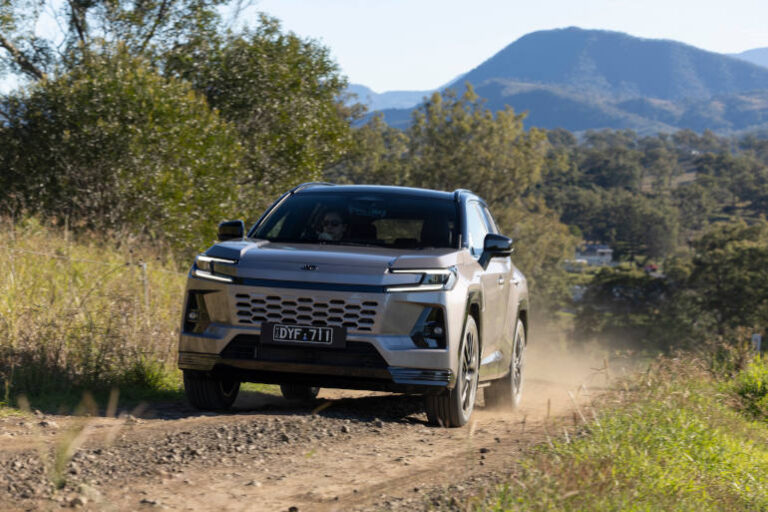
Toyota’s first plug-in hybrid vehicle in Australia could provide fleet buyers with a practical step between conventional hybrid vehicles and full battery-electric adoption.
The new RAV4 PHEV combines a larger battery and electric motors with a 2.5-litre petrol engine, allowing drivers to complete shorter daily journeys using electricity while retaining the range and refuelling flexibility of a hybrid for longer trips.
However, the vehicle’s fleet case will depend on one critical factor: whether drivers regularly charge it.

Toyota says the RAV4 PHEV can travel up to 154km on electric power under the NEDC test cycle. It uses a 22.7kWh lithium-ion battery and is available in front-wheel-drive and all-wheel-drive variants, with the latter producing up to 227kW.
Ray Munday, Senior Manager Product Planning and Pricing at Toyota Motor Corporation Australia, said the powertrain was designed for customers who could charge regularly but still needed flexibility for longer trips.
“Plug-in hybrid electric vehicles allow a customer who spends most of their time doing shorter commutes the opportunity to run on EV alone with the convenience of long-range ICE driving when needed,” Munday said.
“This is particularly useful for customers who can charge at their home or office daily.”
For Fleet Managers, that creates an opportunity and a risk.
A RAV4 PHEV used primarily on urban or suburban routes, with reliable workplace or home charging, could significantly reduce petrol consumption and tailpipe emissions. It may suit account managers, government fleets, community-service providers and field staff whose vehicles return home or to a depot each day.
But a plug-in hybrid that is not charged consistently can become a heavier petrol vehicle, with much of its emissions-reduction potential left unused.
That makes charging policy, driver education and data visibility as important as the vehicle’s electric range.
Fleets considering PHEVs will need to decide who is responsible for charging at home, whether staff are reimbursed for electricity, how public charging is managed, and whether vehicle data will be used to track electric driving and charging behaviour.
Toyota Australia Vice President of National Sales, Marketing & Franchise Operations John Pappas said Toyota expected plug-in hybrids to represent about five per cent of its sales in 2026 as the company expands its multi-pathway product range.
“Our role at Toyota is not to tell customers what they should drive,” Pappas said. “Our role is to provide the broadest possible range of practical lower emission solutions and allow our customers to dictate the pace of change.”
The RAV4 PHEV is positioned as one of those practical options.
For fleets not ready to commit every vehicle to battery-electric power, it offers a way to begin building charging capability and driver habits without removing the ability to complete longer regional or interstate journeys.
Toyota’s approach also recognises that many fleet operations remain constrained by charging access. Not every employee has off-street parking, not every workplace has enough electrical capacity, and not every route can be planned around public charging.
The RAV4 PHEV’s hybrid capability provides a safety net in those situations, but its value will be greatest where fleets can design the operating model around the vehicle.
Munday said the plug-in system provided flexibility depending on driver needs, with EV, auto EV/HEV and HEV driving modes.
“The RAV plug-in hybrid versions offer the best of both worlds for spirited driving,” he said.
For fleet buyers, the stronger argument may be less about performance and more about transition planning.
The RAV4 PHEV offers an opportunity to identify which drivers are ready for regular charging, test reimbursement and policy settings, build internal confidence with plug-in vehicles and reduce fuel use before moving further into battery-electric models.
The technology will not solve every fleet task. But for the right operating profile, Toyota’s first PHEV could become a useful bridge between hybrid familiarity and a more electric future.