


The NSW Government is supporting hydrogen as one of several pathways to decarbonise heavy transport, with early refuelling infrastructure, production hubs and demonstration projects designed to help move the technology from innovation to commercial use.
Speaking at TruckShowX, Gary Foster, Manager Hydrogen Programs at NSW Department of Climate Change, Energy, the Environment and Water, said the government was taking a longer-term view of transport decarbonisation as it works with industry to build the foundations for cleaner fuels.
“My day job is to increase the uptake of renewable hydrogen production and use in the state by managing grant funding for hydrogen production hubs, refuelling networks and infrastructure,” Foster said.
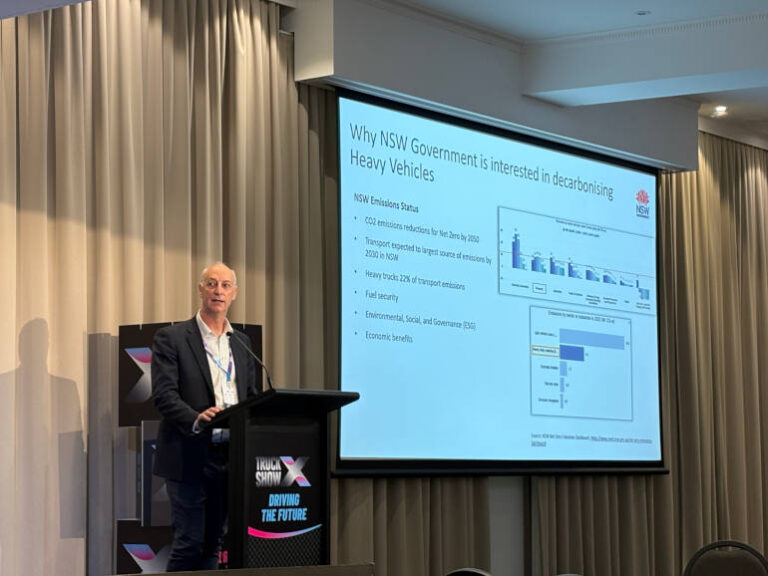
He said the government’s interest in heavy transport reflects the scale of the emissions challenge. By 2030, transport is expected to be the largest contributor to carbon emissions in NSW, with heavy transport accounting for 22% of that sector’s emissions.

Foster said the NSW Government was not backing a single technology pathway. Instead, it is supporting battery electric vehicles, hydrogen vehicles and renewable fuels to understand where each solution is best suited.
“At the moment, we in NSW Government are technology agnostic and developing policies and supporting demonstration projects for hydrogen vehicles, EV vehicles, and renewable fuels that will provide the evidence base to identify where the niche or the use case for each solution best lies,” Foster said.
For Fleet Managers, the message is that hydrogen is unlikely to replace battery electric vehicles in short-range, return-to-base operations where charging infrastructure and duty cycles are more predictable. Foster said battery electric trucks appear to be the simpler and potentially more cost-effective solution for smaller, shorter range tasks.
However, he said longer journeys may face limits around charging time, range and electricity infrastructure requirements. This is where hydrogen could play a role, particularly for larger, higher-utilisation vehicles travelling longer distances.
“We believe the main application for hydrogen vehicles, truck wise, could be for the longer range, larger liable vehicles, including B-doubles or maybe triples,” Foster said.
Hydrogen also offers operational familiarity for some fleets because vehicles can be refuelled quickly, with Foster noting that hydrogen trucks can be fuelled “in the same way that they are today, with little loss of performance”.
NSW has already supported early demonstrations. Foster pointed to a hydrogen bus trial in the Hunter where the drivetrain torque had to be dialled back because passengers complained the bus accelerated too quickly. He also referenced a hydrogen-powered refuse vehicle trial by waste contractor Remondis, which completed a full day of work on one tank of hydrogen, including up to 1,500 bin lifts and operating in the Illawarra.
These examples highlight why governments are interested in trialling hydrogen in demanding duty cycles where payload, uptime and operational range matter.
The challenge remains the “chicken and egg” problem: operators need fuel before they buy vehicles, while fuel suppliers need demand before they invest in infrastructure.
To address this, Foster said the NSW Government has allocated just over $100 million to three hydrogen production projects in Moree, the Illawarra and the Hunter. These projects will initially focus mainly on industrial and agricultural offtake, including ammonia, fertiliser and explosives, before expanding into heavy transport applications.
The first of these projects is expected to be operating as early as the second quarter of 2027 in Moree.
The government is also administering a $100 million Commonwealth grant to support large-scale green hydrogen and ammonia production at Kooragang Island in Newcastle, with production expected from the early 2030s.
For transport operators, the most relevant development is the proposed hydrogen refuelling network between Newcastle and the Queensland border. Foster said NSW is supporting a detailed engineering study for what would become the state’s first hydrogen refuelling network.
“This project is able to take final investment decision early next year,” Foster said.
He said the Pacific Highway project is being developed by Hiringa Refuelling, which has already established a similar project in New Zealand.
The availability of hydrogen as a transport fuel will therefore build in stages. Early production from NSW hydrogen hubs could begin from 2027, with the Newcastle-to-Queensland refuelling network subject to final investment decision in 2027, and larger scale green hydrogen and ammonia production in Newcastle expected from the early 2030s.
Foster also said hydrogen blending with existing diesel trucks could play an interim role, helping operators gain confidence with hydrogen while production and supply chains are established. Larger fuel cell trucks from OEMs are expected to become more available “probably around the end of this decade”.
For Fleet Managers and Sustainability Managers, the practical takeaway is that hydrogen is not yet a mainstream procurement option, but the infrastructure pathway is becoming clearer. Fleet transition plans will need to remain flexible enough to assess battery electric, hydrogen and renewable fuels against real operating requirements, rather than relying on one technology for every vehicle class.
Foster said the hydrogen sector is still at an early stage, with costs needing to fall through innovation, commercialisation, more efficient electrolysers, automation and larger project scale. He compared the likely cost curve with wind and solar, where early government support helped the technologies reach commercial maturity over time.
“The key point is that we’re on a journey,” Foster said. “The world will look very different over the next 10 to 15 years.”
For heavy transport fleets, that journey is now moving from policy ambition to infrastructure planning. The next milestones will be whether production hubs come online from 2027, whether the Pacific Highway refuelling network reaches investment approval, and whether OEMs can bring fuel cell trucks to market at the scale and cost required for commercial fleet adoption.