

Origin Energy’s Chau Le calls on industry to turn millions of parked EVs into a national energy asset
The Australian electric vehicle industry has reached a turning point, according to Origin Energy General Manager of Strategy and E-Mobility Chau Le.
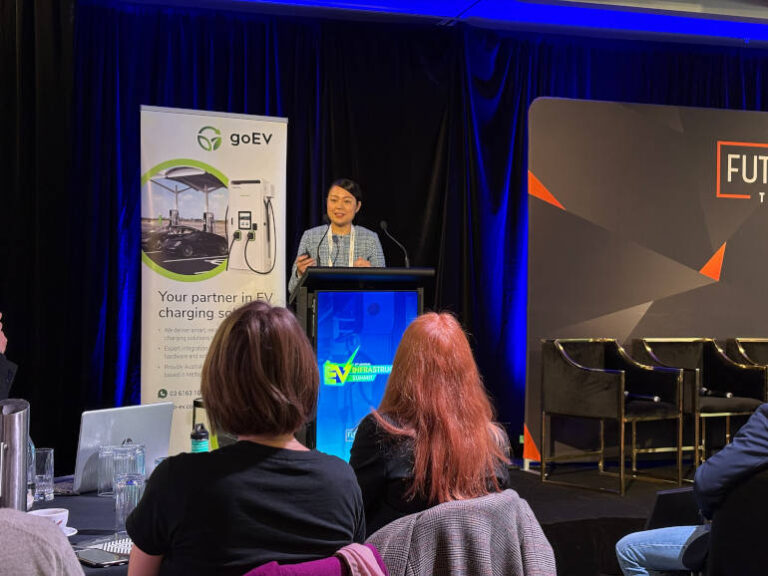
Opening the EV Infrastructure Summit, Le challenged delegates to think beyond charging infrastructure and vehicle sales and instead focus on the next phase of electrification: transforming millions of electric vehicles into a distributed energy network that could reshape Australia’s electricity system.
“Vehicle-to-grid has been the holy grail, the vision that we’ve been moving towards,” Le told delegates. “This year, vehicle-to-grid stops being a vision and starts to be a reality.”

From pipe dream to practical reality
Le opened with the story she pitched to the Origin board in 2020, describing an ordinary Tuesday morning in 2027.
While a family slept, their home energy system quietly charged their electric vehicle when electricity prices were low, topped up the home battery, pre-cooled the house and later responded automatically to grid frequency events before solar generation powered appliances the following morning.
The family woke to a fully charged car, a comfortable home and an electricity bill that had actually earned them money.
“When I pitched this to the board in 2020 they called it a pipe dream,” Le said.
Today, she argues, every element of that scenario is technically achievable.
A storage fleet hiding in plain sight
Le highlighted the scale of the opportunity if Australia embraces vehicle-to-grid technology. Within the next five to ten years, Australia is expected to have around 3.5 million electric vehicles on its roads, representing approximately 175 gigawatt hours of distributed battery storage.
“That’s 175 gigawatt hours of distributed storage, sitting idle, doing nothing for 22 hours a day,” she said.
She compared that figure with the planned capacity of Snowy 2.0.
“Right now we are working towards building a single piece of new generation infrastructure without building a single piece of new generation infrastructure. We are organically growing a storage fleet half the size of our most ambitious pumped hydro project.”
Le argued that the biggest investors in Australia’s energy transition are not utilities but Australian households purchasing electric vehicles for transport rather than energy services.
The industry must move beyond trials
Despite the technology being ready, Le questioned why vehicle-to-grid remains largely confined to demonstration projects.
“The question is, why are we still in the trial phase? Why isn’t every EV on the road already participating in vehicle-to-grid?” she asked.
Her answer was that every participant across the ecosystem still needs confidence built through real-world experience.
Vehicle manufacturers need evidence that controlled charging and discharging will not significantly impact battery health.
Distribution network operators need proof that EVs can reliably respond to network signals and defer expensive infrastructure upgrades.
Energy retailers need to understand the real value stack across frequency control, wholesale energy arbitrage, network support and customer retention.
A potential $5,000 annual value proposition
Origin’s modelling suggests the economics could be compelling.
“Our modeling suggests that the total value stack could be potentially over $5,000 per vehicle per year across the full stack,” Le said.
“Against a typical household electricity bill of around $2,000 these economics are extraordinary. Vehicle-to-grid doesn’t just pay for itself, done properly, it also pays for the car as well as the home.”
However, Le stressed that customers will never think in terms of frequency regulation markets or wholesale electricity arbitrage.
“They wake up thinking, is my car ready? Will it get me to work and back, and is my power bill lower this year than last year?” she said.
Trust before technology
For Le, customer trust is the foundation of mass adoption.
“Charge certainty is not a feature. It is the foundation everything is then built on top of it,” she said.
“If someone gets into the car on a Tuesday morning and finds that the battery is 50% charged instead of the 80% that they expected, that program is over for them.”
She also argued that consumers need simple, tangible value rather than complex tariff structures and energy market explanations.
Origin’s own vehicle-to-grid trial has therefore bundled together an EV subscription, bi-directional charger installation and free home charging into a single monthly package designed to remove both upfront costs and technology risk.
The orchestration challenge
Le believes the biggest opportunity lies beyond simply connecting vehicles.
The future is intelligent orchestration of every energy asset within a household, including rooftop solar, home batteries, electric vehicles, hot water systems, heat pumps, pool pumps and air conditioning.
“The best proposition should orchestrate every energy asset in the home together,” she said. “When all of these assets are optimized simultaneously under a single intelligent platform… the economics become extraordinary.”
She acknowledged that no human operator could manage the constantly changing variables involved.
“Only machine learning orchestration running continuously against live telemetry can operate that at scale.”
A call to the entire ecosystem
Le concluded by positioning vehicle-to-grid as more than an energy innovation.
Australia’s renewable energy ambitions require enormous amounts of flexibility, and she believes electric vehicles represent the lowest-cost distributed storage resource available because they are already being purchased for transport.
“If we get mass market EV orchestration right, we aren’t just helping consumers save money, we’re meaningfully accelerating the clean energy transition,” she said.
Her final message was directed at every participant in the EV ecosystem.
“For most of the history of the electricity industry, customers have been recipients… The prosumer economy inverts that entirely.”
“The customer is no longer a passive endpoint; they are an active participant, generating power, storing power, and trading power.”
“Whether someone owns their EV, subscribes for one, or is simply a passenger in one, the proposition must make sense and must win the customer’s trust, because when it does, we don’t just change how Australians power their homes, we change how Australia powers itself.”
- Foton and Ampol Target Electric Truck Charging
 Foton Mobility Distribution (FMD) and Ampol have signed a Memorandum of Understanding to explore charging solutions for electric truck fleets, with a focus on helping operators charge at depots, commercial hubs and public charging sites. The collaboration will investigate charging options across Ampol’s AmpCharge public network and private facilities for FMD’s fleet, logistics and business
 - Ausgrid’s charging strategy goes well beyond the depotInstalling chargers at the depot might be the obvious starting point for fleet electrification. For Ausgrid, it wasn’t going to be enough. As the electricity network continues electrifying passenger vehicles, vans and trucks, it has developed a charging strategy designed around how employees actually use fleet vehicles. Speaking during the Fleet News Group Awards finalists
- Home Charging Enters a New Growth PhaseEvnex has passed 20,000 connected charger installations across Australia and New Zealand, with rapid growth reflecting the shift of home EV charging from an early-adopter product to mainstream infrastructure. The Christchurch-based manufacturer shipped its first charger in 2017. While reaching the first 10,000 installations took eight years, the next 10,000 were added in just nine
- Ampol’s $225 million Evie deal puts a new value on public EV chargingAmpol’s proposed $225 million acquisition of Evie Networks could prove to be a significant milestone for Australia’s EV charging sector, putting a substantial transaction value on a public charging network that was built well before electric vehicles became a mainstream consideration for Australian fleets. Ampol Energy has entered into an agreement to acquire 100% of
- A Charger That Powers Up Isn’t Finished: Why Commissioning Matters for Fleet EV ChargingAn EV charger can be installed, connected and apparently operating — and the charging system can still be wrong. That is one of the more important lessons from the Local Council EV Integration Project involving Wyndham, Brimbank and Moonee Valley councils. As fleet charging installations become larger, depots are adding not only chargers but load