


Despite Australia representing less than five per cent of Autel’s global revenue, the company is continuing to invest heavily in the local market, sending a clear signal that international charging suppliers still see significant long-term growth opportunities.
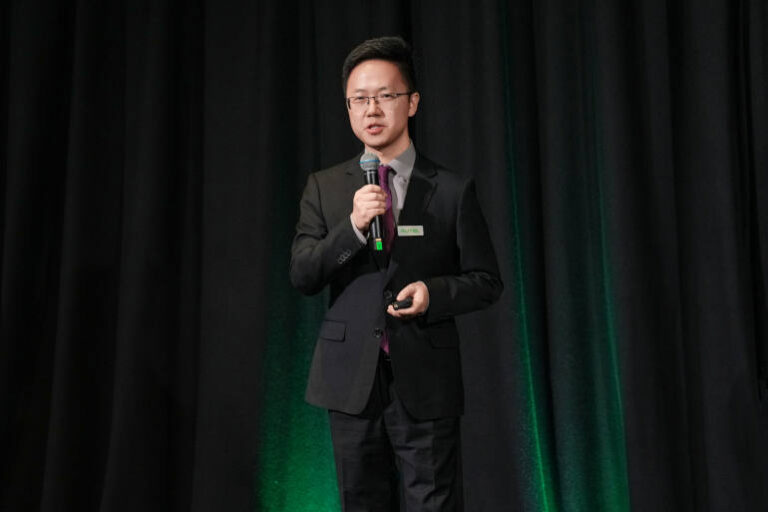
Speaking at the Autel EV Charging Innovation Seminar 2026 in Sydney, Henry He, CEO APAC at Autel, described Australia as a strategic market where the company expects continued expansion as fleet electrification and charging infrastructure mature.
“We have a lot of potential to grow in the Australian market, and we are seeing good potential right now in Australia,” He said.
The comments come as the Australian EV charging industry becomes increasingly competitive, with local and international suppliers investing in new products, software platforms and energy management solutions.

Australia is still a small piece of a global business
Autel’s global EV charging business grew by 45% year-on-year in 2025, driven by continued expansion across public charging, commercial, and fleet charging markets worldwide.
While Australia achieved revenue growth of 57 per cent during the year, He acknowledged it still represents a relatively small part of the company’s global business.
“Australia is our strategic market,” he said.
“Autel has invested significant resources for the last few years, including setting up the office in Brisbane.”
“We have a higher growth rate than our average. It’s about 57% revenue growth in 2025. However, our revenue compared with global is still a small portion, it’s less than 5%.”
Rather than viewing that as a weakness, the figures highlight how much room remains for expansion as Australia’s EV market develops.
The fundamentals are attractive
He believes Australia shares many characteristics with the larger and more mature EV markets of Europe and North America.
“We are more focused on Australia because the Australian market is more like US and Europe, the user habits, the culture and the customer pain points are similar,” he said.
That alignment means charging technologies developed for those larger markets can be readily adapted for Australian fleet operators and charging networks.
Autel has already established local operations and, over the past five years, has supplied charging projects for organisations including Woolworths, NRMA and IKEA, as well as delivering what He described as Australia’s first 960kW super charging hub.
Government support remains critical
While optimistic about Australia’s future, He suggested the pace of infrastructure investment continues to depend on policy support.
“We see big growth on EV charging infrastructure in both US and Europe,” he said. “I think part of the reason is the government is actually giving a lot of financial support to building infrastructure.”
By comparison, He sees Australia progressing at different speeds depending on the state.
“New South Wales is a bit more proactive. Other than that, it’s kind of hesitating.”
For fleet operators, greater public and depot charging investment will be essential as organisations move beyond pilot programs towards large-scale electrification.
Innovation continues despite a crowded market
Rather than slowing investment because of increasing competition, Autel continues to expand its Australian product range.
After listening to local customer feedback, the company recently introduced an ultra-slim standalone DC charger designed specifically for Australian conditions where parking space is limited.
“When I first entered the Australian market five years ago, customers were already saying they wanted chargers as slim as possible,” He said.
“So we used every effort we could to design it to be as slim as possible. That’s where we are. I think it’s one of the slimmest in the industry.”
A message to the industry
For other EV charging suppliers, Autel’s continued investment carries an important message.
Although Australia’s charging market remains relatively small by global standards, rapid revenue growth, increasing fleet electrification and similarities with established overseas markets make it an attractive long-term opportunity.
With international manufacturers continuing to establish local teams, invest in Australian-specific products and compete for fleet and commercial projects, the race to build the country’s charging infrastructure is still in its early stages.
For Fleet Managers, that competition is likely to deliver more choice, better technology and increasingly sophisticated charging solutions as suppliers position themselves for the next phase of Australia’s electric vehicle transition.