

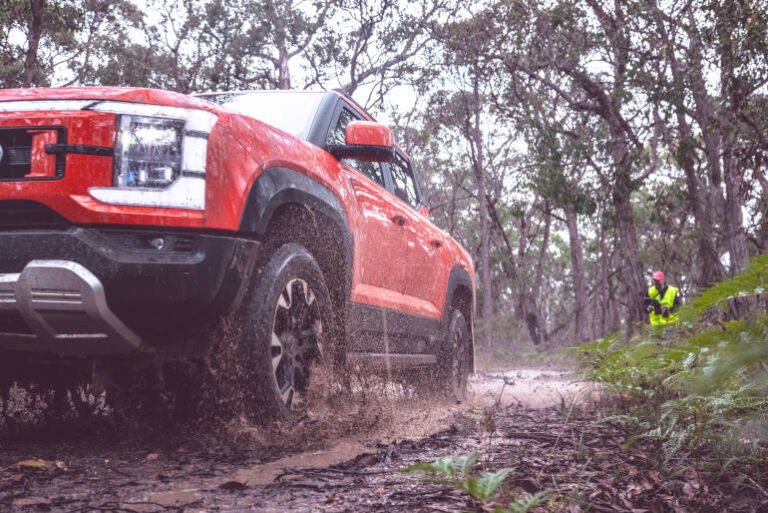
One of the less visible stories behind the success of the BYD Shark 6 in Australia is the growing role of local engineering, with Australian feedback and development work directly influencing suspension tuning, off-road performance and software updates.
Speaking at the launch of the new Shark 6 Performance and Cab Chassis variants, Sajid Hasan, Chief Product Officer for BYD and Denza Australia and New Zealand, said local development has become a key part of the vehicle’s ongoing evolution.
While the Shark was developed specifically with Australia in mind, Hasan said the local engineering team has continued refining the vehicle since launch based on customer feedback and real-world testing.
“Australia sells the most Shark 6s in the world,” Hasan said. “This car was developed for our market, and it’s really rewarding and fulfilling to be part of a team that can drive that type of development and direction.”
Local Team Influencing Product Development
BYD has steadily expanded its engineering capability in Australia, giving the local team a stronger voice in future product improvements.
According to Hasan, feedback from Australian media, customers and off-road users is taken seriously by BYD headquarters and can result in changes being implemented much faster than traditional automotive development cycles.
“Your feedback and your driver impressions, these are all really valuable things as well for us, because they pay a lot of credence to that feedback,” Hasan said.
“Whatever you say to us, we’ve got the voice, we say it back to HQ, and it happens pretty quickly.”
That direct communication has already resulted in significant changes to the Shark’s off-road systems.
Fixing Off-Road Performance Through Software
One area identified after the original Shark launch was low-speed off-road performance.
Hasan acknowledged that while the vehicle performed well in many conditions, the traction control system could struggle in specific low-speed climbing situations.
“When we launched this car, the traction control system would tend to bog down on itself on low-speed, low-mu, high-angle surfaces,” Hasan said.
The issue highlighted the difference between Australian off-road expectations and the environments where much of the original development work had been completed.
“A lot of the off-road driving that they do (in China) is high-speed and just blasting up slopes, but that low-speed control kind of thing is not really their forte,” Hasan said.
Rather than waiting for a model update or facelift, BYD’s engineering teams developed a solution that could be delivered directly to vehicles already on the road.
Crawl Mode Delivered Via OTA Update
The result was a new Crawl Mode system designed to improve low-speed off-road capability by better managing wheel speed and torque delivery.
“We’ve used that feedback from the launch to improve our off-road systems,” Hasan said.
The new software helps maximise traction during steep climbs and technical off-road conditions by continuously monitoring wheel slip and adjusting power delivery.
Importantly, the upgrade is not limited to new vehicles.
“This was also an OTA that will roll out to every other Shark that we’ve already sold as well,” Hasan said.
That ability to continuously improve vehicle performance through over-the-air updates is becoming a major advantage for BYD and other software-driven vehicle manufacturers.
Rather than requiring dealership visits or waiting for future model years, customers can receive meaningful improvements remotely.
Suspension Development Continues
The latest Shark range also reflects ongoing local chassis development.
Hasan revealed that significant engineering work was undertaken during the development of the new Cab Chassis variant, including collaboration with Ironman 4×4 on tray and suspension solutions.
The company now offers light, medium and heavy-duty suspension packages to suit different payload and operational requirements.
For fleet operators and tradespeople, these locally developed solutions allow the Shark platform to be tailored for Australian working conditions while maintaining ride comfort and vehicle dynamics.
The engineering effort behind the new Cab Chassis extended beyond simply fitting a tray.
“We’ve actually made our Dynamic Cab Chassis variant the dynamic benchmark for our range,” Hasan said.
“The tray adds that rigidity, so it’s actually a more engaging drive.”
Faster Product Development Cycle
Hasan said the Shark demonstrates how quickly BYD can respond to market feedback compared with traditional automotive development timelines.
The introduction of Crawl Mode, towing upgrades, suspension options and software refinements within little more than a year of launch highlights the company’s willingness to adapt products after they reach customers.
For Australian buyers, that means vehicles can continue improving throughout their ownership experience rather than remaining fixed at their original specification.
As BYD expands its local engineering resources, the Shark 6 appears likely to remain a showcase for that approach, combining local suspension and chassis development with software updates that can be delivered directly to vehicles already on the road.
The result is a ute that continues to evolve long after it leaves the showroom floor.
- Origin partners with EVDealer Group to accelerate fleet transition
 Origin and EVDealer Group have partnered to give Australian businesses a single, end-to-end path to electric vehicles (EVs) – from planning and charging through to vehicle delivery and driver handover – so fleet managers no longer have to coordinate it all themselves. Origin’s Group Manager Sales, E-mobility, David Helmy, said, “Businesses tell us the hardest
 - Volkswagen ID. Buzz Cargo wins 2026 Fleet EV of the YearThe Volkswagen ID. Buzz Cargo has been named the 2026 Fleet EV of the Year in the Fleet News Group Awards, finishing ahead of two very different electric fleet propositions after assessment by fleet industry judges using Best Value Analysis. The Volkswagen ID. Buzz Cargo BEV 550 competed against the Toyota HiLux SR BEV 4×4 Double Cab Pickup and Kia EV5 Air
- Kia PV5 wins 2026 Fleet LCV of the YearThe Kia PV5 Cargo has been named the 2026 Fleet LCV of the Year in the Fleet News Group Awards, giving Kia an important win as electric commercial vehicles move further into mainstream fleet consideration. The Kia PV5 Cargo S 4D LR finished ahead of the Hyundai STARIA Load Hybrid and Isuzu D-MAX SX 2WD Single Cab, giving judges three very different
- Toyota Camry wins 2026 Fleet Car of the YearThe Toyota Camry Ascent Sport has been named the 2026 Fleet Car of the Year in the Fleet News Group Awards, reinforcing the continuing role hybrid vehicles can play in helping fleets reduce fuel use and emissions. The Camry finished ahead of the MG ZS Vibe CVT and Subaru Forester Hybrid AWD after assessment by fleet industry judges and Fleet News
- Can an electric van really be better to drive all day? Kia thinks soFor Fleet Managers considering electric vans, range, payload and charging usually dominate the discussion. But there is another factor that can have just as much influence on whether a new vehicle succeeds in a fleet: what drivers think of it after spending an entire working day behind the wheel. That was one of Kia’s priorities