


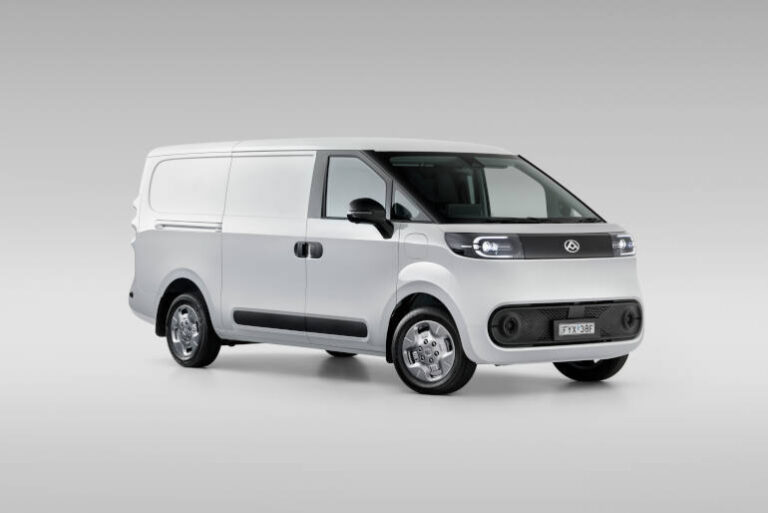
LDV Australia is aiming to shake up the light commercial vehicle market with the launch of the all-new eDeliver 5, an electric van priced below many diesel competitors and positioned to make battery-electric transport more accessible for small businesses and fleet operators.
Starting from $47,990 drive-away for ABN holders as part of a limited-time launch offer, the new eDeliver 5 becomes one of the most affordable electric vans available in Australia. The first customer deliveries are expected from July 2026.
LDV has already established itself as one of the pioneers of Australia’s electric van market with the larger eDeliver 9 and mid-sized eDeliver 7. The arrival of the eDeliver 5 expands the range further and provides a lower-cost entry point for businesses looking to transition away from diesel-powered vans.
To accelerate the launch, LDV Australia air-freighted the first example into the country for final validation testing ahead of local deliveries. Expressions of interest are now open through participating dealers nationwide.
According to LDV Australia General Manager Dinesh Chinnappa, changing market conditions have increased interest in electric commercial vehicles.
“There has been a seismic shift in consumer behaviour due to recent geo-political tensions, fuel insecurity, and surging diesel costs,” said Chinnappa.
“With that in mind we brought forward our plans to introduce the LDV eDeliver 5 to the Australian market, which is why stock will initially be limited.”
For fleet operators and small businesses, the eDeliver 5 offers a compelling combination of payload, cargo capacity and operating cost advantages. All variants are powered by a 120kW electric motor producing 240Nm of torque and paired with a 64kWh battery pack. The front-wheel-drive van delivers a WLTP driving range of up to 335km in short-wheelbase form, while long-wheelbase versions offer up to 321km and 301km depending on roof height.
The battery can be charged from 20 to 80 per cent in approximately 36 minutes using a 70kW DC fast charger, helping reduce downtime for operators requiring multiple shifts or longer daily utilisation.
A standout feature is vehicle-to-load (V2L) capability, making the eDeliver 5 the first electric LDV sold in Australia to offer the technology. With up to 6.6kW of power available, the van can operate tools, equipment and other electrical devices directly from the vehicle battery, potentially reducing the need for portable generators on worksites.
The cargo area has been designed with practical business use in mind. Depending on the variant, cargo volume ranges from 6.6m³ to 8.7m³, while payload capacity reaches up to 1,265kg. The vehicle features twin sliding side doors, rear barn doors capable of opening to 270 degrees, durable vinyl flooring throughout the cabin and load area, and a three-seat cabin layout.
Technology features include a 12.3-inch infotainment screen, wireless smartphone connectivity through Apple CarPlay and Android Auto, digital instrumentation, DAB radio and overhead storage.
The launch range consists of three variants:
- eDeliver 5 SWB Low Roof – $47,990 drive-away (ABN launch offer)
- eDeliver 5 LWB Low Roof – $52,990 drive-away
- eDeliver 5 LWB High Roof – $54,990 drive-away
Private buyer pricing starts from $52,621 drive-away.
From a fleet perspective, the pricing strategy is likely to attract attention from organisations that have been hesitant to adopt electric vans due to purchase costs. With many diesel medium vans now approaching or exceeding similar price points, the eDeliver 5 could provide fleet managers with a practical pathway to reduce emissions while maintaining payload and cargo carrying capability.
LDV backs the eDeliver 5 with a five-year/160,000km vehicle warranty and an eight-year/250,000km battery warranty, providing additional confidence for business operators evaluating the whole-of-life costs of an electric van.
As fuel prices remain volatile and businesses continue to seek lower operating costs, the eDeliver 5 arrives at a time when electric vans are moving from niche fleet purchases towards mainstream commercial vehicle consideration.