


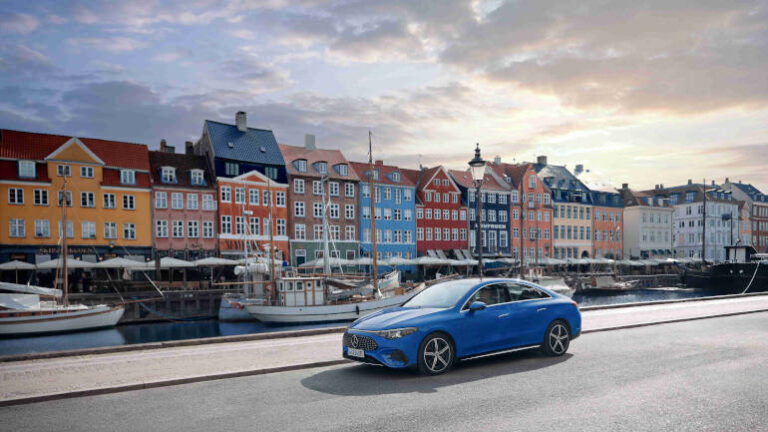
The all-new Mercedes‑Benz CLA has been awarded European Car of the Year 2026, adding another major accolade to a growing list of international awards and putting the spotlight firmly on Mercedes-Benz’s next-generation electric vehicle strategy.
Announced at a ceremony held during the Brussels Motor Show, the award was decided by a jury of 60 automotive journalists from 23 countries, with the electric CLA prevailing over 34 new models and six finalists. For organisations assessing the next wave of fleet vehicles, the result is a clear signal that efficiency, technology and usability are now aligning in mainstream electric passenger cars.
What the award means for fleets
While Car of the Year awards are often associated with consumer appeal, the criteria closely align with what Fleet Managers, Sustainability Managers and Finance Managers are now evaluating: efficiency, safety, real-world usability and technology maturity.
The electric CLA has been recognised for delivering strong efficiency outcomes alongside a high level of onboard intelligence. Its electric variant offers a WLTP-rated range of up to 792 kilometres, positioning it as a realistic option for many business use cases that have traditionally been difficult to electrify without operational compromise. Long driving ranges directly support higher utilisation rates, reduce charging downtime and lower the need for operational workarounds—key considerations for organisations still building their fleet management maturity.
Technology as an enabler, not a barrier
Mercedes-Benz has positioned the new CLA as its most intelligent and flexible vehicle yet, underpinned by the MB.OS operating system and a new generation of MBUX powered by artificial intelligence. For fleets, this shift is less about novelty and more about readiness.
Vehicles with advanced software platforms are better suited to integration with fleet systems, driver assistance technologies and future updates over the asset life. For organisations still developing policies around vehicle technology, safety systems and data use, platforms like this reduce the risk of early obsolescence and support longer-term planning.
Charging speed supports operational certainty
Beyond headline range figures, charging performance is increasingly important for fleets trying to match EVs to duty cycles. The CLA’s 800-volt electrical architecture allows up to 325 kilometres of range to be added in around 10 minutes under optimal conditions. While not every fleet will rely on public ultra-fast charging, this capability provides flexibility for high-kilometre drivers and mixed-use fleets, particularly during transition phases.
Strong demand sends a market signal
Mercedes-Benz reports that customer demand has exceeded expectations since the CLA went on sale in Europe in mid-2025, with the order bank already filled well into the second half of 2026. For fleet decision-makers, this matters. Strong private and corporate demand supports residual values, improves supply confidence over time and signals that the vehicle is likely to be supported with a mature service and parts ecosystem.
Ola Källenius, Chairman of the Board of Management of Mercedes-Benz Group AG, said the recognition reflected both jury and customer feedback:
“The new CLA was named Car of the Year 2026 — a proud moment for Mercedes-Benz. Jurors from across Europe have confirmed what our customers have been telling us: the CLA is a game-changer, delivering outstanding efficiency and effortless intelligence.”
A practical step forward for fleet electrification
For organisations still early in their electrification journey, the electric CLA represents more than an award-winning model. It highlights how passenger EVs are now addressing the practical concerns that often slow fleet adoption: range anxiety, charging time, driver acceptance and whole-of-life suitability.
As fleets continue to balance emissions reduction targets with cost control and operational delivery, vehicles that combine efficiency, technology maturity and strong market acceptance will play a critical role in lifting fleet management capability and confidence over the next replacement cycle.




