


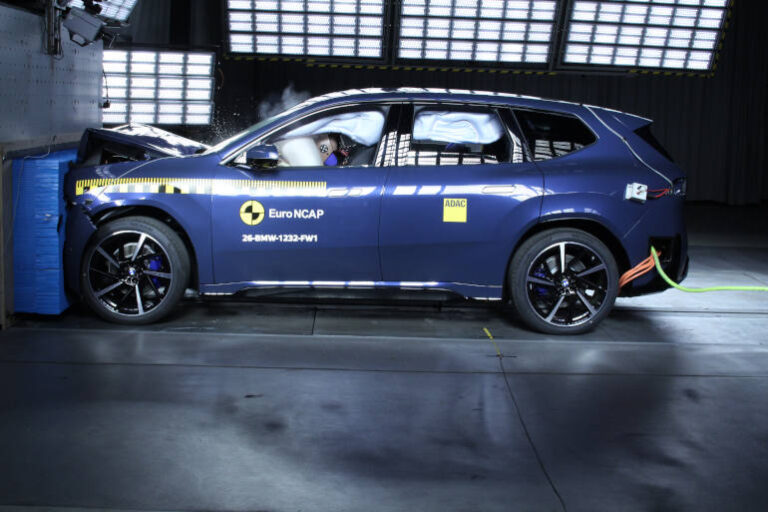
The new-generation BMW iX3 has secured a five-star ANCAP safety rating, delivering strong results for crash avoidance, occupant protection and post-crash performance under ANCAP’s latest 2026–2028 testing criteria.
The rating applies to the battery-electric BMW iX3 50 xDrive and iX3 40 variants sold in Australia. The 50 xDrive is also covered in New Zealand. Australian vehicles covered by the rating are built from March 2026 and went on sale from June 2026.
The medium electric SUV achieved scores of:
- 71 per cent for Safe Driving
- 83 per cent for Crash Avoidance
- 86 per cent for Crash Protection
- 95 per cent for Post Crash
The results provide fleet operators and private buyers with a detailed picture of how the iX3 performs across the complete safety journey, from supporting the driver and avoiding a collision to protecting occupants and assisting emergency responders.
Strong crash avoidance performance
ANCAP reported that the iX3’s autonomous emergency braking system performed well when detecting vehicles travelling in the same direction and in turning scenarios.
Pedestrian and cyclist detection was also rated highly, while the emergency lane-keeping system achieved strong results when responding to road-edge departures, oncoming vehicles and overtaking traffic.
The iX3 received 95 per cent for lane departure collision avoidance. Its system can also use information from the driver monitoring technology to reduce unnecessary steering intervention when it determines the driver remains attentive and in control.
An anti-dooring feature, designed to prevent occupants opening a door into the path of a cyclist approaching from behind, received the maximum score.
One weaker area was the vehicle’s response when crossing the path of a motorcycle, where the system achieved 16 per cent in that particular test.
Driver monitoring delivers high scores
The iX3 is fitted with sensors capable of identifying common signs of fatigue, distraction and impairment.
ANCAP awarded the system a maximum score for detecting fatigue, unresponsiveness and impairment, although its performance for shorter periods of distraction was rated at 56 per cent.
The vehicle also includes child presence detection, which can alert the driver when a child may have been left inside.
Physical controls remain available for important driving functions, including the indicators, hazard lights, headlights, horn and gear selector. However, ANCAP noted that some phone and climate functions did not meet its requirements for distraction-free operation.
A lane-centring system is standard on vehicles sold in Australia and New Zealand. It was not tested because it was not standard on the European-specification vehicle used during the assessment, meaning no points were awarded for that function.
High levels of occupant protection
The iX3 performed strongly in frontal and side-impact testing, receiving maximum scores for adult and child occupants in the side-impact test and for the driver in the oblique pole test.
A centre airbag between the front seats helped reduce the risk of occupants colliding with each other during a side impact.
Whiplash protection was another highlight, scoring 98 per cent across the front and rear seating positions.
ANCAP applied a deduction for vehicle compatibility in a head-on collision, finding that the iX3 could present a moderate risk to occupants of an oncoming vehicle.
Protection for pedestrians and cyclists was more varied, with the vulnerable road-user impact assessment returning an overall score of 64 per cent.
Post-crash systems suit fleet requirements
The iX3’s 95 per cent post-crash score will be particularly relevant for fleets considering the vehicle for executive, management or operational use.
Its emergency call system can transmit the vehicle’s location and information about the severity of a collision to an emergency assistance centre. BMW will provide this service in Australia and New Zealand for at least the six-year period required by ANCAP.
The battery-electric drivetrain demonstrated effective high-voltage isolation and fire-risk management following a collision.
ANCAP also confirmed that the electric exterior door handles remained extended and operational after crash testing. Manual releases are provided if the electrical system becomes unavailable.
The doors can still be opened following the loss of the 12-volt electrical supply, while the windows remain operational for a minimum period if the vehicle becomes submerged.
With strong crash avoidance technology, effective occupant protection and comprehensive post-crash systems, the five-star result gives fleet operators another premium electric SUV carrying a current ANCAP rating under the latest and more demanding testing standards.