


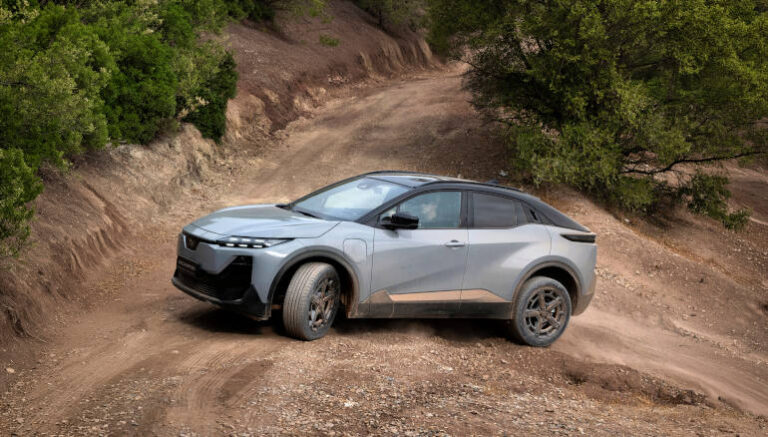
Subaru is rapidly expanding its electric vehicle range, and the new Uncharted could be the model that makes the transition to electric feel most natural for existing Subaru owners.
The Subaru Uncharted is an interesting addition to Australia’s increasingly crowded electric SUV market because it doesn’t feel like Subaru has tried to reinvent itself simply because the powertrain is electric.
Instead, the Uncharted takes many of the things long-term Subaru customers already know — all-wheel drive, a practical cabin, plenty of physical controls and predictable road manners — and packages them around a 74.7kWh battery and dual-motor electric drivetrain.
That might ultimately be its biggest advantage.
For people who spend their time comparing platforms and specifications, there are obvious connections between the Uncharted and Toyota’s latest electric vehicle products. But most Subaru customers aren’t necessarily approaching the vehicle that way.
They are coming from Foresters, Outbacks, Crosstreks and other Subarus, and the Uncharted immediately feels familiar.
And with Subaru now building an electric family that includes the Solterra, Trailseeker and Uncharted, that familiarity is becoming increasingly important.
It feels like a Subaru
Spend some time behind the wheel and there are plenty of Subaru cues.
The steering wheel is probably the most obvious. There are physical buttons everywhere — perhaps even too many — but after driving some newer EVs where almost every function has migrated onto a touchscreen, there is something reassuring about having controls where you expect them.
There’s almost an irony in complaining that a Subaru has too many buttons when one of the biggest criticisms of many newer EV brands is that they don’t have enough.
But the important point is that you don’t climb into the Uncharted and feel as though you need to learn an entirely new way of operating a vehicle.
The 14-inch centre touchscreen is large without completely dominating the cabin, while wireless Apple CarPlay and Android Auto, satellite navigation and a 10-speaker Harman Kardon audio system are standard.
The cabin itself is comfortable and very usable.
There are two wireless phone charging positions directly in front of the centre console. You get in, put the phone down and forget about it. It sounds like a small design detail, but in a vehicle used every day it reduces clutter and makes the cabin easier to live with.
There’s also a generous centre console and additional storage underneath the floating section of the console.
For someone who spends plenty of time on the road carrying sunglasses, charging cables, coffee cups and all the other bits and pieces that accumulate during a working week, these things matter.
The cupholders are probably the weakest point. They sit low in the console and aren’t particularly convenient with larger takeaway coffee cups.
If that’s one of the bigger complaints after spending time in a new EV, though, Subaru has done reasonably well.
Rear-seat passengers haven’t been forgotten
The Uncharted is 4,535mm long, 1,870mm wide and sits on a 2,750mm wheelbase, making it large enough to provide useful passenger accommodation without becoming an oversized SUV.
Rear passengers receive their own ventilation, USB-C charging and heated outboard seats.
The rear seat also reclines, which adds another level of comfort for family use or anyone regularly carrying passengers.
The vehicle I drove was fitted with the optional panoramic glass roof. Personally, a sunroof isn’t high on my list of priorities, particularly in Australia, but buyers who like the additional light and sense of space will appreciate the option.
More important for everyday use is the boot.
Subaru quotes 403 litres of cargo capacity with the rear seats upright. It’s generous rather than enormous, but there is enough room for a couple of overnight bags and additional underfloor storage for charging cables and items that don’t need to be accessed every day.
There is no front boot, with the front compartment occupied by the electric drivetrain hardware.
Electric performance without changing the character
Subaru has equipped the Australian Uncharted AWD with dual permanent-magnet electric motors.
The front motor produces 167kW and 268Nm, while the rear contributes another 88kW and 169Nm. Subaru quotes a combined system output of 252kW and a 0–100km/h time of around five seconds.
That’s considerably more performance than most buyers genuinely need. What matters more is the way it drives. And this is where the Uncharted feels particularly convincing.
It drives the way you expect a Subaru to drive. The steering and handling feel settled and predictable and, compared with some of the newer Chinese electric SUVs I’ve driven, the Uncharted feels more mature dynamically.
That’s not necessarily exciting enough to dominate a specifications comparison, but competence is something buyers appreciate every day.
The Uncharted also gets Subaru’s Symmetrical All-Wheel Drive, two-mode X-Mode, Grip Control and 211mm of ground clearance, reinforcing the connection with the broader Subaru range rather than presenting the vehicle simply as another urban electric crossover.
Range should make it usable beyond the city
The 74.7kWh lithium-ion battery carries a quoted WLTP driving range of up to 522km, with official energy consumption listed at 160Wh/km.
During predominantly urban driving, I was averaging around 16kWh/100km, which lines up surprisingly closely with Subaru’s quoted consumption figure and is a respectable result for an AWD electric SUV of this size.
The Uncharted supports up to 150kW DC charging, along with 7kW single-phase and 22kW three-phase AC charging.
Subaru quotes approximately four hours for a full charge using 22kW AC, while its brochure quotes roughly 30 minutes for a high-power DC charge, although the brochure uses slightly different starting charge levels in different sections.
For fleet operators with depot charging, that 22kW AC capability could be particularly useful because vehicles can potentially recover significant range between shifts without relying on public DC infrastructure.
There is also a 1,500W vehicle-to-load outlet, adding another practical feature for drivers who need to power equipment away from the office or home.
Plenty of equipment as standard
Subaru hasn’t treated the Uncharted as a stripped-back entry into the EV market.
Standard equipment includes synthetic leather upholstery, heated front and rear seats, a heated steering wheel, powered front seats, powered tailgate, digital rear-view mirror, dual wireless phone chargers and 20-inch alloy wheels.
There’s also a comprehensive driver assistance package including adaptive cruise control, lane tracing assistance, blind-spot monitoring, rear cross-traffic alert, a 360-degree camera, parking support braking and a driver monitoring system.
Subaru backs the vehicle with its five-year/unlimited kilometre warranty for eligible private use and an eight-year/160,000km high-voltage battery warranty. A five-year/75,000km capped-price servicing program is also included.
Interestingly for salary packaging customers, Subaru’s roadside assistance terms specifically include eligible novated lease customers, although fleet, government and rental companies are excluded from that particular offer.
The Fleet EV News verdict
The Subaru Uncharted doesn’t need to be the most radical EV on the market. In fact, trying too hard to be different would probably work against it.
Subaru owners have traditionally been a loyal group. They like the brand, they understand the all-wheel-drive story and they know what they expect when they climb into one.
The Uncharted gives those buyers a way to move into an electric vehicle without abandoning that familiarity.
The interior is practical, comfortable and thoughtfully designed. The dual wireless chargers and console storage work particularly well in everyday use. Rear passengers are properly catered for. Performance is plentiful and the handling feels more polished than several newer entrants in this part of the EV market.
There are little things you can pick at. The cupholders aren’t great. There’s no front boot. And the cabin certainly isn’t chasing the minimalist, screen-only approach adopted by many newer EV brands.
But that may be exactly the point.
The Uncharted feels less like Subaru has built an electric car and more like Subaru has built another Subaru that happens to be electric.
For existing Subaru customers considering their first BEV — and for fleet or novated lease buyers who value familiar controls, AWD capability and everyday practicality ahead of novelty — that could make the Uncharted one of Subaru’s most important new models.